

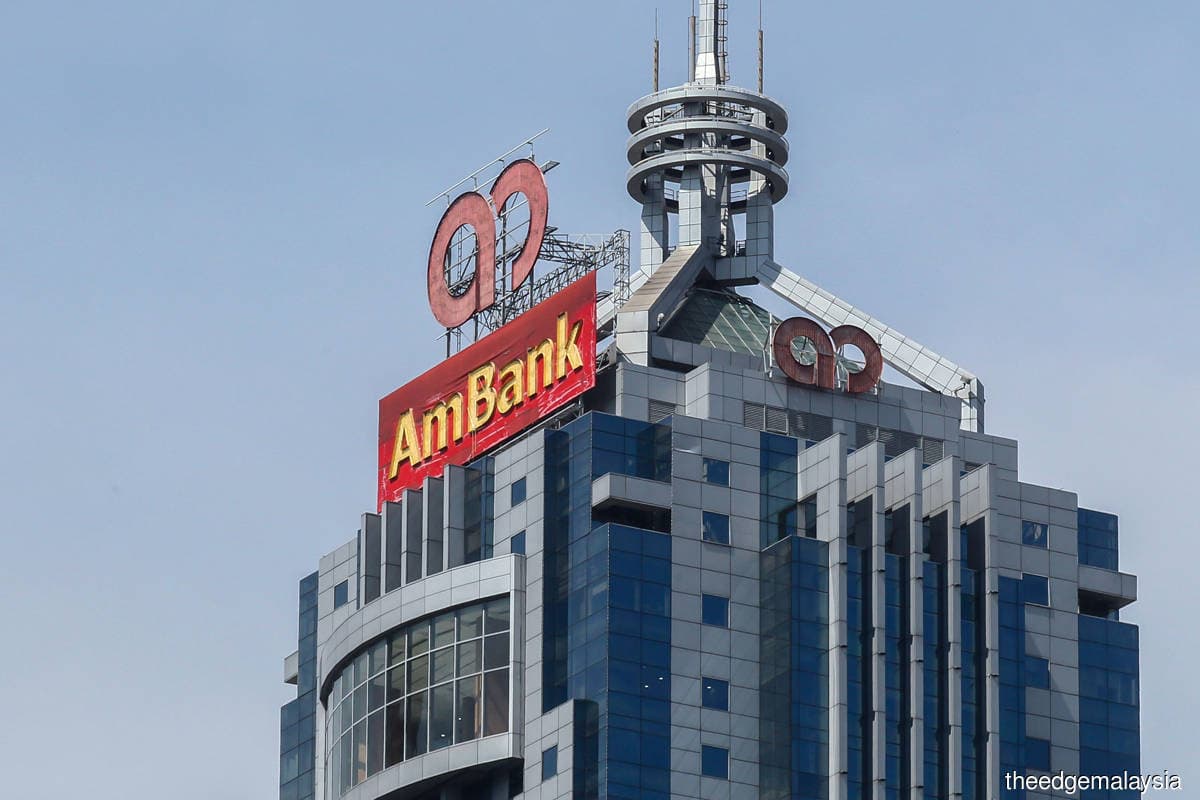
This article first appeared in The Edge Malaysia Weekly on July 31, 2023 - August 6, 2023
AMBANK was put under the spotlight again last week when former Bank Negara Malaysia governor Tan Sri Zeti Akhtar Aziz pinned the blame for many of the illicit banking transactions involving 1Malaysia Development Bhd funds on the bank’s failure to conduct due diligence of its clients’ accounts — principally the accounts of former prime minister Datuk Seri Najib Razak — and to alert the central bank to suspicious transactions or deposits entering his bank accounts. The accounts were opened with the bank in 2011.
Zeti maintained that the central bank only knew of the billions of ringgit in Najib’s accounts at the bank a good two years after the money had been deposited — and that was only because Najib had then sought Bank Negara’s approval to return some of the money, said to have been donated by an Arab, back to the donor. Again, this was a result of AmBank’s failure to alert Bank Negara, she reiterated.
“The first line has to be done by the financial institution [AmBank]. They have to first investigate and report their assessment. If anything was irregular they [the bank] should make a suspicious transmission report (STR) that the money is in the account already and not on the potential inflow,” she said.
She was asked by Deputy Public Prosecutor Kamal Bahrin Omar, who is the deputy director of the National Anti-Financial Crime Centre, whether the bank was obliged to make an STR.
Unless alerted, Bank Negara is not allowed to look into an account
Zeti provided some insight on the role of Bank Negara in monitoring financial institutions. She explained that the central bank, as a competent authority, is tasked with having oversight of any money laundering activity — but can only do so if alerted by the banks. “If banks do not undertake due diligence, there would be penalties imposed.”
She indicated that if a bank has doubts concerning a transaction, it is required to submit an STR to Bank Negara under the Anti-Money Laundering, Anti-Terrorism Financing and Proceeds of Unlawful Activity Act (AMLATFPUA), following which the central bank would investigate if any wrongdoing or irregular transaction had taken place.
“Without the STR, Bank Negara could not look into the account. That is the purpose of having the STR, to report suspicious transactions,” she said, adding that an investigation into it would take three working days.
Zeti added that banks also have the International Transaction Information System (ITIS) where they can monitor and report transactions, as it details the payee, recipient, amount and purpose of the transaction.
She explained that on a daily basis during her days at Bank Negara, ITIS transactions ran into US$12 billion — increasing now to some US$20 billion — as Malaysia is an open market.
“There is a high volume of turnover daily and Bank Negara publishes it daily. So, the people could see the volatility of the ringgit and the inflows and outflows inside the country. One of the roles of Bank Negara is to maintain orderly conditions in the foreign exchange market.
“This is important as we don’t look at each and every individual transaction. Bank Negara would not be able to look at each and every single transaction. ITIS is relevant to monitor this,” she stressed.
“In this particular case, it was not only the omission to inform but also in providing false information in their submissions,” Zeti said, adding that AmBank had failed to inform the central bank of many of the transactions.
Money entered Najib’s accounts in eight tranches
Responding to questions from Kamal Bahrin, Zeti said AmBank did not submit an ITIS report in many of the transactions involving Najib, and this could be considered false reporting. She explained that with regard to the money going into Najib’s accounts, AmBank did not report the funds as entering into his account (personally) but into AmBank’s account, and this is why she considered it false reporting.
Touching on the US$619 million (RM2.6 billion) that had been deposited into Najib’s accounts, which the prosecution claims belongs to 1MDB, she explained that it was divided into eight tranches of remittances. “Even so, there is no report as to who was the recipient or what amount. AmBank only reported the last US$100 million entry, but even that it did not disclose that the beneficial recipient was Najib, as it only said it went to AmBank’s account itself.”
Moreover, she pointed out that between March 22, 2011, and June 20, 2013 — a period of more than two years — AmBank had not lodged any STR with Bank Negara over the huge inflow of money into Najib’s accounts.
March 22, 2011, was when former AmBank managing director, Cheah Tek Kuang, informed Zeti’s then deputy Tan Sri Nor Shamsiah Mohd Yunus (who later succeeded Zeti as governor) of a letter dated Feb 1, 2011, addressed to Najib from Saud Abdulaziz Majid Al Saud of Saud’s intent to donate and to transfer funds to the then PM’s account.
June 20, 2013, referred to a letter on that date from Najib seeking Bank Negara’s permission to return RM2.26 billion of the purported donations and gift to the donor. Zeti stated that there had been 500 plus transactions in Najib’s four bank accounts before they were closed in 2013.
Kamal Bahrin: Between this two-year period, did AmBank lodge any STR report to Bank Negara?
Zeti: Never. At the material time, Bank Negara had not received any alerts or STR reports from AmBank to Bank Negara as the competent authority under the AMLATFPUA.
She explained that Najib’s letter was the first time the central bank had learnt of the RM2.26 billion in Najib’s accounts.
Following investigations into AmBank for its non-disclosure, false reporting and failure to comply with prudential regulations, Zeti said AmBank was fined the highest penalty of RM59 million. In addition, the bank was reported to have paid the government RM2.83 billion (US$699 million) as settlement in relation to 1MDB.
Save by subscribing to us for your print and/or digital copy.
P/S: The Edge is also available on Apple's App Store and Android's Google Play.