

This article first appeared in The Edge Malaysia Weekly on July 17, 2023 - July 23, 2023
WHEN Barisan Nasional (BN) lost control of Selangor in the 12th general election (GE12) in 2008, the shock defeat of the then powerful coalition stunned the nation. Less than five years earlier, it had won a super majority in the state legislative assembly, taking 54 out of 56 seats.
Fifteen years on, Pakatan Harapan (PH) has to be on guard against a similar outcome at the upcoming state polls on Aug 12.
There has been a sea change in the political landscape since that shock defeat. In 2018, riding on the anti-BN narrative during GE14, PH swept into power at the federal level. It also put on a strong showing in Selangor, where it took 51 seats in the state legislative assembly.
Then came four years of political instability, culminating in the snap general election of November 2022 (GE15), which produced a hung parliament. To break the deadlock, PH teamed up with former rival BN and the political blocs in Sabah and Sarawak to form a national unity government.
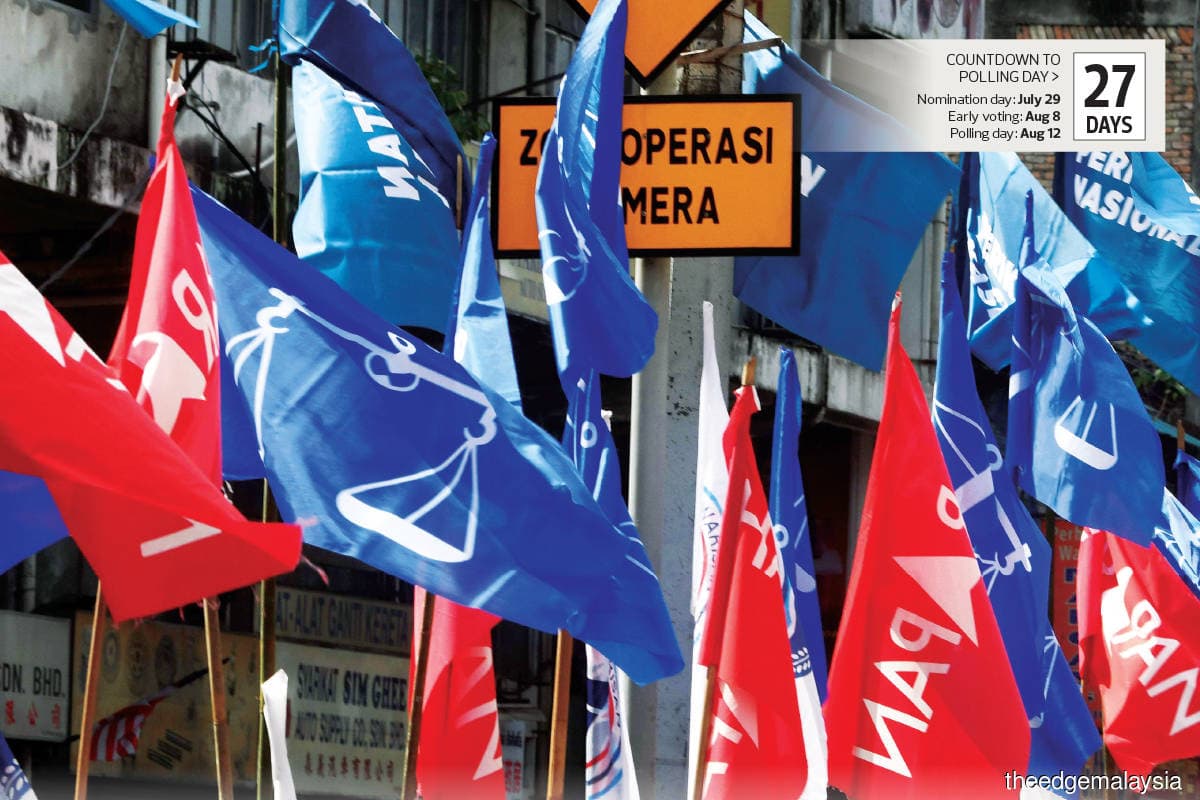
Six states, including Selangor, did not go to the polls in November last year. Now, the former political foes have to convince loyal voters of their respective coalition that they must forget old quarrels and unite against the rhetoric of their new rivals, the Perikatan Nasional (PN) coalition.

“So far, only one independent body thinks Selangor can be captured [by the opposition] … [but] we don’t take it for granted,” says Selangor caretaker menteri besar and state PH chairman Datuk Seri Amirudin Shari.
“Even after we won the super majority [in 2018], I reminded the members [of how the tide turned for BN in 2008]. Since day one, we have worked hard, not as a super-majority government. There is no element of complacency,” the Parti Keadilan Rakyat vice-president tells The Edge.
With the unity government, led by Prime Minister Datuk Seri Anwar Ibrahim, at just seven months old, Selangor’s fortunes will weigh on the balance of power at the federal level. It is one of Malaysia’s most developed states, contributing nearly a quarter to the country’s GDP.
Against this backdrop, the coalitions on both sides of the aisle have set ambitious goals. PH is aiming for at least a two-thirds majority (38 seats) in Selangor, while the opposition PN has alluded to erasing that possibility, or even taking over the state. The coalition won six of the 22 parliamentary seats in the state at GE15.
A major booty in the battle is the Malay votes, which make up 53.9% of the electorate and constitute the majority in 38 state seats, more than the required 29 seats to form the state government.
Competition for Malay votes
At GE15, about 49% of the Malay electorate in Selangor was thought to have voted for PN, making up almost all of the coalition’s voter base in the state. BN and PH won 23% and 24% of Malay votes respectively.
The million-dollar question is whether the BN-PH partnership will translate into a victory at the upcoming polls.
Amirudin points to a survey conducted by his team before GE15 on whether it is possible for PH to work with BN, or even PN, as a coalition. “The readiness of PH supporters was beyond our expectations, with 60% to 70% ready to work with other coalitions to ensure political stability,” he says.
“Our challenge now, honestly, is to make sure BN’s supporters back PH. The work has to be done.”
Political analysts share a similar view. “All coalitions face the danger of losing votes to their rivals or to abstention,” says political scientist Dr Wong Chin Huat.
But the trouble lies with Umno voters in seats contested by PH, who may resist the affiliation and protest against the leadership “especially after the purging of dissidents”, says Wong. This includes former Selangor Umno chief Tan Sri Noh Omar, who openly campaigned for PN in the Malay heartland, and Khairy Jamaluddin, who is vocal against the current administration. They were sacked by the party in January.
“Likewise, some PH supporters may be annoyed and instead [choose to] stay home if Umno continues [Umno president Datuk Seri Ahmad] Zahid’s [Hamidi] line that a vote for BN-PH is to defend Najib-Zahid,” says Wong.
James Chin, professor of Asian Studies at the University of Tasmania, thinks the huge support for PH among non-Malay voters in 2022 will be retained despite the BN factor as “they want Anwar to stay in power”.
“I don’t think they have a problem supporting BN, as long as they make it very clear that they [BN] are part of the unity government,” says Chin.

Drumming up sentiment
Apart from promises of “an even more developed Selangor”, PN roadshows in the state have harped on sentiment among BN supporters who disagree with its leadership and the party’s partnership with DAP. Similarly, there are Malay PH supporters who are disillusioned with its new coalition partner.
“Umno is no more. What is left is Zahid Hamidi’s exclusive club,” Bersatu deputy president Datuk Seri Ahmad Faizal Azumu said during PN’s Selangor convention on June 24.
At the convention, the focus was on national issues, including the ringgit’s weakness and interest rate hikes that are affecting the masses.
A PN campaign worker explains: “Selangor is a developed state, so bread-and-butter issues are less highlighted [at the recent roadshows], although more may be shared on state matters upon the launch of the Selangor PN manifesto later.”
The party member adds, “A vote for PN in Selangor is a protest vote against Zahid and the Umno-DAP partnership.”
For the unity government, a key concern that some of its leaders have highlighted is the fear among its supporters that conservative Islamic attitudes may gain ground in Selangor in the vein of Kelantan, Terengganu and Kedah.
In 2021, the Kedah government decided not to renew the operating licence of number forecast operators (NFO), effectively ending their operations in the northern state where 23% of the population are non-Malays.
Umno supreme council member Datuk Noor Lokman Adam has reflected this sentiment on social media posts with statements like: “don’t ‘Kelantanise’ Selangor but let’s turn Kelantan into Selangor”, comparing the highly urbanised west coast state to the PAS stronghold on the east coast.
Amirudin, commenting on the polarising campaign trail, acknowledges that politicians have to be more mature and control the narrative. “Because finally, everyone is working with each other … The issue is maturity, and the most difficult sometimes is among the leadership. It’s not the public [the voters].”
In the interview, he touched on the state government’s efforts during his tenure, ranging from the replenishment of state reserves to RM3.4 billion to the introduction of the state medical subsidy, empowerment of technical and vocational education and state-endorsed programmes such as free vaccines as part of the RM1.1 billion it spent to address the pandemic crisis.
Last year, the Selangor government launched its first five-year plan — 1st Selangor Plan (RS-1) — which included the redevelopment of the Shah Alam Sports Complex, the creation of a special economic zone on Carey Island and the rejuvenation of the Klang river into a viable raw water source.
Amirudin believes the priorities of the 3.75 million voters in Selangor revolve around bread-and-butter issues of job opportunities, income growth and price of goods as well as public welfare issues that influence the quality of life in the state.
“The voters of Selangor, I think, are quite rational. They can compare between federal and state issues, and this is [an election] to appoint the state government,” he says.
New voters, candidates the wildcard
For all the rhetoric of the coalitions, it is unclear what will move Selangor’s 1.3 million fence sitters — representing 35% of its voter base — who will cast their vote only for the second time since their inclusion in the electoral roll under the automated voter registration (AVR). This compares with the smaller percentage of 29.6% in Negeri Sembilan, Kedah (27.7%), Kelantan (25.7%), Penang (23.4%) and Terengganu (20.9%).
Urbanisation is a significant factor to consider. In Malay-majority suburbs like Kota Damansara and Pandan Indah, the voter swing at GE15 was less significant than in the Malay heartland in the outskirts of Selangor, where support for PN was stronger.
“Selangor voters have different backgrounds, cutting across from rural to urban localities and includes the lower, middle and upper classes,” says Universiti Sains Malaysia professor of political sociology Dr Sivamurugan Pandian. “And state elections are very much localised compared to general elections.
“[The upcoming election] depends on several push and pull factors, including candidate selection, campaign strategy and making sure there is no internal sabotage. If the candidate selection goes wrong and the campaign strategy to pacify loyal BN-PH supporters is ineffective, and it fails to counter-attack on the 3R (race, religion, royalty) issues, that could give PN an advantage in making inroads into Malay-dominated constituencies.”
Ahead of nomination day on July 29, several names have been mentioned as potential candidates for menteri besar for Selangor. They include PN’s Datuk Seri Mohamed Azmin Ali, who is rumoured to be defending his state seat in Hulu Kelang. Azmin, who was Selangor menteri besar from September 2014 to May 2018, failed to defend his Gombak parliamentary seat during GE15, which was won by Amirudin.

While some point to Azmin’s reputation among PH voters as a key player in the Sheraton Move, it matters less to BN and PN supporters as the political manoeuvre brought both coalitions to power from 2020 to 2022.
Speculation is rife that the unity government’s shortlisted candidates include Umno member and Investment, Trade and Industry Minister Tengku Datuk Seri Zafrul Abdul Aziz, who is in his final term as Dewan Negara senator and who lost in his bid for the Kuala Selangor parliamentary seat at GE15.
Amirudin says he has left the matter of his candidature to the party but expressed his intention to continue as menteri besar for another term to complete the plans put in place for Selangor’s development. “But that must be decided by the party leaders, if I have to go to the federal level … we have to be positive but let me accomplish the mission first.”
Conditions for PJD Link are the same as those for Kidex, says Amirudin
Traffic congestion remains one of the biggest issues faced by the residents of Selangor, the country’s most urbanised state.

On this note, ahead of the upcoming state polls on Aug 12, Selangor caretaker menteri besar Datuk Seri Amirudin Shari highlighted plans for a rail network to connect Klang with the northern parts of the state, such as Sabak Bernam and Kuala Selangor, and even the Kuala Lumpur International Airport to Putra Heights.
However, a transport project that has received pushback is the 25.4km Petaling Jaya Dispersal Link (PJD Link), which some have equated to the now-defunct Kinrara-Damansara Expressway (Kidex).
“We have to solve the problem of traffic congestion,” says Amirudin. “One of the solutions is highways. Definitely, we have to see the overall impact, the changing socioeconomic activity and the liveability of the residences.
“There are proposals. We have allowed [PJD Link (M) Sdn Bhd] to undertake the necessary assessments like EIA (environmental impact assessment) and SIA (social impact assessment). We are waiting for the report.
“I think the state government will have to be consistent. We rejected Kidex, if the PJD Link is just a repeat of Kidex, definitely the state government will maintain its position and reject the project. But if the promise is to tackle every issue related to Kidex such as noise, alignment … definitely the state government wants to see the new alignment and impact on the environment, society and traffic. This is a federal project … there is nothing to hide. But as a government, we have to remain impartial.”
The PJD Link was proposed as an elevated expressway between Damansara and Bandar Kinrara, cutting through Petaling Jaya. Its concession holder, PJD Link (M) Sdn Bhd, secured RM922 million in funding on June 6 to develop the project, which will see MCC Overseas (M) Sdn Bhd (MCC Malaysia) as the project contractor.
PJD Link (M) has proposed a reverse takeover of Practice Note 17 company Scomi Energy Services Bhd. The due diligence is ongoing and expected to be completed by Sept 15.
Kidex, which was proposed by Emrail Sdn Bhd to reduce traffic congestion in a similar area, was rejected by the Selangor government in 2015 following the developer’s failure to submit a traffic impact assessment, social impact assessment and environmental impact assessment by the stipulated deadline.
Amirudin says that while he understands the concerns of Petaling Jaya dwellers over the project, those living in Puchong “are very happy” because they will not face a traffic jam when going to Kuala Lumpur.
“We have to consider and listen to everybody … It’s not about the political sentiment or the votes we can enjoy just by rejecting projects, but definitely we have to solve the issue of congestion, and the rejuvenation of Petaling Jaya. We do not have any personal interest in the projects,” he adds.
To be sure, affected residents will protest against highway projects before and during the construction phase but these are typically well received upon completion, such as the Damansara-Shah Alam Elevated Expressway (DASH) and the Sungai Besi-Ulu Kelang Elevated Expressway (SUKE) which commenced operations last year.
Over the years, the Selangor government has introduced pilot projects and more extensive bus networks for first- and last-mile transport.
Infrastructure projects such as highways and railworks — and even the upcoming RM28 billion Carey Island port, first mooted in 2017 — are federal government-led. Amirudin alluded that the state-federal government relationship is crucial to ensure a smooth implementation.
The state government is led by Pakatan Harapan (PH), while the federal government is currently led by the unity government, which includes PH and Barisan Nasional (BN).
“With stability comes prosperity … The first time we were aligned with the federal government was for 22 months [from May 2018 when PH took control of Putrajaya]. And this time [under the unity government], for about seven months [since the 15th general election],” says Amirudin.
“For me, this is the best moment and opportunity to [secure] understanding between the two governments. And we can solve issues [in Selangor] as soon as possible.”
Save by subscribing to us for your print and/or digital copy.
P/S: The Edge is also available on Apple's App Store and Android's Google Play.