

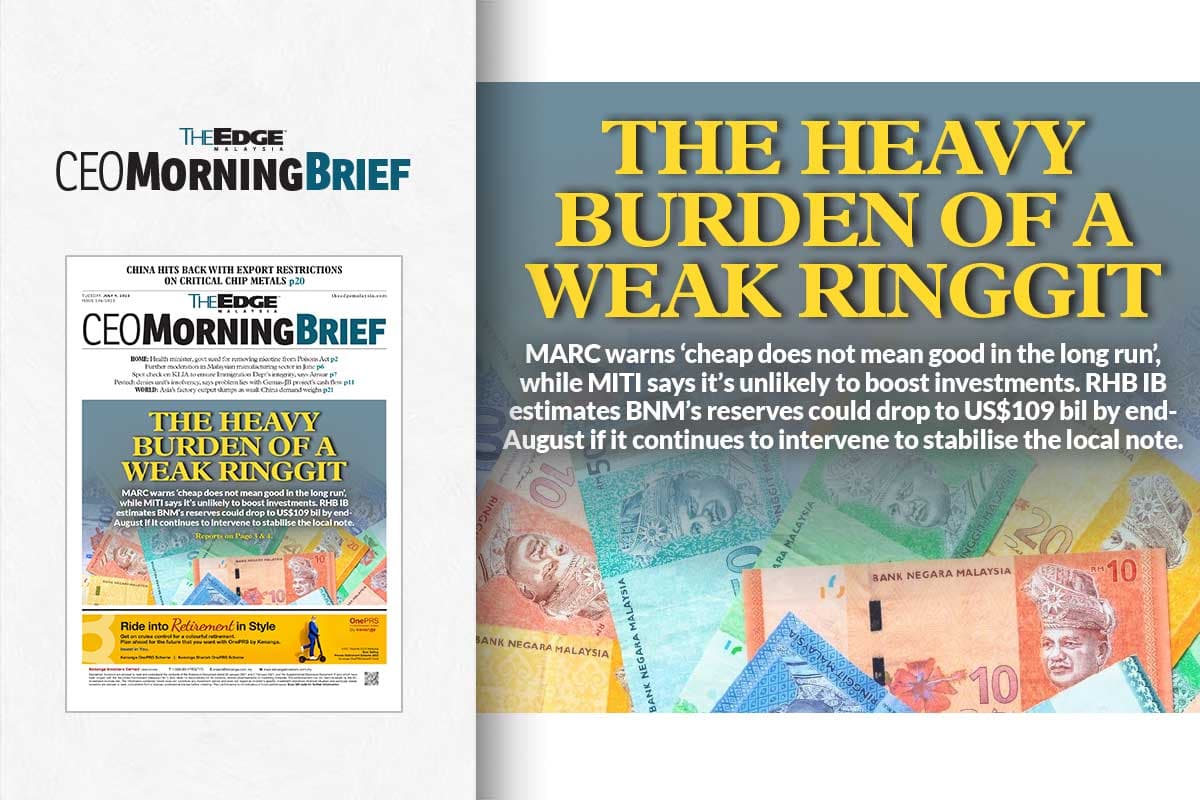
MARC also called the notion that exchange rate depreciation benefits a country “not holistic”, as it can only provide a limited boost to the current account balance.
KUALA LUMPUR (July 3): Malaysia Rating Corp Bhd (MARC) has warned that long-term reliance on a weaker currency exchange rate could put a nation towards a “race to the bottom”.
“This contradicts not just the fundamental concept of raising a country up the value chain but relegates a country to de-development,” the rating agency said in a statement on Monday (July 3).
Addressing the argument that a weaker ringgit is an automatic stabiliser since it theoretically increases the value of exports, MARC said it was only a “temporary adjustment to prices to maintain competitiveness”.
The rating agency added that competitiveness has several aspects which include political stability, infrastructure and tax rates, and a country needed to be distinguished from merely having cheap exports.
This came amid the sharp weakening of the ringgit which reached an unprecedented low based on its Real Effective Exchange Rate (REER) according to data from the Bank of International Settlements (BIS).
REER is a measure of the exchange rate value weighted by trade and adjusted for inflation.
“On one hand, it explains that exports from Malaysia are now cheaper relative to history and relative to its peers; it also implies that imports are increasingly more expensive, affecting businesses and consumers.”
MARC also called the notion that exchange rate depreciation benefits a country “not holistic”, as it can only provide a limited boost to the current account balance.
“Of note, Malaysia’s current account balance-to-gross domestic product (GDP) ratio deteriorated over time from 15.9% as at end-1999 to 1.0% as at first quarter of 2023 (1Q2023).
“This proves that cheap does not mean good, especially in the long run.”
It added that Malaysia’s trade partners and capital market investors have evolved to a higher level of sophistication and will approach their dealings with the mantra of value optimisation, and not just cost savings.
Weaknesses in debt sustainability and public financial strength
The rating agency also noted that both the ringgit’s performance and the perceptions of Malaysia’s economic standing are related to international confidence.
“Besides the issue of weaker external balances, debt sustainability and public financial strength is weakening,” said MARC.
“At its apex in the 1990s, Malaysia had a fiscal surplus but it is now forecast to record a fiscal deficit of around 5% in 2023.”
“This deficit has an adverse impact on Malaysia’s debt servicing payments-to-revenue ratio, which has trended higher since 2012’s 9.4% and breached the self-imposed threshold of 15% during the height of the pandemic in 2020-2021.”
MARC said this pointed to structural issues in which revenue was only sufficient to cover operating expenditure while encroaching on the use of debt to fund development expenditure.
“This is why the proposed Fiscal Responsibility Act is so important, and it is hoped that the postponement of its planned tabling from June 2023 to the year end is a precursor to a well-thought-through plan rather than an indication of coordination challenges,” said the agency.
It added that continuing to stick to various debt measures such as debt limits and debt service ratios on a long-term and consistent basis is preferred by international investors.
“Building up economic buffers beyond basic adequacy is imperative, since global uncertainties can crystallise multiple risks into a perfect storm — this is when what was once adequate turns insufficient.”