

This article first appeared in The Edge Malaysia Weekly on May 29, 2023 - June 4, 2023
BETAMEK Bhd — an electronics manufacturing services (EMS) group that produces infotainment systems for the automotive sector, including for Perusahaan Otomobil Kedua Sdn Bhd (Perodua) — is looking at the healthcare and medical devices sectors to diversify its customer base.
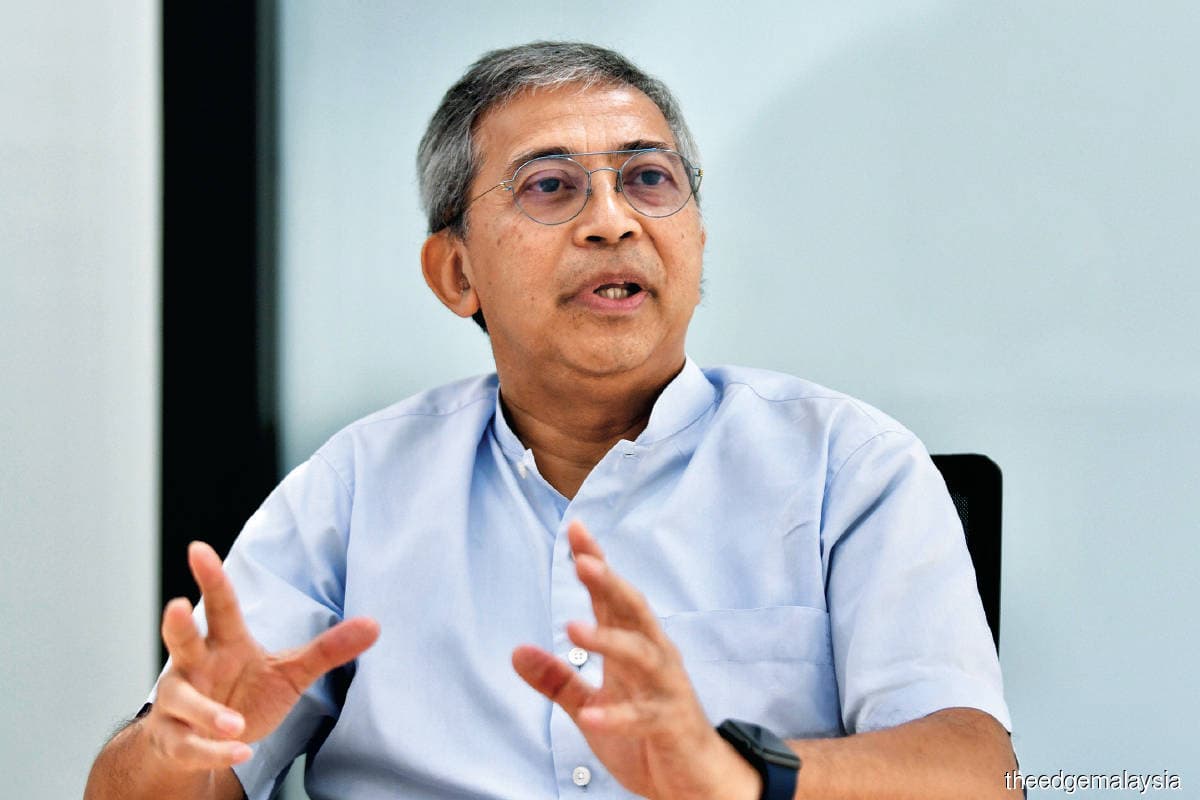
In an exclusive interview with The Edge, Betamek’s largest shareholder and group managing director Mirzan Mahathir, 64, says the healthcare and medical devices sectors require the same high level of quality and safety standards as the automotive sector.
“Automotive is where we started. The practices of the automotive sector, where there is a high emphasis on quality and safety, allow us to produce for other sectors that also require this kind of focus. So, we are also looking to market ourselves to these specialised sectors.
“We are not trying to be like a commodity, we are not trying to be a contract manufacturer for the world, but to be very specialised in the sector where we can provide electronics manufacturing services,” says Mirzan at his private office in Q Sentral, Kuala Lumpur.
He did not elaborate, however, on the group’s diversification strategy.
Betamek was founded more than 32 years ago through its wholly-owned subsidiary Betamek Electronics (M) Sdn Bhd, which produced car audio systems for the export market. In the early 1990s, Mirzan became a major shareholder in the company and was appointed an executive director. He now has 72% equity interest in Betamek via Iskandar Holdings Sdn Bhd.

In 1993, Perodua was founded as the second national car maker, a project led by the then prime minister Tun Dr Mahathir Mohamad in his effort to speed up the country’s industrialisation. Mirzan is Mahathir’s eldest son.
Over the last three decades, Betamek has been growing with Perodua, with the latter currently contributing more than 90% to the former’s revenue. According to Mirzan, the group has consistently supplied all Perodua models with the audio system, initially, and, now, the infotainment system.
Last year, Perodua produced 289,054 vehicles, with Betamek supplying infotainment systems for 60% of them. With the rising complexities of Perodua’s cars as they are fitted with more electronic parts, Betamek is well positioned to support its growth, according to Mirzan.
In fact, despite the expected slowdown in the sales of cars, Perodua is still forecasting growth this year. The Rawang-based car maker is targeting 314,000 units in 2023, up 11.34% year on year from 282,019 units.
In the quarter ended March 31, 2023 (4QFY2023), Betamek recorded RM5.71 million net profit, compared with RM1.66 million in the preceding quarter, on the back of RM55.95 million in revenue, which was 2.23% higher quarter on quarter.
For the financial year ended March 31, 2023 (FY2023), Betamek posted RM16.27 million in net profit, on the back of RM205.7 million revenue. This was an improvement of 20.74% year on year from the FY2022 net profit of RM13.47 million.
The improvements to Betamek’s profitability can be attributed to the jump in Perodua’s sales in 2022 and in the first quarter of 2023. In the first quarter of 2023, Perodua sold 78,564 units, an increase of 27.5% year on year from 61,624 units in the first quarter of 2022.
With the continued support from Perodua and given its expected growth, it could be more difficult for Betamek to diversify its customer base without engaging in mergers and acquisitions (M&A).
Mirzan admits that Betamek is looking at M&A to diversify its customer base as well as tapping into other growing markets in Southeast Asia and the surrounding region. The company has yet to determine, however, the investment value that it is ready to commit to.
Mirzan says the group will take a measured approach when choosing potential new customers or acquiring companies as part of its diversification strategy.
For starters, Betamek, which was listed last October, does not wish to become just another contract manufacturer by securing orders from technology companies or brands. According to Mirzan, it is part of the group’s DNA to collaborate with its customers in developing products.
He says: “We don’t do [contract manufacturing] because we feel that if we go into that, it is a race to the bottom.
“We look at it in another way; when a customer is looking to create a device or product, we work with them. They have the specifications; these are the requirements and features and what not. We work with them on the design and then we develop the product for them.”
The memorandum of understanding (MoU) with Singapore-based Krakatoa Technologies Pte Ltd shows Betamek’s penchant for developing products with its partners, instead of simply taking orders to produce parts like most other contract manufacturers.

The MoU, which was entered into in March, is for Betamek and Krakatoa to explore the potential of collaboration in developing a chip-based battery management system for electric vehicles (EVs). Krakatoa, a start-up that is being developed by Indonesians Jumeidi Alexander and Bondan Rufen, is part of a group of Indonesian companies and institutions that are developing electric trikes and buses. Betamek plans to support the venture in the EMS space by developing the battery management system.
While EVs are now mostly a premium product, Betamek is working with its technology partners to bring some of the features into mass-market products. It has been successful in introducing premium features into mass-market products in the past.
This is where Betamek’s niche is, and Mirzan says the group will continue in it. “We always work on trying to bring the technology to a point where it is affordable. It is something of a niche to us, figuring out a way to make that happen. As we develop the technology, it becomes more efficient. We can get the unit price down, and so on.”
Mirzan concedes, however, that it is a challenging industry to be in, especially as the group is looking outside its home turf.
Nevertheless, he hopes the group’s track record with Perodua and its partnerships with technology companies in China and India will be the platform for the group to get into other automakers’ ecosystems.
Betamek was listed on the ACE Market of Bursa Malaysia on Oct 26, 2022, with a public issue of 67.5 million new shares, representing 15% of its enlarged share capital, and an offer for the sale of 45 million existing shares to selected investors by way of a private placement. The issue price was 50 sen per share.
The group raised RM33.24 million net proceeds from the IPO. According to the IPO factsheet, RM10 million of the proceeds were allocated for the repayment of bank borrowings, RM7 million allocated for the research and development of new products, and RM6.5 million were allocated for the expansion of R&D office space, raw material storage and ancillary facilities.
As at March 31, 2023, the group had RM13.42 million in total borrowings, and RM54.97 million in cash and bank balances.
Market lukewarm on Betamek
Betamek’s share price has been trading throughout May at a lower level than its initial public offering price of 50 sen. The counter was also trading at below 50 sen for much of March 2023 and November 2022.
Closing last Thursday at 45 sen apiece, Betamak has lost 37.32% of its value compared with its close of 71 sen on its listing day.
The counter’s performance was also compounded by a weak set of financials for the third quarter ended Dec 31, 2022 (3QFY2023), when Betamek’s net profit fell 64.4% quarter on quarter to RM1.65 million, from RM4.65 million, as its gross profit decreased to 16.1% from 17.73% in the preceding quarter.
The decline in gross profit was due to appreciation of the US dollar, says Betamek, adding that it expects its earnings to be resilient in FY2024 ending March 31, 2024, on the normalisation of raw material prices that it has seen since 4QFY2023, as well as reduced exposure to the US dollar.
Betamek says it had reduced its exposure to the US dollar, from 62% of payments to suppliers done in the greenback to 50%, with higher exposure to the yuan, rising from 19% of payments to suppliers to 30%.
The US dollar peaked against the ringgit on Nov 5, 2022, at 4.75, and it has declined to 4.24 on Jan 24, 2023. The US dollar is strengthening again, however, reaching 4.62 as at Thursday (May 25).
The recent weakness of the ringgit against the dollar could still be an issue for Betamek, although less so compared with 3QFY2023.
This can be seen in the performance of the group in the fourth quarter ended March 31, 2023 (4QFY2023) when its net profit more than tripled to RM5.71 million compared with RM1.66 million in 3QFY2023.
In a statement accompanying the results, Mirzan says that the normalisation in the raw material prices and stabilisation of the ringgit against the US dollar in 4QFY2023 has increased the group’s gross profit margin for the quarter to 19.9%
The 4QFY2023 net profit was the best result so far for Betamek as a listed entity. For FY2023, Betamek achieved a cumulative net profit of RM16.3 million on the back of RM205.7 million revenue. Its earnings per share stood at 3.61 sen.
This means based on last Thursday’s closing price of 45 sen per share, the group is trading at a price-earnings ratio of 12.47 times, which is lower than Pecca Group Bhd’s trailing 12-month PER of 18.53 times and APM Automotive Holdings Bhd’s T12M PER of 15.17 times.
Save by subscribing to us for your print and/or digital copy.
P/S: The Edge is also available on Apple's App Store and Android's Google Play.