

This article first appeared in Forum, The Edge Malaysia Weekly on May 29, 2023 - June 4, 2023
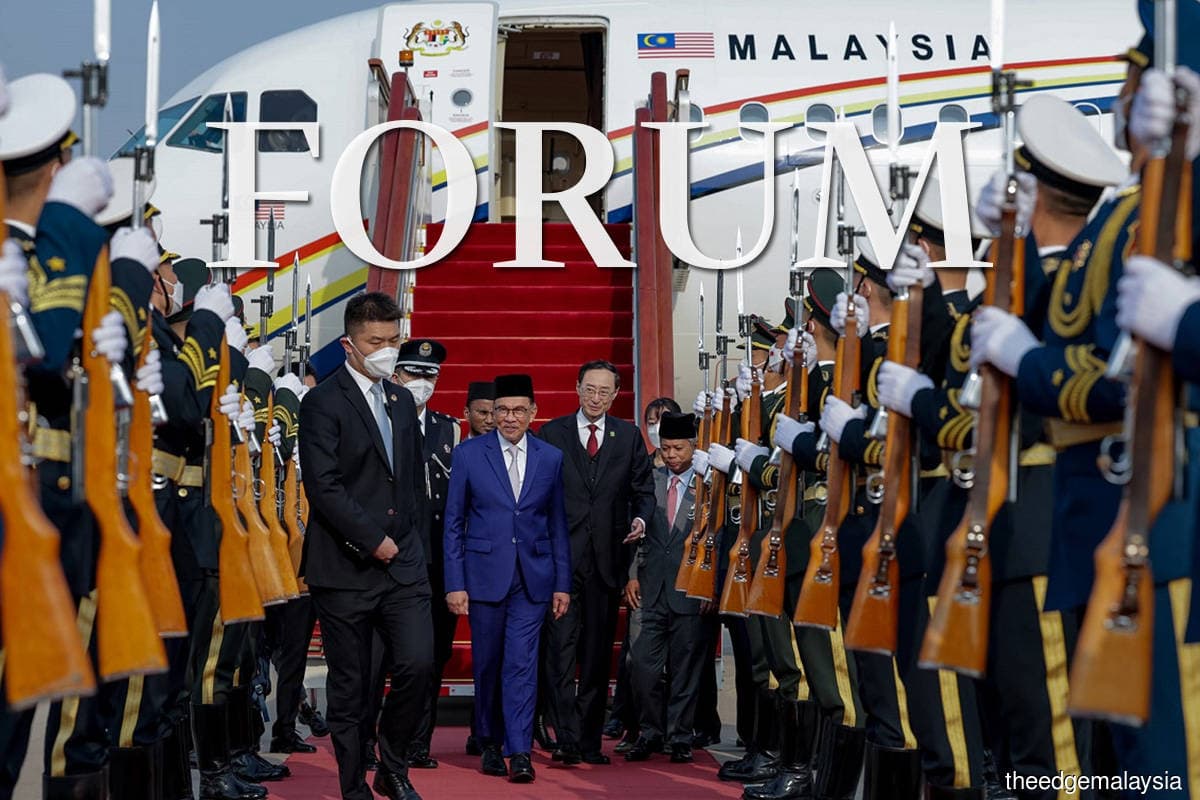
Any visit by a Malaysian prime minister to China is a test of gumption, enterprise and judgment. When the leader of a country that is as strategically pivotal as Malaysia deals with a major power, every word and gesture is watched by audiences — both foreign and domestic — with abundant detail and scrutiny. And so it was when Datuk Seri Anwar Ibrahim visited the People’s Republic of China from March 29 to April 1.
Anwar is, of course, no stranger to China, having visited many times when he was in the cabinet previously and while he was out of government, mainly on speaking engagements at forums and academia.
Yet, this visit came at a crucial strategic time for the region — soon after President Xi Jinping began an unprecedented third term as China’s leader, as restrictions of China’s zero-Covid policy were largely scrapped and the country has finally opened up to the world again, and when many foreign leaders are looking for an opportunity to re-engage with the Chinese leadership.
The prime minister’s visit also came at a time when the rivalry between China and the US had reached depths that were previously thought unthinkable, with both dire ramifications and latent opportunities for those willing to seek them out.
How, then, should Anwar tread in such troubled waters? As it turned out, it was the dollars and cents — or rather, the yuan and ringgit — of this visit that made the headlines, which reported investment commitments worth up to RM170 billion.
A masterstroke of economic diplomacy, no less, and the upshot: a huge win not just in quantity but also qualitatively, with a concentration on high technology, green technology, the digital economy and the automobile sector. Even a realisation of a mere half of those commitments will have tremendous multiplier effects on the Malaysian economy.
China’s Belt and Road Initiative (BRI) projects in Malaysia are among the most comprehensive in the region. They do not just span an assortment of physical, connectivity, energy and digital infrastructure projects, but involve multiple stakeholders, from government-linked to those entirely managed by the private sector. While some BRI projects here proved controversial in the past, it would do well for Malaysia to position itself to selectively tap this and other initiatives that flow from China’s broad and complex economic ecosystem.
Yet, Anwar did not shy away from key strategic issues and concerns. To do so would have been diplomatic malpractice. He addressed directly the dangers of unfettered major power rivalry in his meetings with the three highest officials of the central government — Xi, Prime Minister Li Keqiang and Zhao Leji, chairman of the standing committee of the National People’s Congress.
Anwar clinically focused on issues that intersected with Malaysia’s vital interests, whether they were to do with semiconductors or the right to pursue oil and gas explorations in the South China Sea. Some of these messages were amplified during his speaking engagements at the Bo’ao Forum for Asia and at Tsinghua University.
Anwar even brought up the civil conflict in Myanmar and the recalcitrance of the ruling junta to seek a political settlement with anti-coup actors, exacerbating the human suffering in the Asean member state.
One will recall his Bangkok speech when he first spoke of the need for Asean “to carve Myanmar out” on account of the “atrocities” committed by the junta, following the 2021 coup. Any suggestion that this was a one-off utterance is untenable, considering that shortly after Bangkok, he doubled down on this in Manila, and in Labuan Bajo at the Asean Summit, he pushed the “deal with Myanmar” agenda with even greater vigour.
Some pundits have likened Anwar’s predicament in China-US relations to having to navigate between Scylla and Charybdis. But there is a more congenial way of viewing this. Thus, contrary to some claims, Anwar’s visit to Beijing was also a masterclass in hedging — whereby Malaysia seeks to reduce the prospective risks on the bilateral front and assert our national interests while maximising the benefits of a continued, productive relationship with China.
Make no mistake, when Anwar visits the US, a country that is one of Malaysia’s largest historical sources of both direct and indirect foreign direct investment (FDI), he will seek to strengthen both bilateral and multilateral engagements, as he did in Beijing.
A key part of this is expected to be a push for investments to help Malaysia step up its semiconductor value chain participation with higher-quality and higher-tech plants. In sum, any analysis of Malaysia’s foreign policy that singularly focuses on Anwar’s engagement with one major power without looking at how he manages relations with the other would be incomplete.
Malaysia has long straddled between China and the US, leveraging overwhelmingly positive relations with both major powers. Malaysia has also benefited from close, functional relations between the two powers themselves, something that is now at risk with signs of bifurcation and zero-sum rivalry.
While Malaysia has and can further benefit from a degree of competition between the two, we cannot afford to see the wider international system and regional architectures, many anchored to Asean processes, crumble under the weight of unbridled major power rivalry. There are potentially difficult times ahead — any open conflict culminating in war will see severe costs to Malaysia and our key positions in the global supply chain. These issues deliberately shape the theme and focus of ISIS Malaysia’s Asia-Pacific Roundtable, which will be convened from Aug 8 to10, with the keynote by Anwar.
It will be in Malaysia’s interest to work with other like-minded countries and international actors to promote de-escalation and moderation. Both concepts have been part of a policy by previous governments before but must be adapted to a wider stage. At a time of global tensions, hardening resolve and a shrinking margin for error for countries like Malaysia, only deft and imaginative diplomacy will secure the ship of state.
Prof Dr Mohd Faiz Abdullah is chairman of the Institute of Strategic and International Studies (ISIS) Malaysia
Save by subscribing to us for your print and/or digital copy.
P/S: The Edge is also available on Apple's App Store and Android's Google Play.