

This article first appeared in The Edge Malaysia Weekly on April 10, 2023 - April 16, 2023
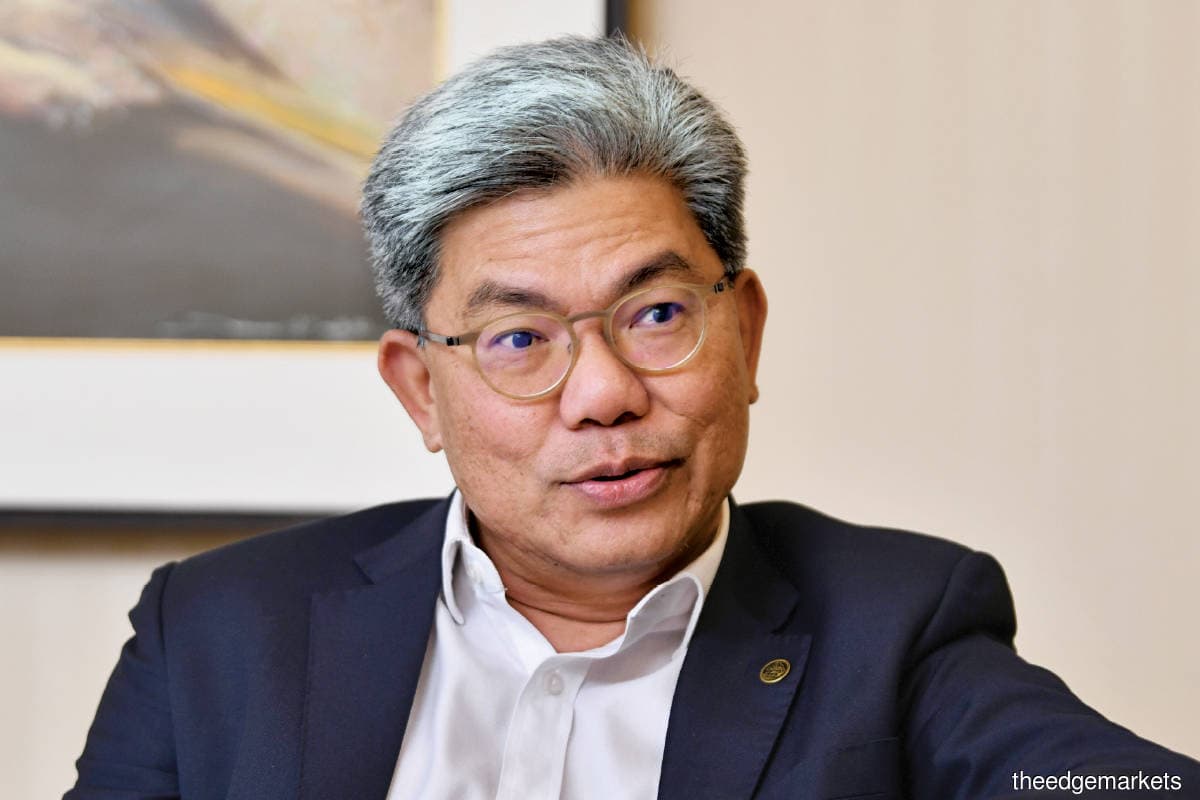
IT was a homecoming of sorts for Datuk Khairussaleh Ramli, the former CEO of RHB Bank Bhd, when he returned to Malayan Banking Bhd (Maybank) as its group president and CEO after some nine years away.
He had worked for the country’s biggest banking group between November 2008 and September 2013, first as the group chief financial officer (CFO) and later, as the president director and CEO of Maybank’s Indonesian operations.
Khairussaleh, who turns 56 this year, then left to join RHB, the fourth largest banking group, in December 2013, not long after a change of leadership in Maybank.
“Time flies, really. It has been an interesting journey, trying to understand again what Maybank is all about after having left for about nine years,” he tells The Edge in his first media interview since taking the helm in May last year.
“It is different, it is more complex, and it has made quite a bit of progress on the digital and sustainability front, particularly sustainability, which has become part of the strategy. That’s key,” he says.

Speaking to us in a room on the 48th floor of Menara Maybank, which has a bird’s eye view of the city skyline, he is quick to add though that some things have stayed comfortingly familiar.
“[My office] was on the same floor, next door,” he says with a laugh. “I used to go to the CEO’s room last time, and that room — which I now occupy — has not changed at all. The furniture, the paint … everything is the same. So in a way, it’s coming back to a familiar place.
“And all the exco (executive committee) members today, with the exception of one, I had known and worked with before, so that helped in terms of quick onboarding and so on.
“I was away for nine years, but I always had one eye on Maybank in terms of its performance — what’s happening, benchmarking, who’s moving here and there,” he says.
In fact, when he received that fateful call from a headhunter one November evening, he knew immediately it was for the role in Maybank. He shares: “This headhunter was explaining, trying not to disclose the name Maybank, that [the bank] does this and that. I immediately could tell it was Maybank.”
Did he always aspire to be CEO of the biggest banking group?
“Actually, no. After nine years, I already thought there is no more chance, just move on, no more talk about Maybank. To be honest, I was about to retire and just rest.”
However, that one phone call changed everything. “I had a few [conversations] with my wife, and [while] she also wanted me to retire and spend more time with the family, she gave me the blessing to join Maybank simply because I was going back to a familiar territory, not something totally alien. I knew this organisation, I knew the people, so I thought that would make my comeback easier. And indeed, that helped.”
More importantly, it was an opportunity to “build a legacy again, hopefully taking Maybank from good to great, working with the 44,000 people” across the group, he adds.
Not many may know, but Khairussaleh was among the key people who coined Maybank’s “humanising financial services” mantra over a decade ago. It is an aspect of the group he particularly loves.
“I like this part again about humanising financial services. I think that is one thing that kind of convinced me to come back,” he says.
Asked what advice he would give those in middle management who hope to have a similar kind of career progression, he says: “I always tell our people: First, you need to understand your mandate, why you are [in] that position. Second, try to do it as best as possible. Third, once you do it well, people will notice you, and that is where the opportunity comes about.
“So, be patient. A lot of people may not be patient. In my experience, for example, I was given the opportunity to go to Indonesia. I was already the group CFO, but I must say if I had not gone to Indonesia, I wouldn’t have been in this position, or even in RHB, because that was an opportunity to run a business. That experience was very valuable.
“Hence, my advice to a lot of people is: try new things, get out of your comfort zone.”
Khairussaleh, who has now notched up over 30 years of experience in the financial services and capital markets industry, had stints at Telekom Malaysia Bhd (as group chief strategy officer), TM Ventures (CEO) and Bursa Malaysia Bhd (CFO). He also spent eight years at Public Bank Bhd, working in its corporate banking and stock/futures broking divisions.
Those familiar with Khairussaleh see him as having steady and capable hands to navigate the bank through what is expected to be a tough next few years.
Some describe him as a man in a hurry to show results — something Khairussaleh does not disagree with. “While I am patient in many things, I can be impatient in getting outcome. Those are the things that keep me up at night — my delivery outcome.”
He has three children, aged 25 to 17, and rounding up the family is their pet cat, Fluffy.
He is clearly a busy man these day, but makes an effort to keep his weekends free. “I try not to disturb my exco members during the weekends, and I hope they don’t disturb me also. I do get calls or WhatsApp messages, but that’s fine once in a while, but I try to switch off from disturbing people.”
If he isn’t travelling for work, he likes doing simple things over the weekends, like cycling with like-minded friends. “Whenever I am at home, I try to cycle in the morning, but not as much as before, of course. After that, I go to a mamak stall, order teh tarik and talk about everything else except business. Then, meals with my wife and daughter … just simple pleasures.”
Below are excerpts from the interview.
The Edge: Some analysts think that the targets under your M25+ strategy, such as loan growth (LG) of 7% a year, are lofty and it is likely that you won’t achieve them by end-2025. Are these targets realistic or aspirational?
Datuk Khairussaleh Ramli: They are realistic. If you look at LG, for example, if we can turn around or “uplift” Indonesia, that can provide the growth. In Malaysia, in terms of SME and mortgage, we still have room to grow. While, say, for mortgage, we have a market share of 14.8% in Malaysia, there are certain “regions” within the country that are below that. So, we are going to go more granular. Even in Johor Baru, for example, there are still a lot of customer bases that we are not penetrating yet. So, we think a LG of 7% is realistic.

If you notice, we adjusted our ROE target under M25+, so we are being practical as well, because earlier we had a target of reaching 13% to 15% by 2025. Given all the challenges, we think that 15% is not realistic anymore. And, when we discussed with the board, they agreed collectively with us that 12% is a more realistic target. If you notice, some banks, the ROE has come down as well. This year, we have got a target of 10.5% to 11% [from 10% last year], so we have two more years to uplift it to 12%. Fifteen per cent to me sounds more like a private equity as opposed to a banking return.
Will you benefit from any further overnight policy rate (OPR) hikes? The house view is for one rate hike this year?
Yes, but we don’t pinpoint the time. We will benefit, but not significantly, [as] deposit rates will adjust quickly. In our planning, we assume that there’ll be one OPR increase of 25 basis points (bps) this year but we are still forecasting a reduction in our net interest margin (NIM) of between 5bps and 8bps, because of competition not just in the deposits space but also lending.
[Note: Bank Negara Malaysia raised the OPR by 25bps four times last year, taking the OPR to 2.75% — a level last seen in early 2020 — and has yet to make any change to the rate this year.]
So, that whole thinking that OPR hikes are good for banks seems to no longer be the case?
Everything being equal, it’s good, right? But, you also have to take into account an environment where liquidity is challenging and everyone, as you say, is going for the same loans.
What is your assessment of the next three years?
Well, we cannot have a crystal ball too long outside the current year, but, there’ll be a time when things will improve. There’ll be a time when rates will peak. There’ll be a time when volatility is not as great, and that’s where, with the various levers that we have, we can [tap the] opportunities. We are growing, but responsibly, and at the same time, we think that we are able to manage credit cost well. So, even though we are investing, hopefully that improvement in credit cost can help us mitigate our performance.
You expect credit cost to improve. But the general impression out there is that things are still hard for many people. Politicians have been calling for targeted Employees Provident Fund withdrawals to ease the people’s burden.
Yes, the challenges are there, but our unemployment rate [at 3.6% as at January] remains low, so people are still able to service [their loans]. At the same time, even though the repayment assistance [RA] programmes offered by the industry have expired, every bank is still able to offer its own [relief initiatives]. So, in a way, we’re still facilitative, we allow our borrowers more time if they need. For Maybank, it goes back to our purpose of “humanising financial services”. We cannot just pull the rug [from under customers]. We need to help them where we can.
In terms of asset quality, today, where do your concerns lie?
Well, I think there’s no specific sector concern. I guess, if you look at overseas, that’s potentially where one challenge is, right, because people do trade, people do business with those overseas, then maybe if the supply chain is disrupted, that could be one possibility. But generally, I don’t see any specific area that would be a concern.
Do you have exposure to the Serba Dinamik group?
I can’t mention names, but whenever necessary, we have made provision already. Not just for oil and gas, but for everything.
So, we shouldn’t expect any substantial increase in provisions?
Touch wood, no. Sometimes, it’s not just about the sector, about the industry, there could be so many other reasons why a company could get into difficulty. From what we know now, we are comfortable.
You have a unique edge in Singapore, in that you have the most branches there of all the Malaysian banks. Are you pushing Singapore enough?
We can do more. Now, Singapore contributes about 14% of our group’s profit before tax. So if we just look at that pie, potentially that can grow even bigger. On the global banking business, we are making good progress, not just with the big clients but also the public-listed companies there. But with SMEs [small and medium enterprises], we are just scratching the surface at the moment, to be honest. If we can facilitate that business through digitalisation and the ecosystem, that can help us as well.
There is a view that, despite being the world’s fifth largest Islamic bank by assets, Maybank Islamic Bhd isn’t very visible or well known on the global front.
If you look at sukuk, we are ranked the fourth largest sukuk lead manager globally. And if you look at our financing proportion — Islamic to total financing — that’s about 40-odd per cent already. Maybank Islamic’s contribution to Maybank Malaysia loans and financing is already about two-thirds [67.2%]. So, we are making good progress.
Yes, perhaps we have to shout a bit more about the things we are doing. One thing that we’re really focusing on in Malaysia is our Islamic wealth management ... and it’s something that we can extend to our Singapore operations as well.
To us, the success of Islamic banking is not necessarily in the size of assets. It could potentially be AUM [assets under management] for Islamic wealth, because that’s a bit more unique in terms of value proposition.
Maybank has been increasing its cross-border business. Given geopolitical tensions and a lot of cross-border sanctions these days, would it hit some of your business?
No, in Asean, we’re okay. We believe that in Asean, the geopolitical dynamics are not as dire as, say, in Eastern Europe and so on. Our presence is in this region, anyway.
Maybank has been a leader in the digital game. But with new digital banks being launched in the market from next year onwards, how do you plan to stay ahead of the game? Some feel that you may lose younger or future generations of consumers to these new digital banking players. Do you agree?
That’s why one of our 12 strategic programmes under M25+ is about analytics, about hyper-personalisation. We need to be able to understand the persona of every segment, including the young, the students, even the B40 and micro-SMEs. This ties back to our intention on customer centricity.
I wouldn’t say it is just the [new] digital banks that will be trying to ‘eat our lunch’, as there are many other banks that are also doing things digitally. So the question then is, which bank is the most successful in providing different offerings for different segments of the customer based on what they need. And that’s why, one of the key things we are also trying to achieve with this transformation is our way of working, an agile way of working. I introduced the Agile [method] in RHB Bank and we’re trying to do the same thing here, because we truly believe in its benefits. The key thing about Agile is that we cannot wait too long before we launch certain things. We tell our people that they must introduce minimum viable products very fast. The product may not be perfect, but at least it satisfies the customers, based on what they think they need at the moment, and then we improve on it.
So, the long and short of it is that, yes, there will be competition, definitely. That’s why we need to step up our efforts on customer centricity.
What is your view on the prime minister’s proposal to allow people to use EPF savings as loan collateral?
I think we need to make sure that this does not burden people further — that is key. I think the intention is good, [the government] wants to help. Hopefully, it won’t [end up] burdening people further from the borrowing.
Do you think it is a good idea?
We [leave it] to the EPF to do the assessment.
Cybersecurity is a rising concern. Are things going to get worse before they get better?
It is difficult to say [whether] it is going to get worse or better, but you know, bad people are always trying to think ahead, and we need to make sure that we are also able to keep up with what they are thinking and keep investing to address those things.
There are some efforts from the industry to overcome scams. For example, there are five measures that Bank Negara has mentioned for banks to implement, including tightening fraud detection rules and triggers and restricting authentification of online transactions to one mobile device for each account holder. The only thing that Maybank has yet to implement is the migration of SMS OTP to Secure2U, and that we will do by June 2023.
Would you consider an acquisition of a bank if the opportunity arose? At Public Bank Bhd, following the demise of its founder, there could be developments?
But it is not easy, right? A merger sounds sexy, but it is not easy to execute, because you have to consider valuation, more importantly culture, and synergy. Now it’s all about cost [synergies].
So, on the whole, at Maybank, we don’t have any intention to consider a merger. Not for us, but maybe for others.
Not even if people knock on your door?
We really have to assess it seriously, right? I think, at the first instance, as a default, we would like to focus on our organic business. I mean, every year we grow about RM60 billion of assets ... RM60 billion is potentially as big as one bank in Malaysia, [so there’s] no need to consolidate or change the synergy. So, no merger talks at the moment.
What is your exposure to environmental, social and governance (ESG)-vulnerable sectors? Like palm oil?
The thinking we have is, how do we help these sectors [become more sustainable]? It is not about turning away people, because we’re talking about key sectors of the economy — oil and gas [O&G], power, palm oil, things like that. To me, I will pay more attention to how we help people to decarbonise, as opposed to trying to reduce our exposure to these people.
Overall, potentially, our exposure to them can still increase, as long as they are transitioning, as long as we help them with their transition. [As at end-2022, Maybank’s exposure to retail SME and non-retail borrowers in palm oil was 2.02%, O&G (3.08%), coal (0.34%) and forestry and logging (0.69%).]
But, for observers out there, those are some of the metrics that they look at, to have a gauge of whether the bank is showing improvement in terms of ESG.
Yes, but this is a journey we’re on, right? I mean, even for us, for example, we do measure that, we do have those statistics. Our risk [management] people will show these statistics every month. But we keep reminding them, the most important thing is, are we helping the [customers] with the transition, will they be able to still do business but in a more sustainable way? We haven’t come up with the [proper] metrics yet, but I think that is our principle, to help our customer through the transition and decarbonise.
On dividends and capital, what can you guide investors going forward?
We still have a [payout] policy of 40% to 60%, no change in that. Of course, if we can afford to pay more, given our growth and portfolio, we will try, but the policy remains the same.
Will you cut down the number of branches as you go more digital?
We don’t have any specific initiative to do that. What we are doing is, seeing what are the activities that we need to do differently at the branches first. Transactions have come down, so maybe we need to add more sales or advisory people; but no, we don’t have any big plan to consolidate or rationalise branches.
Will Menara Maybank will be rented out once you move your headquarters to PNB’s Menara Merdeka 118 in 2025?
PNB has agreed to become a master lessee for Menara Maybank for 10 years.
So they will be responsible for filling up Menara Maybank?
Yes. Potentially, we will still have one branch there.
The general impression out there is that Maybank is moving because PNB cannot fill up Menara Merdeka 118.
No, the thing is, because we want to be a leader in sustainability, we need to have [building certification] that represents that as well. For us to convert Menara Maybank into a platinum-rated green building is not just going to cost a lot of money, but will also disrupt our business — we potentially have to move out first, and then come back. So, we thought that with Menara Merdeka 118, the condition is that it must be a platinum green building, certified internationally. Then, it fits into our overall objective of becoming a leader in sustainability.
What happens to your buildings in Bangsar?
We have two towers there, one is Dataran Maybank [which will continue to house some of our businesses], the other one is Menara Etiqa. Menara Etiqa will be almost fully rented out, we actually have external parties renting that. And then, of course, we have the Etiqa Twins towers [in Jalan Pinang, KL], which is owned by Etiqa as part of its investment, so they need to find tenants for that building.
Does Maybank need to have a presence in Indonesia’s upcoming new capital city in Kalimantan?
Let’s see, we need to monitor its progress. Potentially, it can be like Putrajaya and KL — in Putrajaya we have a branch, whereas KL is where our main business is, so it could be something like that.
Save by subscribing to us for your print and/or digital copy.
P/S: The Edge is also available on Apple's App Store and Android's Google Play.