

This article first appeared in The Edge Malaysia Weekly on April 10, 2023 - April 16, 2023
IN about two years’ time, toll booths will be removed from all highways as the government will be implementing a new toll collection system called multi-lane free flow or multi-lane fast flow (MLFF).
With this system, motorists would no longer need to stop or slow down their vehicles to pay toll charges.
Ideally, it will see the end of long queues at toll stations caused by motorists changing lanes to head towards the lane designated for their preferred payment method, and motorists holding up traffic because they have insufficient balance in their Touch ’n Go (TNG) cards or e-wallets. In addition, motorists will be allowed to use debit or credit cards to pay toll.
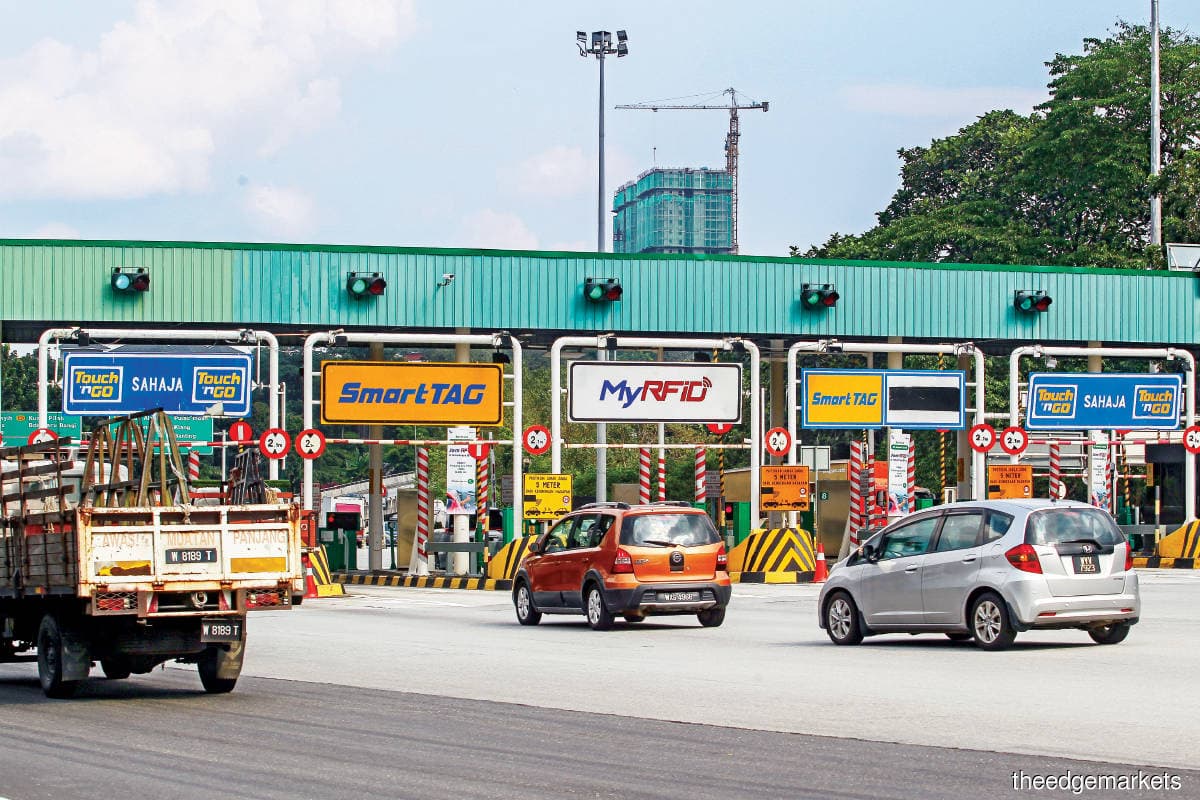
Once MLFF is implemented, conventional toll booths with boom barriers will be removed from highways, while new MLFF gantries — which are essentially barrier-less toll plazas similar to Singapore’s Electronic Road Pricing (ERP) system, which is operated by the republic’s Land Transport Authority — will be installed, giving road users a seamless experience.
This will help reduce traffic congestion at toll stations.
The Ministry of Works (KKR) announced last month that the government had allocated RM3.46 billion for the implementation of the new toll collection system.
For the implementation of MLFF, which was mooted over 20 years ago, the government needs to draft a new legal framework that will be tabled in parliament and appoint a centralised toll collection agency.
In an email reply, Works Minister Datuk Seri Alexander Nanta Linggi tells The Edge that the MLFF will adopt the Public-Private Partnership (PPP) model.
He says the government has, via the Malaysian Highway Authority (MHA), appointed a legal firm to study and propose to the government the legal framework that is required.

“The legal firm’s role is to advise the government on amendments of laws, or even the introduction of a new law, to govern the implementation of MLFF,” he says.
According to Nanta, the legal adviser was appointed through an open tender process. It is working closely with all government agencies to formulate the relevant law.
“The ministry anticipates that the law will be passed by the end of second quarter 2024, just before MLFF is fully implemented. The relevant law and enforcement activities need to be in place to avoid greater leakages,” the minister says in the email.
He also points out that “a specific agency” will be responsible for managing the day-to-day collection from users and transferring the funds to the concession companies.
“The current proposed structure will consist of both the public and private sector working hand in hand to ensure the smooth implementation of MLFF,” he adds.
Given that the implementation will be via the PPP concept, Nanta says that a specific concession period will be granted to the agency to recoup the capital investment.
“However, the existing concession period of the highways will not be extended, nor [will] the toll fares [be] adjusted to finance the project. This means users will be able to enjoy seamless movement on highways without any extra cost.”
According to industry sources, certain parties from the private sector, including public-listed conglomerates, have shown interest in being the agencies.
“A centralised toll-collecting special purpose vehicle (SPV) is being mooted as a toll collection entity for all highways when MLFF is fully implemented.
“It is believed that part of the legal framework will be for the purpose of empowering the authorities or the SPV with enforcement powers for unpaid toll fares to prevent toll leakages from all highway concessionaires,” says a source.
“With the barrier-less MLFF, highway concessionaires have to be assured that all motorists pay their toll charges. That’s where the toll collection agency could play a role,” says another source.
Breaking a 26-year payment monopoly
The current government seems determined to break the monopoly that TNG has had on toll payments for over 20 years. Currently, all motorists have to pay toll using a TNG card or e-wallet for RFID payment.
At least 11 highways, including the New Pantai Expressway, Guthrie Corridor Expressway, Penang Bridge, Damansara-Puchong Expressway (LDP) and SPRINT Highway will implement the open payment system by mid-September.
Touch ’n Go Sdn Bhd declined to comment when contacted by The Edge.
It remains to be seen what role TNG and other e-wallet or e-payment companies will play in the MLFF project in the future.
Nanta notes that as a start, the open payment system will be introduced to allow users to have the option of payment via debit and credit card.
“The implementation of the open payment system will [enable] the companies and the government to identify and address issues relating to payment methods before the MLFF is implemented fully,” he explains.
“Next, users will see gantries being installed at selected locations [for a trial] on the detection of vehicles, which we expect to be carried out by October 2023. The first fully MLFF installed highway is expected to be launched by the third quarter of 2024.”
Most highway concession companies seem to be supportive of the MLFF project, as they believe this is the way forward in enhancing highway users’ experience, reducing traffic congestion as well as improving road safety, given that physical interactions are no longer required on the highways.
Ekovest Bhd managing director Tan Sri Lim Keng Cheng has long advocated for highway toll fares to be transacted via cashless payment systems and for the removal of conventional toll booths from highways in favour of MLFF systems.
“Apart from causing congestion on highways, toll booths are also seen as potential road obstacles that can cause fatal accidents, endangering the lives of the drivers and also the toll collectors working inside the toll booths,” he tells The Edge.
Ekovest owns a 60% stake in Konsortium Lebuhraya Utara-Timur (KL) Sdn Bhd, which operates the toll concession for the Duta-Ulu Kelang Expressway (DUKE) Phase 1 and 2, and Setiawangsa-Pantai Expressway (also known as DUKE Phase 3).
Under Lim’s initiatives to prioritise the safety of both toll collectors and road users, DUKE 1 and 2 had in 2015 become the first highways in Malaysia to fully implement Electronic Toll Collection (ETC). Cash is no longer accepted and road users can choose to pay tolls using either TNG cards or Smart Tag On Board Units (OBU).
“DUKE 1 was also the first highway to conduct RFID pilot testing in 2017 and was among the first highways to offer highway users the RFID payment system. Since late 2022, DUKE 1 has been conducting its private POC (proof of concept) for MLFF, involving the OBU system, and will present its findings to the KKR and MHA in the coming months for their deliberation,” says Lim.
Long-awaited project
This is not the first time that the Malaysian government is looking at implementing MLFF. Such a plan already existed in early 2000, says Nanta.
“However, due to its complexity in terms of enforcement and high capital expenditure, the implementation was delayed until 2021, when the KKR began to seriously consider its implementation by 2025 to resolve congestion at the toll plaza areas,” he adds.
KKR is spearheading the implementation of MLFF, supported by the MHA and the Association of Highways in Malaysia.
Nanta says the MHA had carried out some studies between 2015 and 2017.
“[With] those studies being the guide, MLFF is being planned and soon will be implemented. MLFF has been implemented in many countries including Thailand and Indonesia. Therefore, the ministry has been actively engaging with our counterparts from other countries to identify issues and plan the implementation,” he adds.
Nanta acknowledges that MLFF’s implementation in Malaysia is taking some time as the ministry has to deal with more than 30 highway concessionaires, all of which have different cost structures and funding.
“The ministry must ensure that the companies’ toll revenues are not affected with the implementation of MLFF, hence an inclusive and holistic approach needs to be considered at every level of decision making.
“Therefore, the ministry needs a bit more time [for] the successful implementation of MLFF to avoid any inconvenience to the users or any backlash from the industry,” he concludes.
Save by subscribing to us for your print and/or digital copy.
P/S: The Edge is also available on Apple's App Store and Android's Google Play.