

This article first appeared in The Edge Malaysia Weekly on March 20, 2023 - March 26, 2023
THE global plant-based meat market is forecast to surge to US$75 billion (RM336 billion) in 2031 from US$8.1 billion in 2022, according to a 2022 Bloomberg Intelligence Research report titled “Plant-based Foods Poised for Explosive Growth”. Meanwhile, the plant-based dairy industry is expected to expand to US$66.8 billion from US$27.8 billion.
Growth in general is expected to be driven by population growth, which causes a strain on resources, an increase in awareness of health and sustainability benefits, as well as a continued decline in product price.
In a market dominated by players such as Los Angeles-based Beyond Meat Inc and Impossible Foods Inc (known for its signature Impossible Burger that went mass market in 2018) as well as traditional food giants such as Nestlé’s Harvest Gourmet and Kellogg’s MorningStar Farms, Indonesian plant-based meat tech start-up, Green Rebel, plans to capture a piece of the expanding pie.
The brand, whose unique selling proposition is its range of Asian flavours, expects to take a nibble out of the multibillion-dollar industry as it enters new markets, innovates new local flavours and educates the market by promoting the health and environmental benefits of shifting to a plant-centric protein option.
After ending 2022 with 1,100 distribution points in Indonesia, Singapore and Malaysia, Green Rebel targets to increase the number to 4,000 by year-end as it enters Vietnam, the Philippines and South Korea. And by end-2024, as it launches in Australia, Green Rebel’s goal is to have a total of 10,000 distribution points. Distribution points, sometimes referred to as doors, include grocers and restaurants.
Green Rebel, which debuted in Malaysia last December and has 70 distribution points so far, expects to see 500 distribution points by June. “Outside of Indonesia, Malaysia is expected to be a key market for Green Rebel,” co-founder and CEO Helga Angelina Tjahjadi tells The Edge in a recent interview. Its first overseas market was Singapore, where it made its debut last April.
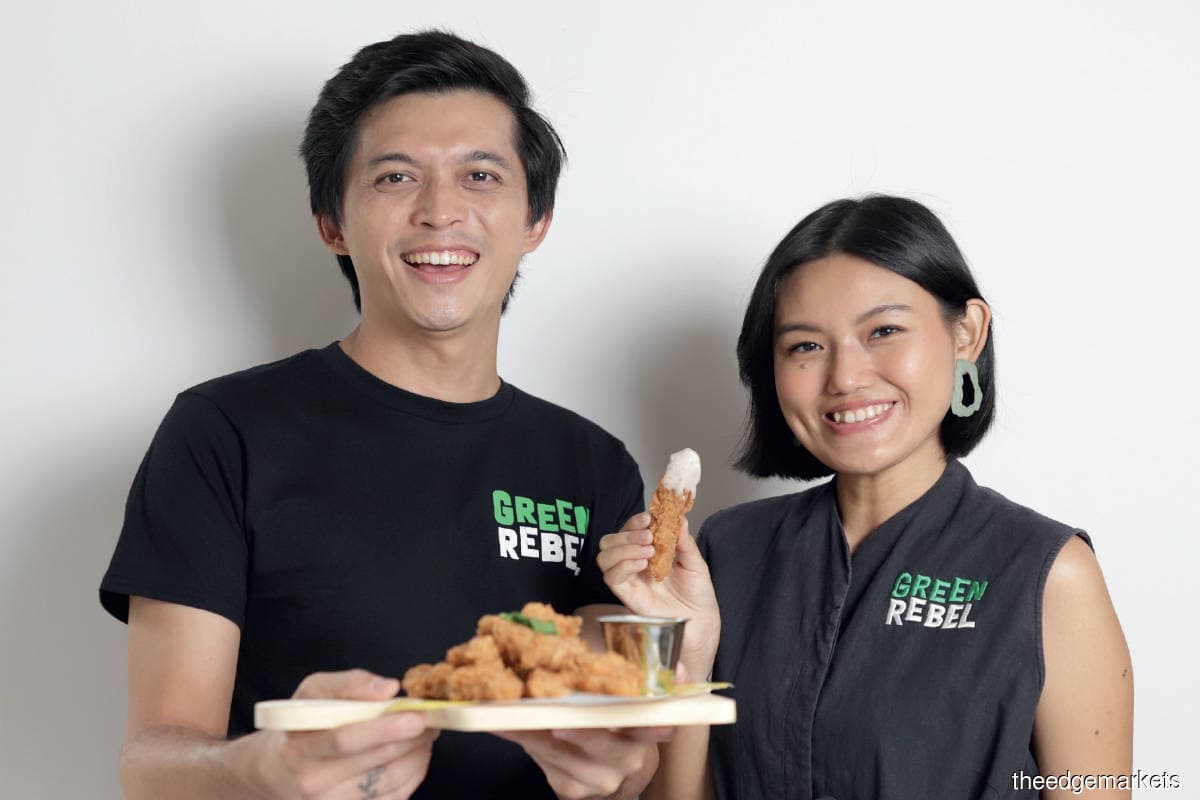
Green Rebel was co-founded by Helga and her husband Max Mandias. Recounting how this business venture began, Helga says she became a vegetarian at the age of 15 when Western medicine failed to relieve symptoms caused by an autoimmune condition. She decided to try a plant-based diet after an alternative healing material she had been reading recommended it. As a result, her symptoms improved and, within two years, they disappeared, and have never returned. “That was the start of my passion for plant-based nutrition,” she recalls.
Helga, 32, met her husband, Max, 34, while she was studying in the Netherlands. In 2013, the duo had a calling to do something that was in line with their passion and they ventured into plant-based culinary and food technology. Today, Helga manages the business while Max, as the chief innovation officer, oversees product creation and innovation, as well as manufacturing.
Upon their return to Indonesia, they opened their first plant-based restaurant called Burgreens in Jakarta. Today, there are nine Burgreens outlets located mostly in greater Jakarta and in Bali.
The duo had always wanted to sell their most popular items and flavours on a larger scale. “The pandemic accelerated our execution timeline. When the pandemic hit Indonesia in March 2020, we turned our bestsellers into frozen food,” Helga says. Response to the beefless rendang, beefless satay, chicken satay and chicken katsu, which were sold online, was better than expected as consumers had moved from eating at restaurants to eating at home.
Who is behind Green Rebel?
According to Helga, there were investors who were keen on the frozen Burgreens products and asked whether they would spin it off under a different company and offered to back them up. At the time, Burgreens, which is majority-owned by the couple, already had the backing of angel investors who were high-net-worth-individuals from Indonesia; venture capital (VC) firms (Teja Ventures, Ango Ventures); and Kane Lim, a Netflix star who has a show called Bling Empire.
Thus, Green Rebel was born. It raised US$1 million in the first round of growth and, last March, it raised US$10 million in a pre-series A round from a group of investors including Unovis Asset Management, Better Bite Ventures and AgFunder. Unovis, which backed players such as Beyond Meat and Oatly, partners with entrepreneurs developing innovative plant-based and cultivated alternatives to animal products, including meat, seafood, dairy and eggs. Better Bite is a VC that invests in alternative protein start-ups in Asia-Pacific. AgFunder, meanwhile, invests in impactful companies that transform the world’s food system.
“We raised our seed round [of funding], which went into building a fully halal and vegan commercial facility in Tangerang, which is a suburb south of Jakarta, for our meat and dairy alternatives. It can produce 60 tonnes of plant-based meat a month,” Helga says.
Today, the shareholders of Green Rebel include all the investors of Burgreens, Unovis, South Korea’s leading food company CJ CheilJedang Corp (whose portfolio includes bibigo-branded K-food products and bakery chain Tous les Jours), as well as Chryseis Tan (daughter of Berjaya Group founder Tan Sri Vincent Tan) and her husband, Faliq Nasimuddin.
In Malaysia, Green Rebel is working with Country Farm Organics, a subsidiary of Berjaya Corp Bhd, for product distribution.
The products
Although Helga was unable to disclose specific performance figures, she says “revenue grew six-fold” between 2020 and 2022. During the same period, Green Rebel, which was available at 100 food service outlets in 2020, had managed to increase its reach to 1,000 food service outlets and 100 retailers by end-2022.
Green Rebel entered Malaysia with six stock keeping units (SKUs) in three product categories. They include meatless/beefless alternatives made from shitake mushroom such as beefless rendang and beefless steak; and chicken alternatives made from non-GMO soy such as Chick’n Katsu and Chick’n Karage.
The third category is wholefood protein, which does not mimic the taste or texture of chicken or beef but highlights the different types of ingredients used. Products in this category include shroom balls, mushroom patties and vegan gyoza. These typically cater for long-time vegetarians or vegans who do not look for a piece of meat anymore, Helga says.
A fourth category, which will be launched in Malaysia this year, comprises dairy alternatives — called Creamy Crew in Indonesia — such as cheddar-style blocks, Caesar dressing and a mayonnaise version called Mayo Nice.
Elaborating on the products, Helga says while its signature products are the beefless rendang and beefless steak, its signature technology is its ability to produce whole-cut meats. “Most of the available products [in the market] are in the form of minced meat, which are turned into patties and sausages. Our technology is able to produce textured meat,” she says. Shitake mushroom and soy are texturised to mimic the fibrous meat texture of chicken and combined with emulsion technology to produce whole-cut forms such as steak.
She explains that her products are versatile and can be used in various types of cooking, including high heat and high moisture. The products stay intact, whether put on high heat or in high moisture, she says. They do not disintegrate. The “meat” can also be braised and marinated and “flavour absorption is into the deepest level”, she adds.
Green Rebel prides itself on its ability to recreate Asian flavours such as rendang, satay and karage. “Our key differentiation and strength is the ability to recreate Asian flavours,” says Helga. The company is working on concocting Malaysian and Indian-inspired flavours.
Asked about the reception and demographics of purchasers in Malaysia, Helga says: “It is still early days. For now, we are in 70 doors, including Jaya Grocer, Qra, vegan speciality grocers and speciality restaurants like Hijau Kuala Lumpur, The Hungry Tapir and SALA. We have had conversations with some brands to launch Green Rebel that will get us into 500 doors in Malaysia alone by June.” She adds that the doors will include food service outlets and retailers.
Green Rebel’s target markets are not just vegans and vegetarians but the growing number of flexitarians, who are consciously reducing meat consumption and increasing plant-based protein.
On pricing, Helga says Green Rebel’s products — each pack serves two or three portions — are priced from RM22 to RM26. She agrees that compared with other mock meat producers that have been in the market for decades, Green Rebel’s prices are slightly higher because of economies of scale. She points out, however, that its prices are comparable with those of other local Malaysian start-ups and are 40% lower than those of Western plant-based meat players. “Our plan is to keep prices as efficient as possible as our goal is to achieve price parity with our animal counterpart within two years. When others are increasing their prices, our prices will [remain the same] or be reduced.”
By end-2023, Green Rebel plans to introduce five to six products, including dairy alternatives such as cheddar and mozzarella cheese, and Mayo Nice. Also on the cards are plant-based ribs and plant-based fish.
Helga hopes to make Green Rebel a global brand and the preferred plant-based brand for Asian flavours. “For Malaysia, we would love to be in the forefront of the plant-based and flexitarian movements because the mission is to accelerate the adoption of a healthy and sustainable protein system. We see that happening already in countries such as the UK, the US and Australia.”
Save by subscribing to us for your print and/or digital copy.
P/S: The Edge is also available on Apple's App Store and Android's Google Play.