

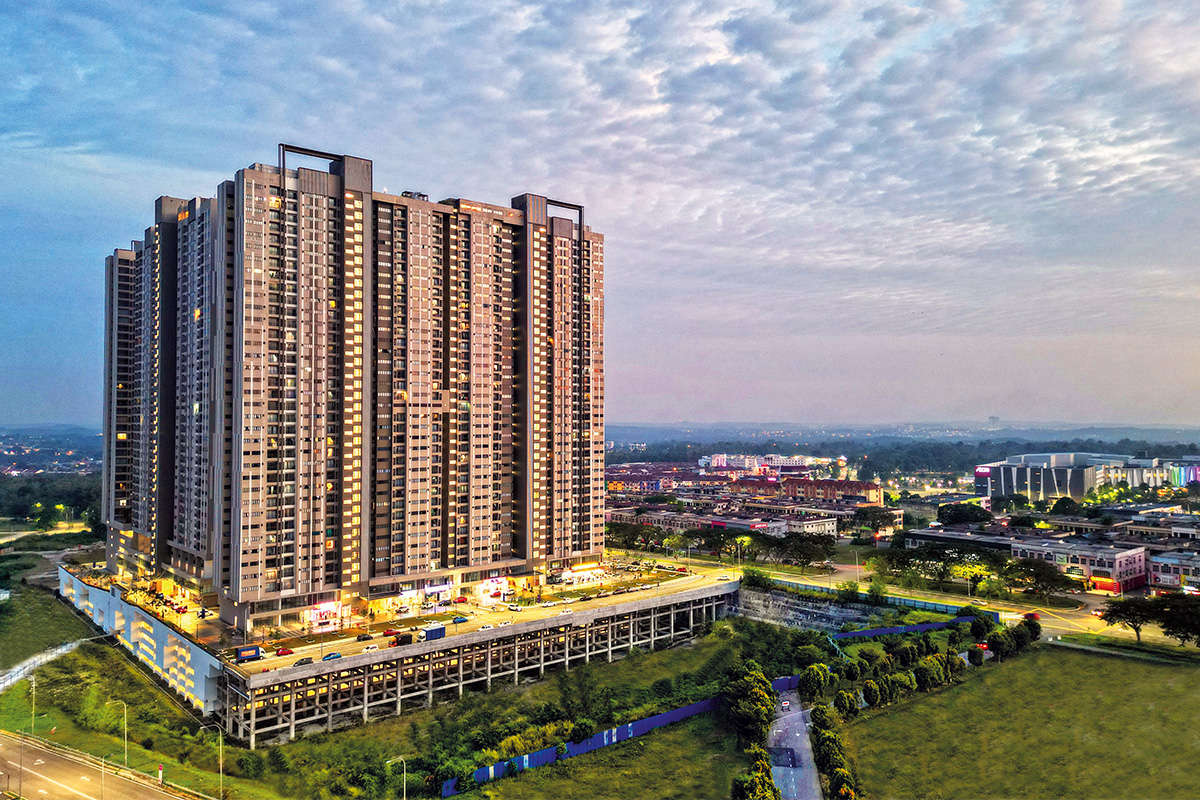

When GD Holdings first entered Nilai more than a decade ago, the township was still widely regarded as a quiet satellite town, in contrast to the rapid growth unfolding across the Klang Valley. Yet for group CEO Ng Khoon Haur, Nilai’s long-term promise lay in its strategic fundamentals rather than its perceived limitations.
Situated near the nation’s capital, Kuala Lumpur, and the Kuala Lumpur International Airport (KLIA), Nilai offers strategic connectivity and scalability, with the right ingredients to grow into something far more dynamic.
“Nilai was underinvested, but its location was incredibly strategic, close to KL and KLIA, and already emerging as a university town,” Ng recalls.
This conviction first materialised through the developer’s Green Beverly Hills integrated project, which includes a series of high-rise developments. Strong take-up across multiple phases confirmed that buyers were receptive to quality developments outside traditional urban centres. “With the strong take-up of our initial developments, it proved our initial thoughts about Nilai were correct. It gave us the confidence to build something bigger,” says Ng.
That next step was Youth City.

Youth City — purpose-built approach to urban living
Youth City was conceived not simply as a residential development, but as a model of community-based urban living. Comprising 3,213 residential units and 96 shoplots, with a gross development value of about RM1.37 billion, it introduced unprecedented scale and amenity provision in Nilai.
The project features four rooftop infinity swimming pools and an Olympic-sized pool, five gymnasiums, a mini cineplex, a grand ballroom, a tennis court, eight badminton courts, two squash courts, meeting rooms, playgrounds and a surau that can accommodate up to 1,000 people, among others.
In terms of layout and pricing, the residential component ranges from studios of about 460 sq ft to three-bedroom apartments of 1,008 sq ft, priced from RM300,000 to RM700,000. The development currently has an estimated occupancy rate of around 75%.
“We wanted to create a community that is vibrant and inclusive, with the added convenience,” says Ng.
This design philosophy has translated into lived-in vibrancy. Mornings see students moving between cafés and transport pickup points, afternoons bring steady retail activity, and evenings draw families, professionals and expatriates to shared decks, gyms and prayer spaces.
Over time, Youth City has grown into a self-sustaining urban environment in Nilai, where daily routines, social life and convenience converge beyond mere housing.
Education as the anchor
The rise of Youth City has unfolded alongside Nilai’s transformation into one of Malaysia’s most concentrated education clusters. Youth City is a strategic partner of INTI International University & Colleges, Nilai University, Mila University, Universiti Sains Islam Malaysia, Meatech International College and ADMAL Aviation College.
That transformation has been shaped not only by developers but also by educational institutions that see Nilai as a long-term foundation rather than a peripheral alternative. According to INTI CEO Dr Chong Kok Wai, Nilai’s appeal lies in its ability to support growth at scale, something increasingly difficult to achieve within the Klang Valley’s more mature urban centres. While accessibility remains critical, he says institutions are now weighing factors such as land availability, expansion flexibility and long-term operational sustainability just as heavily.
“Investors didn’t just see a university; they saw a functioning education gateway into Southeast Asia that could scale from day one, in both academic capability and physical space,” Chong says.
Nilai’s proximity to KLIA, he adds, has been particularly important for international students, allowing arrivals to reach campus quickly while remaining connected to Kuala Lumpur and beyond. Over the past decade, this combination of connectivity and room for expansion has repositioned Nilai from a secondary option into a strategic education node capable of anchoring long-term population and economic growth.
“Today’s learners prioritise job-ready training and strong pathways, even if it means studying outside traditional city centres,” says Nilai University commercial director Michael Chan.
As enrolment numbers increased, particularly among international students, accommodation emerged as a critical component of Nilai’s education ecosystem. Traditional on-campus hostels no longer meet the expectations of many students seeking flexibility, privacy and lifestyle amenities.
From Nilai University’s perspective, the growth in student numbers has made accommodation a form of urban infrastructure rather than a peripheral concern. As enrolment expands, particularly among international cohorts, the availability of professionally managed off-campus housing becomes essential in sustaining both academic performance and student well-being. “A university has the unique ability to anchor a township’s growth, creating steady economic cycles rather than seasonal spikes,” says Chan.
He adds, “Purpose-built student accommodation isn’t just accommodation; it is the structural backbone that turns student volume into sustainable township development and long-term economic value. By integrating purpose-built student accommodation with the township’s infrastructure plans — and reinforcing the resort-style campus experience — we create a cohesive ecosystem that benefits both the university and the wider community.”
Unlike short-term rental solutions, well-managed developments provide stability, safety and consistency, factors that influence not only where students choose to live, but also where institutions choose to expand. When aligned with transport access, retail amenities and community facilities, such accommodation helps integrate students into the wider township, reinforcing Nilai’s evolution into a liveable, education-led urban centre rather than a transient campus town.
Youth City has become one of the most visible manifestations of this alignment. GD Holdings’ Ng notes that about 30% to 40% of its residents are students, while the remainder consists of young professionals, expatriates and small families.
This diversity has created a stable occupancy profile, reducing reliance on a single demographic and enabling the development to remain active year round.
For many international students, particularly those from China, Youth City offers a familiar urban environment. “It’s the closest environment to what they’re used to. The density, the shops, the convenience — it makes them feel at home,” says Ng.


Going above and beyond
What distinguishes Youth City from many large-scale developments is GD Holdings’ decision to operate as both developer and active manager. A dedicated team of around 20 personnel oversees student welfare, daily operations and community engagement, an approach more akin to campus administration or hospitality management than conventional property development.
“For instance, if a parent can’t contact their child, they can call us. We’ll help check on them. This kind of service gives parents peace of mind,” says Ng.
Such protocols have been instrumental in building trust among universities and international families. From INTI’s perspective, this professionalism matters. Chong highlights safety and trustworthiness as essential criteria when recommending external accommodation partners, particularly in an environment where students may otherwise fall victim to poorly managed housing or scams.
Resilience shaped by the community
While Malaysia’s broader property market has softened in recent years, Nilai has remained resilient. Ng attributes this to sustained student inflows, with the number of international students in Malaysia estimated at 250,000 in 2025. In education-centric locations such as Nilai, rental yields of between 6% and 8% continue to support demand, he adds.
To ensure Youth City remains competitive, GD Holdings focuses on continuous adaptation. Retail curation has been refined to prioritise daily-use and wellness-oriented tenants, including Anytime Fitness, while food and beverage offerings are tailored to student and family needs. The planned introduction of a fresh market reflects a deeper understanding of neighbourhood retail dynamics, where essential services drive consistent footfall. At the same time, GD Holdings is actively encouraging additional colleges to establish satellite campuses within Youth City, leveraging its extensive facilities and safety framework to support academic operations.
GD Holdings’ retail strategy has benefited shop operators within Youth City. A tenant who operates a fashion boutique describes a steady flow of customers, including students, families and residents from the surrounding neighbourhood, noting that the diverse retail mix supports the people’s daily needs. Food outlets, in particular, benefit from consistent patronage as people gather to eat and socialise throughout the day.
In addition, community engagement has become one of Youth City’s defining features. Beyond digital communication channels, GD Holdings has an on-site service centre called “Jiran”, enabling residents and tenants to engage directly with management.
This is complemented by regular wellness programmes, festive gatherings, sports competitions and new facilities such as a library and pickleball court. Over time, Youth City’s shared spaces, particularly its elevated communal deck, have evolved into active social zones where residents gather to exercise, pray, read or simply to spend time together.
Collectively, these efforts have created a sense of permanence and belonging that high-density developments often struggle to achieve.
That experience is reflected in how students themselves describe life at Youth City. One first-year Bachelor of Mass Communication student at INTI, who chose to stay there due to its proximity to campus (about a 15-minute commute), describes the environment as calmer and more relaxed compared with larger cities, including those in China. The availability of facilities and daily conveniences, she notes, offers a clear improvement over traditional hostels, with food options and amenities close at hand. For international and local students alike, this balance of accessibility, facilities and a slower pace of life has made settling into daily routines easier, reinforcing Youth City’s appeal as more than just a place to stay during term time.
Meanwhile, operational enhancements continue to shape Youth City’s evolution. Security upgrades, expanded CCTV coverage and improved access control have strengthened safety while also enabling better tracking of pedestrian flows to support retail planning.
Although Youth City was conceived before environmental, social and governance considerations (ESG) became mainstream, Ng notes that its operational lessons are shaping future developments. GD Holdings has since established a dedicated ESG team, and upcoming projects will integrate sustainability, social engagement and governance considerations more deliberately.

A blueprint for Nilai’s next chapter
Reflecting on the journey, Ng describes Youth City as a learning platform. Its open-community model has demonstrated the benefits of vibrancy while highlighting areas for refinement in zoning and circulation. More importantly, the project has generated valuable behavioural and operational data that will inform the next phase.
He also sheds some light on Youth City 2.0 — an education-integrated evolution envisioned with purpose-built spaces for colleges, greater flexibility in layout and expanded cultural and educational programming. GD Holdings is also exploring partnerships with local businesses to enhance services and create employment opportunities within the community.
Overall, Youth City forms part of GD Holdings’ broader Vision City master plan, which positions education as a long-term economic anchor for Nilai.
For GD Holdings, Youth City represents more than a successful development. It demonstrates how property, when paired with operational commitment and institutional partnerships, can function as an engine for sustainable township growth. As Ng puts it, “Instead of purely building townships, we’re focusing on a niche that requires detail, care and service. It’s difficult work, but it sets us apart.”
Find out more: https://youthcity.com.my/