

Many construction firms eventually expand into related businesses, including property development, but none has done so as systematically as Wee Hur Holdings did.
Founded in 1980, Wee Hur has expanded into a string of adjacent businesses: property development in 2009, workers’ dormitories in 2013, and an overseas push into Australia in 2014, where it built a purpose-built student accommodation (PBSA) master trust targeting a 5,000-bed portfolio. A fund management arm followed in 2017, set up to manage that trust and, in the group’s words, develop into “another growth platform”.
By 2020, the PBSA business had grown enough to warrant its own operating arm, launched under the Y Suites brand, which now runs all of the group’s PBSA properties. The expansion into the wider ecosystem continued with an alternative investment business in 2021 aimed at venture capital funds and direct start-up investments, and a push into greenfield land subdivision in Australia in 2023.
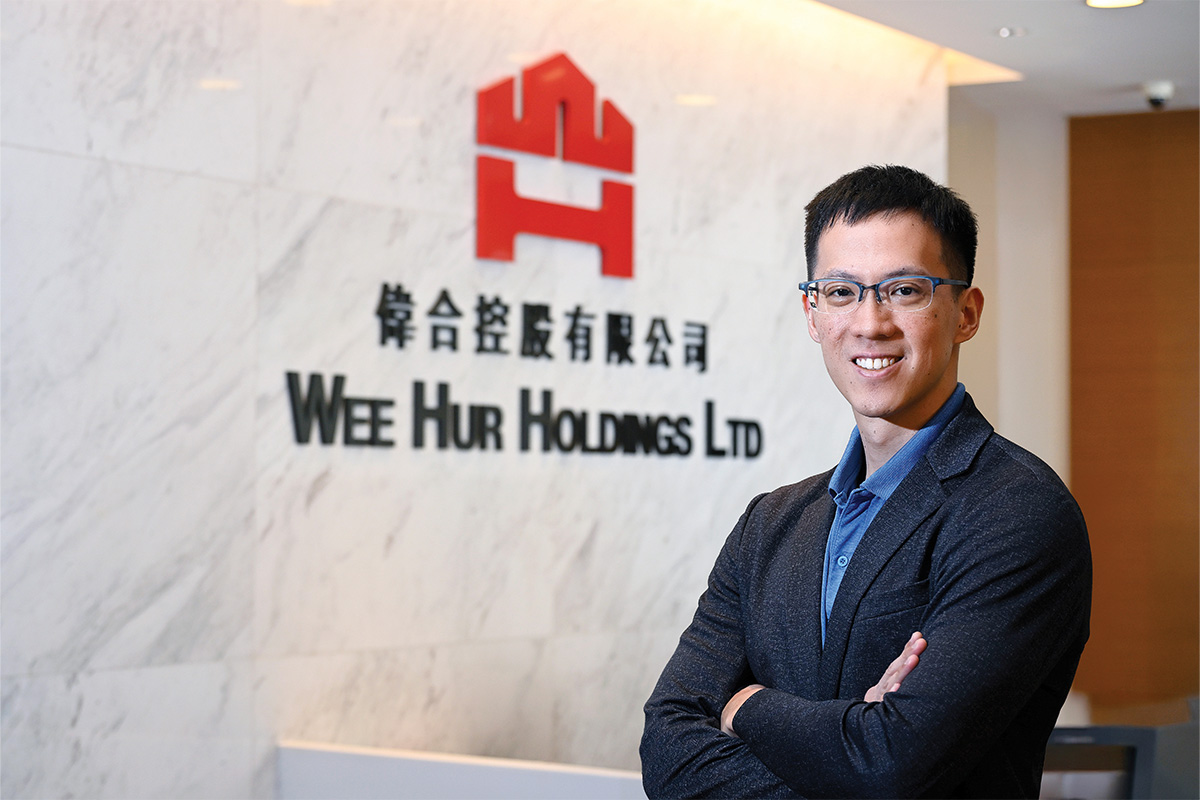
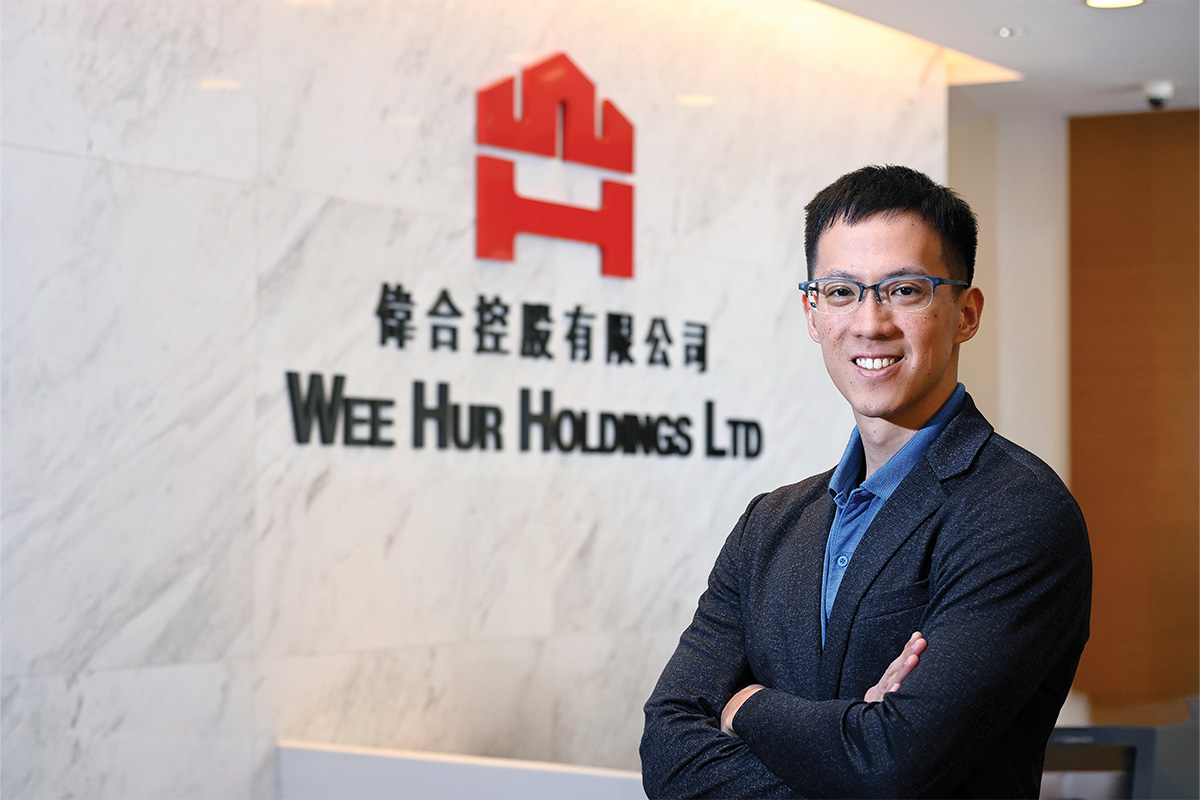
Today, its next generation seeks to take the business further. “Wee Hur is evolving from a construction-led group into an integrated real asset and investment platform, with construction remaining the foundation that gives us the technical capability, market relationships and cost discipline to identify and execute investments,” says Goh Wee Ping, CIO of Wee Hur Holdings and CEO of Wee Hur Capital.
Construction still a ‘substantial market’
Construction is still the base the rest of the group is built on, and by that measure, it is a base that is getting stronger. Thanks to a multi-year high in Singapore’s total construction demand, Wee Hur’s construction order book has climbed to $935 million, closing in on the $1 billion mark which Goh flagged in a September 2025 interview with The Edge Singapore. This is spread across public housing and institutional work instead of being concentrated on any single mega-project such as Changi Airport’s Terminal 5.
The question is what happens once demand cools. According to the Building Construction Authority (BCA), total construction demand is expected to range between $47 billion and $53 billion in 2026 before moderating to $39 billion to $46 billion between 2027 and 2030.
To Goh, the moderation is not a “sudden cliff” and that even at the lower end of the range, there’s still a “healthy level of activity”, supported by public housing, healthcare, transport infrastructure and private-sector work.
He is also betting that the tender process itself is shifting in Wee Hur’s favour. More public tenders are now scored under BCA’s price quality method, where non-price factors such as track record and workmanship can carry 40% to 60% of a building tender’s score. “Price will always remain important because public funds must be used responsibly,” he says, “but competing on the best combination of price and quality is healthier for the industry than a race to the lowest bid, which can eventually compromise investment in people, technology and execution.”
For example, AI-enabled CCTV is used to monitor high-risk work areas and tile-grouting robots and robot painters are at different stages of adoption. Goh isn’t dressing the technology up as more than it is. “We are not adopting robotics or AI simply because the technology is available,” he says.
Despite the optimism, Middle East-linked supply chain pressure hasn’t shown up in the numbers yet, “and a lot will depend on how prolonged the conflict is”, says Goh. He notes that any cost pressures will bite in three key areas: energy-intensive material production such as cement and steel, transportation and logistics for imported equipment and subcontractor pricing that eventually turns up in quotations regardless of where the material was sourced.
He adds that public contracts carry some protection through fluctuation clauses while private-sector work leaves more of the risk with the contractor, which is why the way each project’s contract is structured matters as much as the headline change in commodity prices.
PBWAs, PBSAs and hospitality
Adjacent to construction, Wee Hur is a significant operator of accommodations, generating a growing stream of recurring income. Besides the established 15,744-bed Tuas View Dormitory for workers, which is 90% occupied, the company is driving occupancy at the newer 10,500-bed Pioneer Lodge, which has already hit 85% occupancy.
Wee Hur also provides student accommodation in Australia, and more recently, Hong Kong, which Goh describes as having “a significant structural shortage” with industry estimates putting the shortfall at 120,000 by 2028.
To capture this demand, Wee Hur has announced two projects in quick succession. First, it signed the master lease for the 246-bed Starvia by Y Suites in Fortress Hill, which will begin leasing. Next, Wee Hur bought One Bedford Place in Kowloon, which will have around 500 beds and begin operations in the first half of 2028.
In other moves, Wee Hur is redeveloping the former Hotel Miramar into DoubleTree by Hilton Singapore Robertson Quay. It has also entered a joint venture to bring Wycombe Abbey School to Singapore, its first move into education. In addition, it has built up a land pipeline in South-East Queensland within its Australian land subdivision business. The business, where the group is planning a 358-lot residential subdivision, could become “increasingly meaningful”, says Goh.
“These are not unrelated diversification exercises,” he says. “They share several characteristics we look for: real assets, long-duration demand, barriers to entry, the potential for recurring income and an area where our construction and development experience adds value.”
Goh notes that Wee Hur can earn across five channels: construction margins, development profit, recurring operating income, fund-management fees and capital gains, both unlocking value and building better-quality earnings over time. He claims that few of its peers can replicate all five channels the way Wee Hur has.
One key reason why Wee Hur can command such a position was its ability to generate gains from its early foray into student housing, when it sold 37.1% of its indirect stake in seven of its PBSA assets to Greystar last April. Instead of cashing out entirely, Wee Hur retained a stake from which it can continue to earn management fees. “That is the full cycle we intend to repeat in other sectors,” says Goh, who has rewarded shareholders with a special dividend of seven cents, with a further payout due in July.
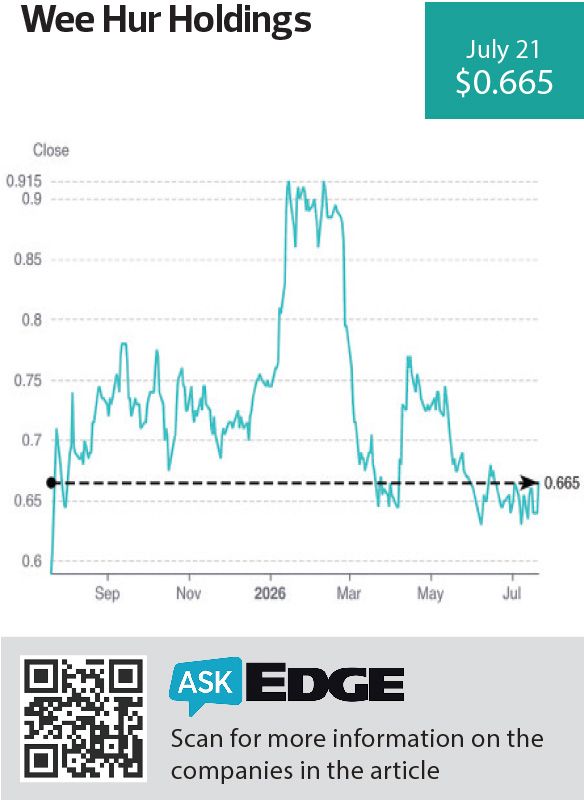
“Our capital-allocation approach is to balance four priorities: maintaining a strong balance sheet, funding committed projects, investing in attractive new opportunities and returning surplus capital to shareholders,” says Goh of the company’s dividend policy. “We do not believe capital should be retained merely for the sake of making the company larger. Every reinvestment must compete against the alternative of returning that capital to shareholders.”
“Where we have capital beyond those requirements and do not see sufficiently attractive risk-adjusted opportunities, we are prepared to return it,” he adds.
One of RHB’s 20 Jewels
An indication of Wee Hur’s efforts was its inclusion in RHB’s 20 Jewels list this year. “We are grateful for the recognition,” Goh says. “For many years, parts of Wee Hur’s value were not necessarily very visible to the market because investors tended to view us mainly as a traditional construction company.”
He notes that being included in the list suggests that the market is beginning to appreciate the “broader platform” that has been built which ranges from construction to dormitory and housing management, to property development and fund management.
That said, Goh is aware that his work is just beginning. “We see recognition as encouragement rather than an end point. Our responsibility is to continue executing, improve the quality and recurrence of our earnings, allocate capital carefully and communicate our strategy more clearly. Ultimately, the recognition has to be supported by business performance.”
Should the strategy play out, Goh hopes for the market to recognise Wee Hur, not just as a contractor, but as an “integrated real-asset platform with valuable operating businesses and a track record of creating and recycling capital”.
“There is still quite a lot in our pipeline that the market has not fully seen play out yet. Just as importantly, we are building the team and organisation to execute that next phase of growth,” he adds.

Management Access
Every month, we dive deep into the companies seeking to unlock value. If you have any questions that has not been touched on, scan the QR code to submit them to Wee Hur’s management team. Responses to selected questions will be published in four weeks’ time.