

What company should you invest in if you want to leverage Singapore’s position as a world-class aviation hub? Some might recommend taking a position in Singapore Airlines (SIA), the city-state’s national carrier. But given how SIA’s stock price has doubled since the lows of the Covid-19 pandemic days, investors hungry for capital gains might be better off looking elsewhere — perhaps a company that is positioned within the same aviation value chain but primed for further growth.
As it turns out, there is a Mainboard-listed company that fits the bill: SIA Engineering Company (SIAEC).
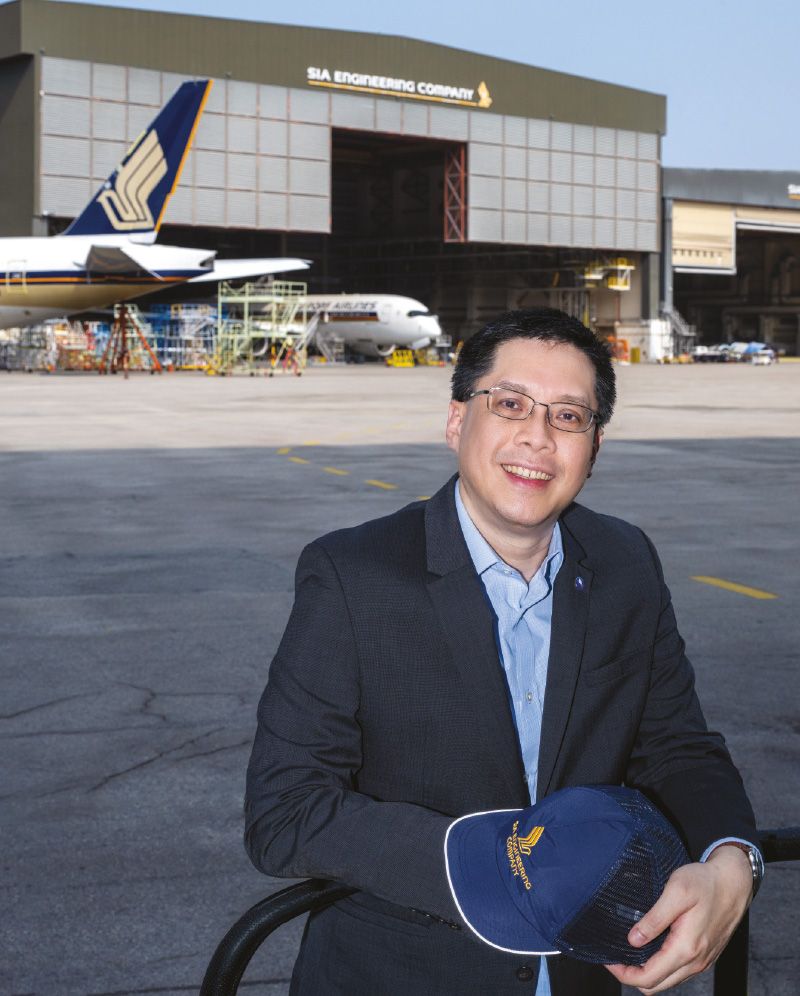
Established as a subsidiary company of SIA in 1992, SIAEC was originally the airline’s engineering division. Since its inception, the company has dedicated much time and resources to develop its capacity and capabilities for next-generation aircraft, and to grow its geographical presence as a maintenance, repair and overhaul (MRO) provider. Today, SIAEC operates across six hangars in Singapore and an additional three hangars in Clark, Philippines. Earlier in May, it announced the official opening of a new base maintenance facility in Subang, Malaysia. The two-hangar facility, with the second hangar expected to be operational in the second half of FY2026/27, further expands SIAEC’s base maintenance network within the region.
While airlines are exposed to the vagaries of seasonal travel patterns, MRO providers like SIAEC have a relatively more stable business model. Afterall, every aircraft needs to go through maintenance to be fit for flight. This will always be the case, whether or not an airline is able to fill up its planes with passengers.
That strategic position appears to have been recognised by the markets. SIAEC’s stock has rallied significantly in the past year, going up by nearly 90% from around $2 in April 2025 to $3.75 in November 2025. The stock continues to trade at above $3, closing at $3.14 on Sept 23.
Build back better
The turnaround in fortunes comes as a surprise considering how disruptive the Covid-19 pandemic was for SIAEC’s business. Strict border entry restrictions saw a near halt in global air travel. As a result, most airlines opted to store their grounded aircraft instead of flying them. To avoid layoffs, SIAEC executives and managers took pay cuts of between 5% to 30%.
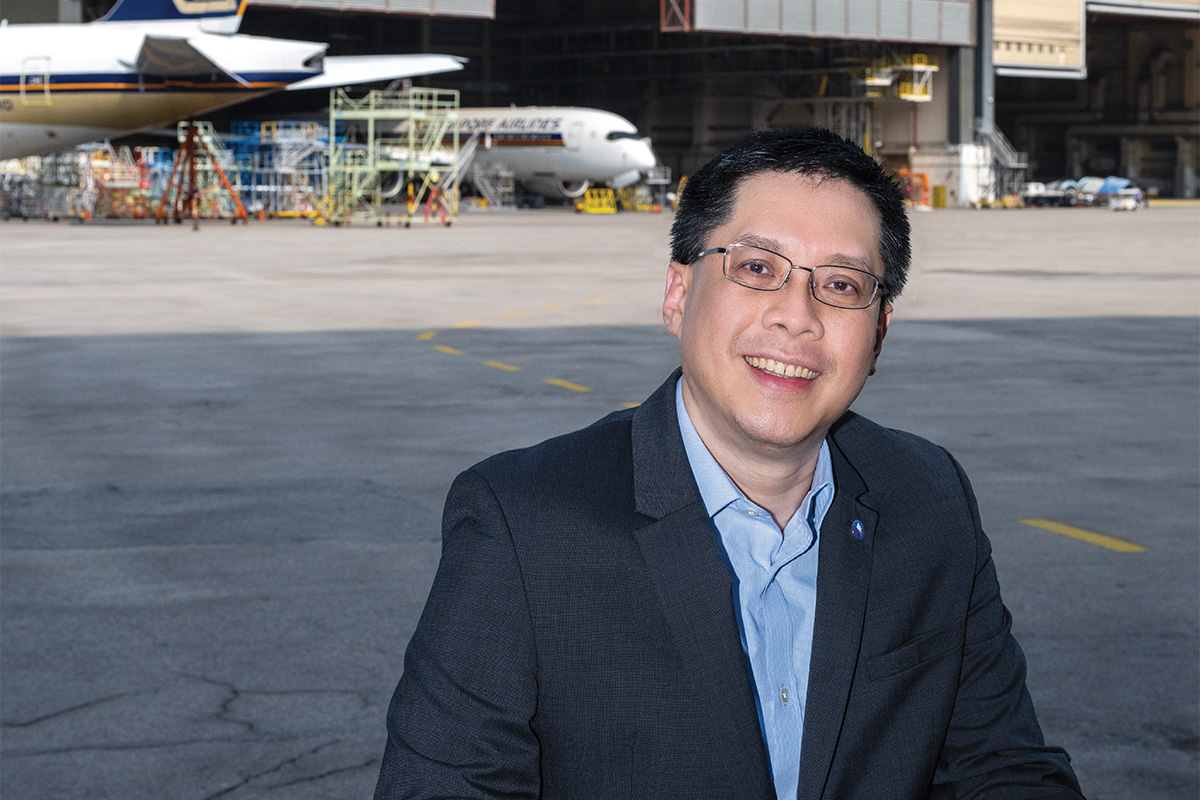
While painful, SIAEC CEO Chin Yau Seng says the Covid-19 pandemic ended up paving the way for today’s booming MRO market. The longtime SIA executive was named CEO-designate on June 1, 2023 before assuming the role fully on Oct 1, 2023.
Before joining SIAEC, Chin was SIA’s senior vice president for cargo. The SIA scholar earned degrees in accounting & finance, and operational research at the London School of Economics and Political Science before starting work at the airline. Chin’s career in aviation has seen him take on a wide variety of roles, including serving as chief executive of SilkAir and Tiger Airways Holdings, SIA’s former subsidiaries.
“Coming out of Covid, there were both challenges and opportunities,” Chin says. “We were quite happy to see a lot of flight activity returning and of course, with flight activity returning, there was a great demand for manpower to support all the additional flights.”
Even till today, the market for aviation talent and manpower continues to remain tight. The collapse in demand for air travel during the pandemic caused many suppliers and sub-suppliers for aerospace manufacturers to either pivot or shutter their operations. Even though new suppliers are coming in, they would need to obtain the necessary qualifications from regulators in order to do business. This, Chin says, poses a huge constraint on supply chains as spare parts are in short supply.
“With the supply lag, it meant that the whole system was overheated,” Chin says, “For us, it was both an impact and opportunity. On one hand, there is an impact because the aircraft had to stay in the hangars for longer. This means we could not induct other aircraft earlier. But, on the other hand, because the supply chain is constrained, it drove a huge rise in demand for repairs, and we are in the repair and MRO business.”
The demand for MRO services is even higher than in the pre-Covid-19 days. For one, airlines who want to recover their grounded planes for use will need to go through quite a bit of maintenance work to return them to the skies again. In addition, the pandemic resulted in delivery delays for newer aircraft models. As such, older planes still have to be flown in the interim.
“Some of the new aircraft orders are coming in late, so you need to fly the older aircraft for a longer period, which actually means more maintenance. You are going through some of the heavy cycles for the aircraft that you would have potentially retired if the new aircraft had come in,” Chin explains.
That is one of the reasons why, under Chin’s leadership, SIAEC has sought to expand its hangar capacity by going into Subang. Today, 70% to 80% of SIAEC’s base maintenance business comes from its parent company SIA, with the remainder from other airlines.
With Subang, Chin says SIAEC will be able to redirect some of their work for SIA there, thus freeing up more space for other customers. The extra space means SIAEC will be able to operate more specialised lines at its hangars for specific aircraft models.
“For instance, today we are sending to Subang all the [Airbus] A350s. So, you will have dedicated A350 lines. When you have dedicated lines, productivity typically increases because this is low mix but higher volume. So, you actually churn your resources a lot more efficiently,” Chin says.
“One of the challenges, when we are doing so much of the work with constrained capacity in Singapore, is that you have to mix the lines because the demand is just so high. You want to make use of every bit of hangar time and you will see that our hangars are actually quite full.”
On top of that, Chin wants to raise SIAEC’s overall productivity through a new framework they are implementing called the Enterprise Operating System (EOS). Launched in 2024 and expected to be completed at all key operational business units by the end of FY2026/27, EOS seeks to revamp the way SIAEC goes about its operations by bringing together Lean management principles, digital tools, and AI.
“With the EOS programme, what we are trying to do is to look at the end-to-end process and do a few things. Number one, what work is more regular? We want that to be done like clockwork. That means if we set it out to be 10 days, no matter what, we will be able to churn out the aircraft in 10 days, despite some of the challenges,” Chin says.
Understanding the entire operational process is critical when it comes to managing supply chain disruptions, which is becoming increasingly common in the volatile world we live in today.
“There are various interventions we can do when things go a little off. If spares don’t come on time, how do we rejig the sequence of the check such that we can still deliver within 10 days? When there are real big disruptions, what are the interventions we can do and build into our process and system? That means for every known disruption, we actually have a remedy for it,” Chin says.
“This EOS is really about stringing together processes to make sure that despite all these supply chain challenges, we can still keep to our rhythm and make sure we do it with optimal manpower.”
Not just an SIA offshoot
Even though SIA is the largest shareholder of SIAEC, holding a nearly 78% stake in the company, Chin says the company actually serves a wide mix of clients. When it comes to flight handling, SIAEC serves other carriers as well besides SIA.
“Flight handling takes place when the aircraft comes in and goes out,” Chin says. “You certify the aircraft. You do some of the basic water toilet servicing. That business is very diversified.”
Even then, SIA remains SIAEC’s largest client, Chin adds. “Everything that is done on the tarmac, when the aircraft are overnighting in Singapore, that is what we call maintenance operations at line maintenance. Typically, you serve the base carrier, which in this case is SIA and Scoot. That part is almost entirely SIA Group, but it is also true of many other airports where there is some MRO servicing a base carrier. That’s just the nature of operations.”
To diversify its business, SIAEC maintains an extensive portfolio of 26 subsidiaries and joint ventures with leading engine and component original equipment manufacturers and other partners. Back in 2001, SIAEC started a 50:50 joint venture company with Rolls-Royce, Singapore Aero Engine Services (SAESL). SAESL is currently in the process of expanding its capacity via a new engine repair facility in Loyang as well as redevelopment works at Rolls-Royce’s existing facilities at Seletar Aerospace Park.
SIAEC’s diversified business was the reason why it was not seriously affected by the tensions in Iran, Chin says. “Some of our line maintenance operations and our joint ventures do serve Middle Eastern carriers and we were hit initially but as things settled, they flew again. Some of the initial lost business has been recovered.”
Look long-term
Chin wants to take SIAEC to greater heights and enter new markets. Earlier, on July 3, the company signed a non-binding memorandum of understanding (MOU) with Air India to potentially set up an MRO joint venture (JV) in India.
“We need to execute well. There is nothing without challenges. India’s market, for instance, is not easy and I think it will call on every bit of our resources to make it work. But I think we have the right people and expertise. We will have to learn very fast,” Chin says.
“There’s all these opportunities for us to tap on, and we have been taking advantage of that. Of course, with most of this, there is some lead time, there is investment cost, but what we are doing is we are securing the growth story of SIAEC.”