

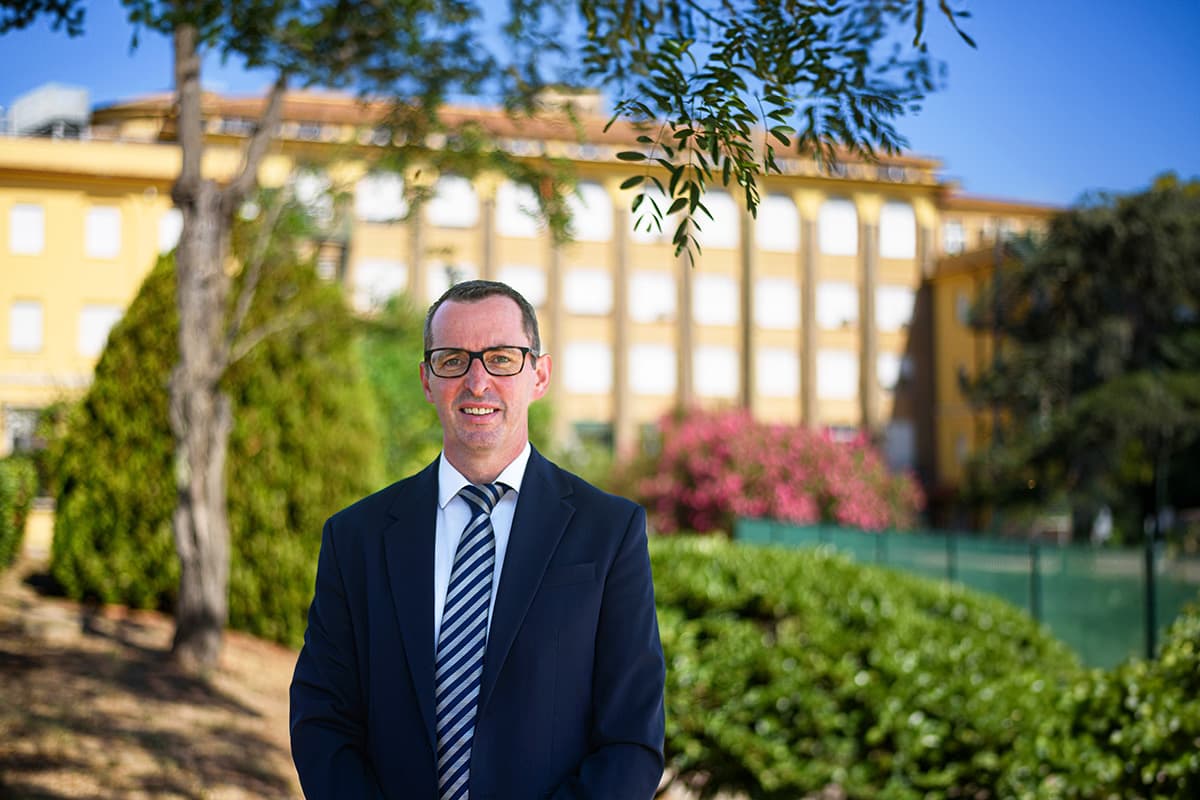

When you are already an established institution that is 80 years strong and has a brand name as recognisable as Alice Smith School, what do you do for your second act?
According to the new Head of School, Dr John Knight, you build on that already established foundation so that you will be around for the next 80 years.
“Alice Smith is a great legacy name. It’s one of the first four British international schools, so the reputation of Alice Smith among international head teachers is up there as outstanding,” says Dr Knight, who assumed his role in May.
With more than 20 years’ experience in international education, he has a proven track record of fostering academic excellence and innovative learning environments. He also serves as Secretary of the HMC International Division, which represents more than 70 leading global schools, and is set to become its Chair in 2027.
Dr Knight always knew he was going into education and is not shy to admit that Alice Smith had always been his dream school. Asked to pinpoint what sets Alice Smith apart from other schools, he says one word keeps coming back to him: community.
“Yes, it has a reputation, but now I’ve been here and since becoming part of the school, I feel it; the community here is really special. When you walk around the school, you can see it. The way students interact with each other, with the staff and with their parents at the drop-off area. You just see happy, smiling students and parents.”

Dr Knight recalls a saying from his youth that school days are often the best of one’s life. He believes that sentiment has been lost amid intense academic pressure and hyper-competitiveness.
“I believe this phrase can become true again for students at Alice Smith. We have a brilliant community, phenomenal facilities and world-class teachers. The real strength and special magic of Alice Smith is its community. There’s real joy here.”
Over the past decade, however, education has changed dramatically — supercharged by technology and shifting expectations about careers. Dr Knight acknowledges this shift, noting that earlier generations followed a more predictable path: a degree, then a job, often with the same company until retirement.
That is no longer the case. Today’s students must navigate a far more fluid reality.
“So, it’s the duty of schools now to make sure students are very flexible. You give them that confidence and courage, the ability to work well with others.
“In a great international school, you get opportunities in sports, music and programmes such as the Duke of Edinburgh Awards. All of these build character, confidence and teamwork. People call them soft skills, but I think they’re essential skills that complement academic study — helping shape well-rounded students who go on to lead fulfilling lives,” says Dr Knight.
He adds that as artificial intelligence becomes more deeply embedded in daily life, machines will still not be able to replicate genuine human connection. As such, the ability to communicate and build relationships will only grow in value.
Another aspect of Alice Smith that resonates strongly with its new Head of School is its not-for-profit model. Funds are reinvested into the school, creating financial flexibility and allowing governors, staff, parents and students to help shape funding priorities. It also gives the school the freedom to pursue initiatives that others may not be able to.
“I feel my values and morals are aligned with the not-for-profit model, where you get to do the right thing for the students,” says Dr Knight. “When I headed a similar school in Brussels before this, we were allowed to take in students displaced by the war in Ukraine, who were basically refugees, and waive their fees because of their circumstances. As a not-for-profit, this means you can focus on doing the right thing. That is a big attraction for me.”


It started with a simple idea
As Alice Smith approaches its 80th anniversary, it is easy to forget that the school began with a simple idea. Its founder, Alice Fairfield-Smith, could not find a suitable school for her daughter, so the Harvard-trained biologist and experienced teacher decided to start one herself. Dr Knight says that same tenacity and creativity continue to shape Alice Smith’s two campuses today.
Alice Smith has around 1,500 students, split between its primary school campus in Jalan Bellamy and its secondary school campus in Taman Equine. The student body is about 40% Malaysian, 30% from European nations, and the remaining 30% from elsewhere in Asia and the rest of the world.
Dr Knight says this blend of cultures and backgrounds weaves together into a vibrant school community. While European schools often structure activities around the seasons, Alice Smith reflects its local context, celebrating festivals such as Hari Raya, Chinese New Year and Deepavali, alongside British traditions.
“It adds to the richness of a British international school rooted in Malaysia. That’s a real strength — you have to know who you are, be honest about it and not try to be something you’re not. You’re a British international school in Malaysia, and you have to embrace both aspects,” he says.
So far, the results have been speaking for themselves. The Spear’s School Index ranks Alice Smith among the top 100 schools globally, and many of its students go on to leading universities such as Oxford and Cambridge as well as Ivy League institutions. Dr Knight says, however, that the school aims to broaden students’ horizons beyond these traditional paths.
“The opportunity is to make sure students know they can go beyond that. There are some really interesting, modern courses at other Russell Group universities, and we want to show them there are so many opportunities out there — you don’t need to limit yourself,” he says.
Under his stewardship, students at Alice Smith can anticipate enhancements to curriculum integration, extracurricular offerings and community partnerships.
Or, as Dr Knight puts it more simply, the sky’s the limit. “The motto of Alice Smith talks about aiming for the stars. That’s what we want for our students: to be able to aim for the very top and have the highest aspirations for their future.”