


The quest to reduce carbon footprint by the corporate sector is getting more intense in Malaysia. It was recently announced in Budget 2026 that a carbon tax will be introduced next year with an initial focus on the iron, steel and energy sectors.
It is aligned with the nation’s goal to achieve carbon neutrality by 2050 with the National Energy Transition Roadmap (NETR) setting the 70% target of renewable energy capacity by that year.
One of the avenues offered by the government to reduce the carbon footprint of individuals and corporations is the Green Electricity Tariff (GET) programme. In 2025, the programme has allocated 6,600GWh of green energy for Tenaga Nasional Berhad (TNB) customers under a first come, first served subscription model.
Even though GET subscription is at a premium rate, which is to support the renewable energy industry in Malaysia, demand has been encouraging. One of its attractive factors is that GET is supported by the internationally recognised Malaysia Renewable Energy Certificate (mREC) through TNBX, a wholly-owned subsidiary of TNB.
“The internationally recognised mREC using the I-REC (E) Standard offers a strong sense of confidence to our customers that the carbon emission avoidance they have purchased are from credible grid-connected green electricity sources,” says Ir. Mohd Razif bin Abd Halim, Managing Director of TNBX Sdn Bhd.
Indirect customers for GET
In collaboration with TNB and the Energy Commission, the Ministry of Energy Transition and Water Transformation (PETRA) announced a new GET feature, GET Greenpath, in July 2025, enabling tenants under bulk and corporate TNB account holders (landlords) to secure green electricity, certified via the mREC.
By removing this limitation, indirect TNB customers in the commercial and industrial sectors can subscribe to green electricity directly from TNB, even while leasing properties, through electricity accounts registered under the Public Distribution Licensee holder (PDL) or corporate TNB customers. In other words, they are able to subscribe to green energy and receive the mREC directly in their name.
Typically, PDL holders purchase bulk supplies of electricity from TNB and distribute it on their own. For example, Malakoff Utilities Sdn Bhd distributes to KL Sentral, Nu Sentral and the commercial buildings and hotels surrounding KL Sentral. Other examples of a PDL are Bandar Utama, Genting Highlands, IOI City and Nur Power in Kulim Industrial Park.
Another opportunity this new GET feature offers is how it empowers tenants of hyperscale co-location data centre operators to register the internationally recognised green electrons under their name, enabling them to address their ESG goals.


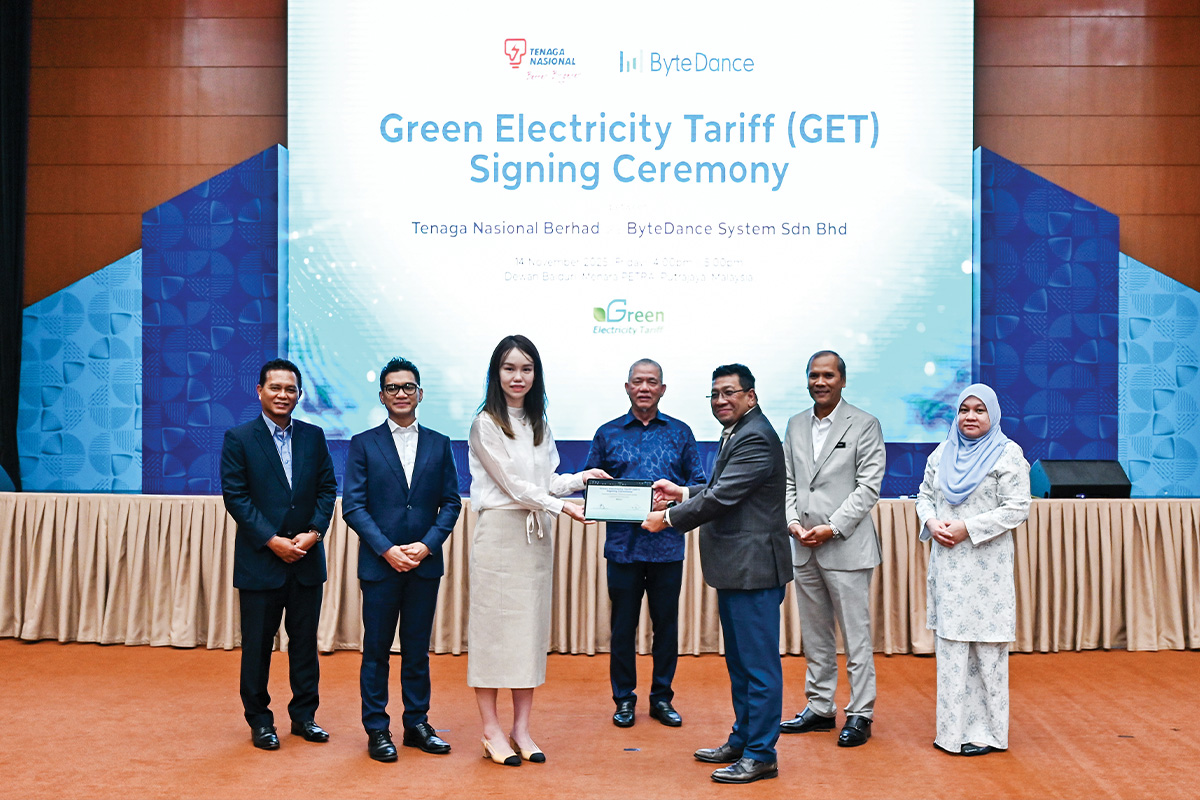
ByteDance, GET Greenpath’s first subscriber
TikTok owner ByteDance has an ESG commitment with the aim of reducing its operational emissions by at least 90% by 2030.
The company is also committed to source 100% renewable energy for its global operations by 2030. Cognisant of the high electricity consumption required to run a typical data centre, ByteDance is determined to utilise available renewable energy sources in Malaysia to reduce its carbon footprint.
With the newly announced GET Greenpath, ByteDance secured its green journey in Malaysia by teaming up with TNB One Stop Centre and TNBX Sdn Bhd for green electrons via the GET Greenpath initiative, amounting to about 20% of the GET quota allocation.
This also means TNB will be able to further support data centre tenants with strong ESG commitments as they are now able to acquire green electricity using the GET Greenpath initiative. ByteDance has committed more than US$8.8 billion for its data centre investments in Malaysia since 2022, with the current data centre capacity already exceeding 400 MW.
“As we advance towards our 2030 carbon neutrality goal, our partnership with TNBX marks a meaningful step forward, enabling end-to-end green electricity solutions that support both operational sustainability and national priorities. By subscribing to TNB’s Green Electricity Tariff, we have accelerated our transition to cleaner energy sources for our data centre operations. We remain deeply committed to reducing our environmental footprint while using our platforms to elevate climate literacy and drive sustainability awareness. More broadly, we see ourselves as a long-term partner in Malaysia’s journey towards a digitally empowered and environmentally resilient future,” says Firdaus Fadzil, Head of Public Policy Malaysia, ByteDance.
“ByteDance is committed to reducing its carbon footprint from its operations, and therefore, is willing to opt for the bundled GET Greenpath to show its commitments. As a responsible energy consumer with data centre operations in its portfolio, ByteDance has set clear goals of ensuring their electricity is coming from RE sources,” says Mohd Razif.
“TNBX aims to be the leading solution provider for RE and EE to the data centre sector, such as green-minded corporations like ByteDance, and help them achieve their sustainability goals.”
GETting easier access to renewable energy
In a bid to get more Malaysians involved in the country’s renewable energy journey, the government introduced the Green Electricity Tariff (GET) programme for individual and business customers of Tenaga Nasional Berhad (TNB) looking to reduce their carbon footprint. Implemented on Jan 1, 2022, the programme enables customers to power their premises with certified green energy from the national grid.
The certification comes in the form of the official, internationally recognised Malaysia Renewable Energy Certificates (mRECs) as proof of a subscriber’s renewable energy usage; using the independent I-REC (E) registry. This is essential for transparent sustainability reporting and offsetting an organisation's Scope 2 greenhouse gas emissions.
Another advantage of GET is TNB customers have the option to purchase a low carbon electricity supply, instead of installing rooftop solar PV systems.

The renewable energy resources for the GET programme are generated by solar power plants under the Large-Scale Solar (LSS) programme and TNB's and/or its subsidiary’s hydropower stations or any other renewable energy plants approved by the Energy Commission (EC).
“The beauty of the GET programme is that it offers an avenue for everyone to be part of the green energy movement as no solar capex investment is required. Presently, all they have to do is pay the premium GET rate to enjoy the GET benefits,” says Ir. Mohd Razif bin Abd Halim, Managing Director of TNBX Sdn Bhd, a wholly-owned subsidiary of TNB.
80% premium rate reduction
According to the Ministry of Energy Transition and Water Transformation (PETRA), as at July 2, 2025, 10,500 GWh of green energy was supplied to 3,551 customers under the GET programme to help them achieve their ESG commitments.
GET subscribers pay a premium rate in addition to the general tariff rate in order to enjoy the limited supply of green energy in Malaysia.
This year, the GET programme was fine-tuned with the introduction of long-term GET subscription plans in increments of one, two and three years. The premium rates were further reduced to 80%, effective July 1, 2025. In addition to receiving the internationally recognised mREC, GET subscribers are exempted from the Automatic Fuel Adjustment mechanism (AFA) and the 1.6% Renewable Energy Fund (KWTBB – Kumpulan Wang Tenaga Boleh Baharu) charge for the green electricity subscribed, giving green consumers a crystal clear certainty in their electricity budget over the subscription period.