


The oil palm industry is facing manifold challenges, ranging from rising fertiliser and fuel costs due to the Iran war to weather and climate change impacts that will negatively affect crop yield. Amid these headwinds, it is essential for Malaysian planters to focus on good agricultural practices to increase yields, says Malaysian Palm Oil Council (MPOC) CEO Belvinder Sron.

The current cost pressures should push the industry to use resources more diligently.
“Fertiliser, field upkeep and replanting are not discretionary if we want to protect future yields. The roundtable reinforced a simple point: Malaysia’s long-term competitiveness starts with agricultural productivity,” says Belvinder, referring to conclusions from the recent roundtable organised by The Edge and the MPOC titled “Beyond the mill: New opportunities for Malaysia’s palm oil industry”.
While the demand for conversion of oil palm biomass into renewable energy, green fuels and carbon credits is growing, these resources should not be diverted without considering their existing role in plantation productivity, she adds. Empty fruit bunches (EFB), for example, are commonly returned to the field as mulch, helping to recycle nutrients, retain soil moisture and maintain soil organic matter. Removing excessive quantities for off-site energy or fuel production could therefore increase fertiliser requirements, raise operating costs and, over time, affect soil health and yields. The priority should be to identify biomass streams that can support new value-added uses without undermining their existing agronomic and operational functions.
Not every oil palm biomass “waste” is available for commercial use. Mesocarp fibre and palm kernel shells (PKS) are already widely used as boiler fuel by mills while EFBs and other residues provide agronomic value when they are returned to plantations. Palm oil mill effluent (POME) is used to generate biogas that is captured for energy.
“Diverting them involves trade-offs between energy generation, nutrient recycling, soil health and commercial value. The right response is to protect yield, improve efficiency, accelerate the replanting of ageing palms and invest in biomass and biogas applications where the economics, energy needs and agronomic benefits justify them,” says Belvinder.
For local planters, the bigger challenge is structural, whereby Malaysia has limited scope to expand its planted areas while regional competitors, which do not have this limitation, have grown their production at a faster rate.
This further strengthens her point that improving the fundamentals is crucial at this time.
“Future growth therefore has to come from producing more value from the land and assets we already have, through replanting, better planting material, mechanisation, digitalisation and stronger estate management,” says Belvinder.
Malaysian planters must stay competitive and relevant
Another issue that she highlights is market access, whereby sustainability, traceability and food safety are becoming commercial requirements and not just reputation matters for the sector.
In this regard, it is crucial for industry players to have Malaysian Sustainable Palm Oil (MSPO) certification and national traceability systems in place while ensuring the inclusion of smallholders.
“The industry also needs to pay attention to the evolution of food safety regulations. Türkiye is a good example. We are seeing greater regulatory attention being placed there on process contaminants such as 3-MCPD esters and glycidyl esters (GE) in refined edible oils,” Belvinder says.
Increasing attention is also being given to mineral oil saturated hydrocarbons (MOSH) and mineral oil aromatic hydrocarbons (MOAH), which are mineral oil hydrocarbons that can enter food through various stages of production, processing, transportation and packaging.
“The direction of travel is clear: global food-safety standards are becoming more stringent and more sophisticated. Whether it is 3-MCPD, GE, MOSH or MOAH, Malaysia must be ahead of the regulatory curve rather than responding after standards have changed,” says Belvinder.
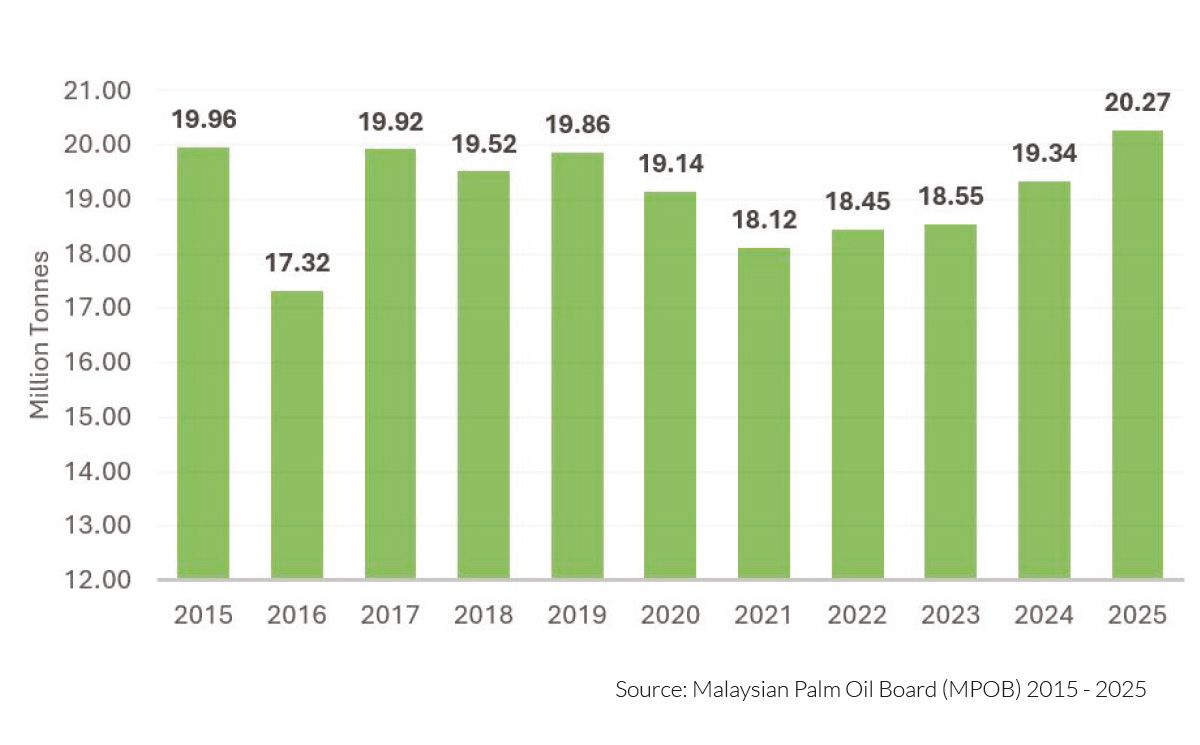
On the other hand, climate variability is an ongoing risk that the industry is already facing and must adequately prepare for. With a severe El Niño expected in the coming year, oil palm yields could be badly impacted. Belvinder points to the previous strong El Niño, which hit in 2015, resulting in a 13% fall in Malaysia’s palm oil production in the following year.
The solution, again, comes back to good agricultural practices.
“The risk cannot be eliminated but resilience can be improved. Good agricultural practices, soil and water conservation, drainage and flood mitigation, as well as [the use of] better planting materials, all matter. Companies are already using climate, weather and estate data to manage drought and flood risks,” she says.
“Smallholders, who generally have less capacity to absorb extreme weather shocks, will require continued practical and technical support to strengthen their resilience,” Belvinder adds.
Tapping into new opportunities and including smallholders
Of course, Belvinder does not discount the opportunities to create new use cases for biomass “waste” from the industry. Palm oil is already part of a bioeconomy spanning renewable energy, biogas, biofuels, biofertilisers, biomaterials, biochemicals, oleochemicals and speciality products.
What is needed is clarity on the availability of the resource and a clear strategy.
“Before new uses are scaled, we need a clearer national picture of how much biomass is genuinely surplus after existing uses in mills and fields, where it is located and what it costs to aggregate,” says Belvinder.
“Beyond that, opportunities include more efficient boilers, renewable electricity, biochar, biomaterials, biochemicals, engineered products and advanced fuels. The right pathway will vary by mill and region. We need to know what is truly available, then address aggregation, logistics, grid access and bankability.”
Additionally, smallholders, who cultivate around 26.8% of Malaysia’s oil palm planted areas, must be designed into the business model from the beginning and included in the transition. In this regard, aggregation is critical, she says.
“Existing structures such as Sustainable Palm Oil Clusters can be extended beyond certification to include traceability, biomass collection, shared processing, financing and technical services. Mills, dealers, cooperatives and collection centres can help create sufficient scale.”
For marginal land or ageing smallholders, other income models could work. For instance, appropriately structured renewable energy projects could be designed for them.
“The future is not about chasing every new technology. It is about choosing solutions that are practical, bankable and capable of creating durable value for industry, communities and the country,” says Belvinder.