


Artificial intelligence (AI) is no longer knocking at the door of business. It is already inside, rewriting the script. Climate volatility and geopolitical uncertainty are raising the stakes. In this high-pressure, fast-paced environment, the question for companies is not whether to adapt to AI but how quickly — and doing this thoughtfully.
PwC, one of the world’s leading professional services firms, is responding with an exciting reinvention strategy and a bold, new brand identity, launched together with a compelling viewpoint: its “Value in Motion” thought leadership.
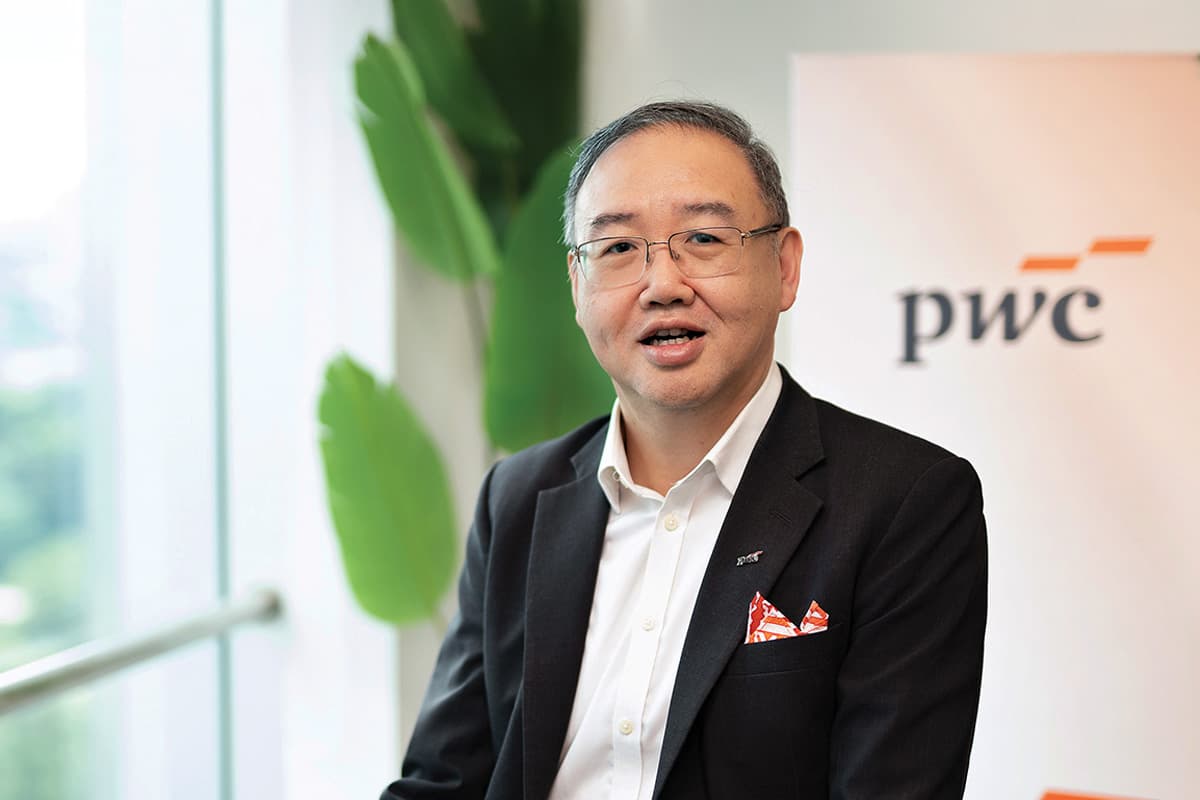
“Being reinvention-ready is no longer an option; it’s a prerequisite for long-term success,” says PwC Malaysia managing partner Soo Hoo Khoon Yean in an interview with The Edge. “We’re reaffirming our commitment to helping clients create and protect value while adapting to fast-moving global megatrends.”
“Value in Motion” signals a mindset shift. It is an invitation for businesses to rethink what they do, how they do it and why they exist in response to the way value is moving, with the formation of new ecosystems, focused on human needs. For PwC, that has meant retooling its own operations first; revamping service delivery, investing in talent and AI, and reimagining the client experience from the inside out.
A NEW BRAND FOR A NEW AGE
For PwC, the rebrand is not merely cosmetic. It reflects a deeper recognition that client needs have evolved. With US$7.1 trillion (RM30 trillion) in revenue expected to shift between companies globally in 2025 alone, according to PwC’s Value in Motion research, the urgency to stay ahead has never been greater.
“We want to help clients realise opportunities from the confluence of megatrends,” says Soo Hoo. “Whether it’s smart energy systems or digital supply chains, the possibilities for synergy are vast.”
PwC is expanding managed services capabilities in areas such as accounting, cybersecurity and sustainability. It is also investing heavily in its people, from AI literacy to learning how to drive innovation through identification of new services as a digital accelerator. All of this is designed to support what PwC calls a “client zero” approach — testing solutions internally, exploring use cases and innovating before offering them to clients.
“We are walking the talk to show businesses that we are also adopting AI,” says Soo Hoo. “It’s important for our clients to know that we are applying the same tools and principles within our own organisation before bringing them to market.”
To support digital transformation across the region, PwC’s Asia Pacific Marketplace, a digital ecosystem, offers clients an array of digital solutions built by PwC and its alliance partners for business issues such as cybersecurity; data and analytics; ESG (environmental, social and governance); organisational effectiveness; risk management and tax.
These solutions enable clients to accelerate innovation and address their most critical challenges.
In Malaysia, PwC has also launched its cloud-based Human Resource Management System (HRMS), known as Work Smartly, to support clients in automating and streamlining HR processes. The platform delivers solutions throughout the employment lifecycle including recruitment, employee profiles, payroll, attendance, leave, benefits, claims and performance management, helping organisations enhance efficiency and improve workforce engagement.
RISK, REWARD AND REDEFINITION OF WORK THROUGH AI
Central to PwC’s reinvention is the role of AI. The firm’s recently released 2025 Global AI Jobs Barometer reveals that industries most exposed to AI globally are seeing revenue per employee grow three times faster than others.
Far from replacing humans, AI is making them more valuable. The barometer, which analysed nearly a billion job ads and numerous financial reports from 24 territories including Malaysia, highlights AI’s significant impact on jobs, wages, skills and productivity. Workers with AI skills commanded a 56% wage premium globally in 2024. Even in highly automatable roles like customer service, AI augments rather than replaces jobs, allowing employees to focus on higher-value tasks.
In Malaysia, the information and communications sector is leading in AI job postings, increasing from 4.4% in 2021 to more than 5.4% in 2024. This aligns with global trends where the barometer revealed especially strong demand in machine learning engineering, cybersecurity, cloud operations and infrastructure architecture.
“AI should make your job better, not replace it,” says Soo Hoo. “The future of work is about doing more, better, together.”
Yet, Malaysian businesses are still finding their footing. According to PwC’s AI Leadership Maturity Assessment, over 80% of local business leaders are still in the “aware” or “experimenting” stages (as at May 13, 2025). Gaps persist in governance, strategic focus and organisational alignment.
PwC recommends that clients integrate AI as a growth strategy, not just a tool for efficiency. That includes embedding responsible AI principles from the design stage, fostering cross-functional collaboration and encouraging experimentation.
TRUST IS THE TRUE CURRENCY
As businesses become more reliant on AI and data, trust is emerging as the foundational layer that supports effective and responsible deployment. It is not a by-product of innovation, but a prerequisite for its success.
“If users don’t trust AI, it will not be adopted at scale,” Soo Hoo notes. “Trust isn’t just a technical requirement; it’s the gateway to economic impact.”
PwC is taking steps to ensure AI systems are governed with integrity and transparency. Ethics checks, bias audits and dynamic protocols are part of its roadmap. Data governance and quality, meanwhile, are being reinforced as a priority. The firm has aligned its efforts with international references such as the Data Management Association (DAMA), which launched its Kuala Lumpur and Selangor chapter at PwC’s flagship AI Leadership Conference recently.
“We treat our own people and use cases the same way we would treat a client engagement,” says Soo Hoo. “That’s the only way to lead with credibility.”
UPSKILLING FOR TOMORROW
With the half-life of skills shrinking rapidly, PwC is embracing a flexible, continuous learning culture. E-learning, certifications and digital academy initiatives are part of its strategy to keep talent future-fit.
“Don’t upskill for the firm alone,” Soo Hoo advises his team. “Do it for your own livelihood.”
This mindset reflects the firm’s belief that employees should not merely adapt to AI, but actively shape its trajectory. The rollout of initiatives like ChatPwC, PwC’s in-house Gen AI tool, is supported by structured training and voluntary learning paths.
At the same time, Soo Hoo stresses that the traditional academic degree still plays a foundational role in shaping talent.
“A university degree continues to be an important base, particularly in building analytical and critical thinking skills,” he says. “But it’s not sufficient on its own. The industry now requires more: agility, real-world problem-solving and an openness to continuous learning.”
The firm’s own global AI Academy has already trained more than 290,000 partners and staff worldwide.
FROM SECTOR THINKING TO SOCIETAL VALUE
Soo Hoo believes that as industries converge, companies must reframe their value propositions beyond traditional boundaries. PwC’s Value in Motion study identifies nine emerging “domains of growth” centred on basic human needs instead of existing industry boundaries — for example, how we make, move, feed, care, govern and serve.
“This is about building ecosystems of value,” says Soo Hoo. “No single company can scale solutions alone.”
Take utilities, for instance. Rather than clinging to coal-fired business models, forward-thinking players are pivoting to enable distributed energy generation, managing assets like solar panels and storage systems for commercial customers.
THE RISK OF WAITING
For companies still hesitant to adopt AI, Soo Hoo offers a word of caution: “You run the risk of becoming irrelevant. The world moves so fast that if you wait too long, you might miss the window.”
He encourages businesses to pursue “quick wins” to build confidence, such as integrating AI into customer experience or internal operations. But the long game is equally important.
Embedding AI into core business operations starts at the top. Leadership must set the tone, not only by championing adoption but also by equipping their organisations to sustain change.
“Leadership isn’t just about what happens during your tenure,” he says. “It’s about setting up what happens after.”