

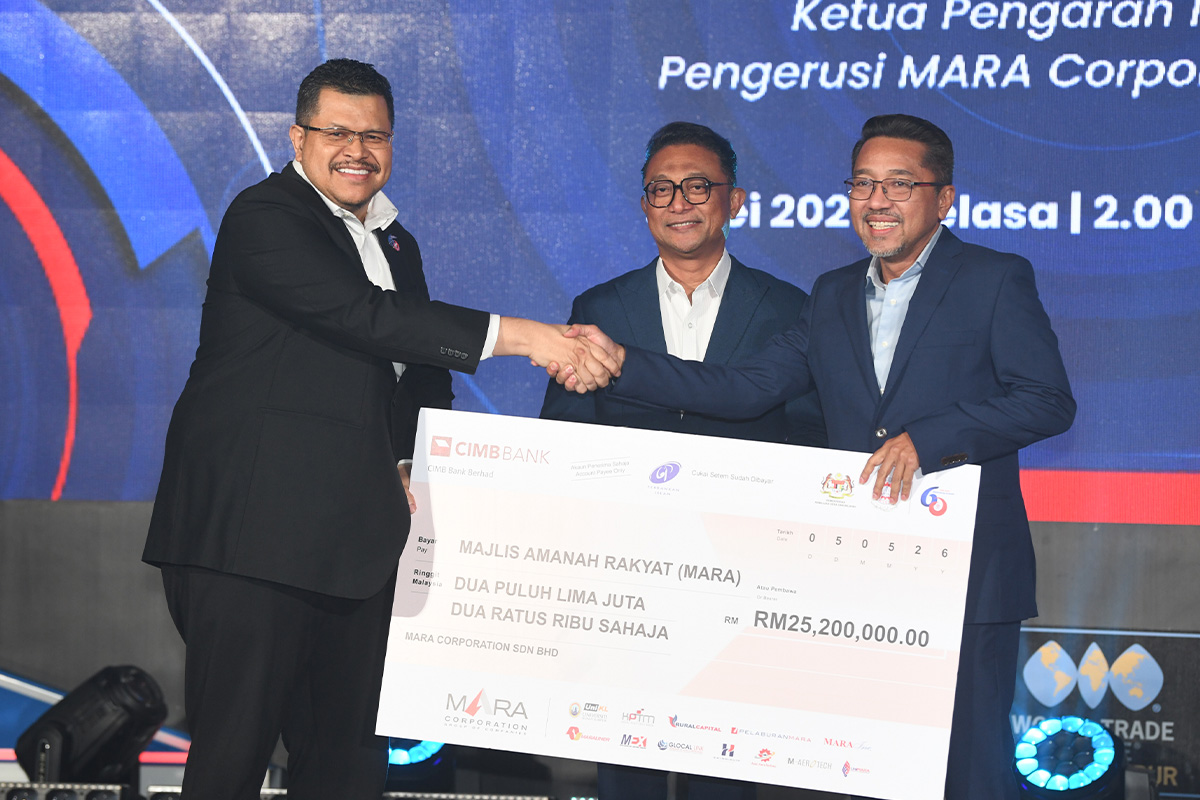

KUALA LUMPUR (May 5): Majlis Amanah Rakyat (MARA) has earmarked RM2.2 billion for targeted, high-impact investments until 2030 as it steps up efforts to strengthen its asset base, diversify income streams and drive long-term value creation.
The allocation forms part of a broader shift towards more disciplined capital deployment as the agency, marking its 60th anniversary, positions itself as a more structured investment institution while maintaining its socioeconomic mandate.
“This milestone reflects MARA’s strategic transition to a disciplined capital allocator, combining financial performance with measurable social outcomes, while positioning its ecosystem for long-term national value creation,” MARA Director General and MARA Corporation Chairman Datuk Zulfikri Osman said during a press conference on Tuesday.
The investments will span carbon credit initiatives, property developments and other high-value sectors aligned with national priorities.
Zulfikri said the initiatives are structured over varying timelines but broadly aligned with a 2030 horizon, with several projects already underway.
Among the key projects are three property developments — in Signal Hill, Kota Kinabalu; Ampangan, Negeri Sembilan; and Jalan Maktab, Kuala Lumpur — with a combined gross development value of about RM1 billion.
“For the three developments, we expect to complete them by 2030,” said Zulfikri, noting that the projects form a core part of MARA’s asset-building strategy.
In addition to property, MARA is advancing its presence in the carbon markets, including plans to develop the world’s first shariah-compliant carbon credit framework.
The initiative, which includes establishing a shariah-compliant carbon credit fund, targets a carbon area exceeding 200,000ha and projected revenue of up to RM450 million by 2030.
“Developed in collaboration with ISRA International Consulting, this framework opens new avenues for institutional participation in the global carbon market within a shariah-compliant structure,” said Zulfikri.
MARA also introduced the PMB Shariah Fixed Price Total Return Wholesale Fund, a shariah-compliant investment product designed to provide institutional investors with access to structured and stable investment instruments.
IPO plans to unlock value
Beyond new investments, MARA is looking to unlock value from its existing assets through capital market initiatives.
Zulfikri said Kolej Poly-Tech MARA (KPTM) and Universiti Kuala Lumpur (UniKL) are being prepared for initial public offerings within the next three years. “We have already started to engage with a corporate advisory company … both are profitable companies and we expect to bring them to IPO within three years,” he added.
He said the move is part of a broader effort to realise the underlying value of MARA’s education portfolio while strengthening financial sustainability.
MARA is also planning listings for selected healthcare-related assets in its ecosystem, including U.n.i.Klinik, U.n.i.Farmasi and U.n.i.Dental.

Financial turnaround gains traction
The investment push comes amid improving financial performance, following a restructuring of MARA’s corporate financial sector.
In 2025, MARA recorded a 10% year-on-year increase in revenue to RM1.69 billion from RM1.53 billion, despite a challenging macroeconomic environment.
At the same time, MARA Corp Group has significantly reduced its accumulated losses, with projections indicating a return to an accumulated profit position by 2027.
“The organisation achieved a significant reduction in accumulated losses, reflecting improved financial governance and effective rationalisation measures,” said Zulfikri.
Operational efficiency has also improved through a more value-driven investment approach, aimed at ensuring sustainable returns across its portfolio.
Socioeconomic impact and governance focus
MARA said its investment activities continue to generate measurable socioeconomic outcomes, with its key developmental entities delivering RM1.67 billion in socioeconomic value between 2021 and 2025.
This includes contributions from MARA’s technical and vocational training arm GIATMARA, which expanded its trainee base to over 36,000 students, and Yayasan Pelajaran MARA, as both entities broadened access to education and skills development while generating positive social returns on investment.
The agency is also scaling up its Wakaf MARA MADANI initiative, with a target to build a RM1 billion wakaf ecosystem to support long-term, sustainable impact.
In parallel, MARA is strengthening its governance framework through digital transformation, including the rollout of an enterprise resource planning (ERP) system targeted for completion by December 2026. The system is expected to enhance financial reporting transparency, improve accountability and support more timely and informed decision-making across the organisation.
Zulfikri said MARA’s strategy remains focused on balancing financial performance with its broader role in advancing bumiputera economic development.
Supported by RM40 million in dividend contributions, the organisation continues to demonstrate its ability to integrate commercial discipline with socioeconomic objectives.
“As the organisation marks six decades of service, it remains firmly committed to sustaining financial growth through disciplined capital allocation, expanding high-value and future-ready investments, and delivering tangible economic outcomes for the bumiputera community,” he said.