

Since 1877, rubber has been one of Malaysia’s vital commodities in its economic and industrial growth, from the plantations of the colonial era to today’s modern rubber industry, placing the country among the world’s leading rubber product manufacturers. Today, however, environmental, social and governance (ESG) considerations are transforming the global rubber trade — a transformation Malaysia is not only preparing for but also anticipating.
Global buyers, particularly in the European Union, are no longer satisfied with quality and price alone. They want proof, such as geolocation data, deforestation-free sourcing and fair labour practices — evidence that the rubber used was produced responsibly.
“Our buyers, our consumers, they are now not only looking for quality but also want their rubber products to be sourced from a background that is reliable and sustainable,” says Dato’ Dr Zairossani Mohd Nor, Director-General of the Malaysian Rubber Board (LGM).
These demands have been put on paper in the European Union Deforestation Regulation (EUDR). But they are not fully in force yet. While it was originally meant to be implemented by 2024, it has been delayed to December this year.
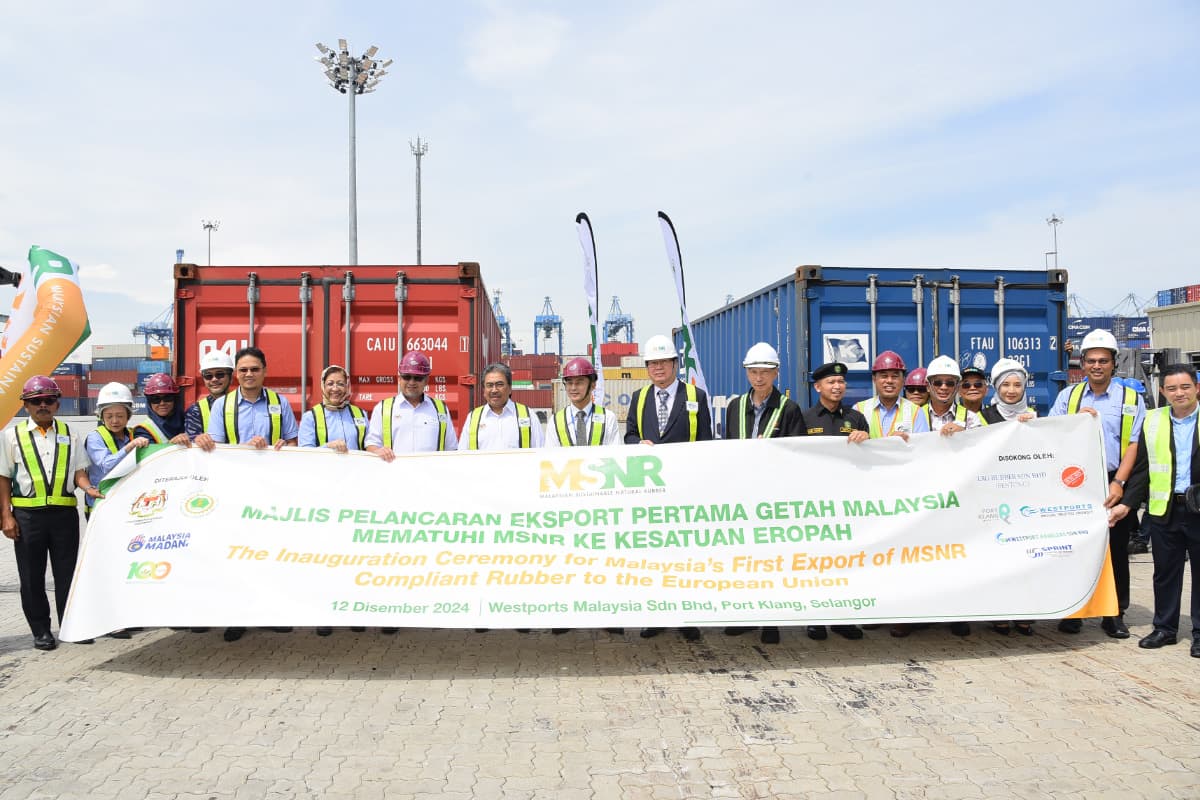
LGM, however, is not going to just wait for these ESG demands to come to Malaysia’s doorstep. Its answer to this shift to ESG is the Malaysian Sustainable Natural Rubber (MSNR) framework, a regulatory system built by LGM and enforced since 2025.
Zairossani describes the MSNR as central to keeping one of the country’s oldest industries relevant. Unlike many voluntary ESG certification schemes elsewhere, he says, the MSNR was deliberately embedded in law.
“Compared with other countries, sustainability in Malaysia is still an option on a voluntary basis. We believe the best path for sustainability is through regulation.That does not mean choice has disappeared entirely; we also encourage the industry and all our stakeholders to engage with our voluntary system to supplement our regulatory aspect,” he adds.
He says the decision was shaped by the scale of the sector as a whole. With more than 300,000 active smallholders, a certification-based model would have been difficult and time-consuming to implement.

Five pillars of the MSNR
Under the MSNR, compliance rests on five requirements — no deforestation for new rubber cultivation; rubber cultivation regulated by land legislation; environmental compliance; social compliance; and traceability.
How each pillar affects businesses in the sector will be different across the supply chain. Zairossani points out, for example, that “the upstream sector will be impacted mostly in terms of the environmental compliance, while downstream businesses will face issues or challenges in social compliance because of their use of foreign labour”.
As a point of reference, he notes that more than 80% of the factory workforce of Malaysia’s glove-making sector comprises foreign labour.
Tying the five requirements together is a digital backbone. Compliance deals and claims are just words without transparency and traceability, which is why LGM has invested in a trace system for the MSNR.
“The MSNR Trace system will record the source of rubber, its geolocation and the transactions occurring along the way upstream,” he says.
The platform is designed to track rubber’s physical journey from the smallholder who taps it, through dealers and processors, to the manufacturer that turns it into a finished product.
Rather than outsourcing the technology, LGM built it internally, which helped keep the costs of sustainability minimal.
“Coming up with a comprehensive traceability system alone can cost up to RM10 million. So, we developed ours from scratch. The board now runs at least seven or eight systems developed internally, from geolocation and transaction to full traceability,” says Zairossani.
That infrastructure is being designed and tested against a wall of emerging rules abroad, such as the EUDR. He says this helps Malaysia’s rubber industry not only to comply with the changing demands but to be future-ready for possible shifts. Europe’s pragmatic approach to transparency has also been a great boon.
“When we talk to [players in places such as Brussels] about the EUDR, they say that they don’t care whether this is on a certificate or regulation basis. What they need is being able to verify our traceability because, to them, the most important thing is traceability and no deforestation,” says Zairossani.
This shift to sustainability is still wholly relevant in today’s market. While sentiment over the past few years has raised concerns and shifts in view of ESG, Zairossani and LGM believe sustainability will always be important and the next main factor that will sustain the rubber industry, giving Malaysia a long-term competitive advantage.

Dato’ Dr Zairossani Mohd Nor,
Director General of the Malaysian Rubber Board (LGM)
Smallholders at the centre
When it came to designing the MSNR, smallholders were always put first, as they are the industry’s foundation. Rubber plantations, which account for the bulk of the country’s output, cover about a million hectares and have existed for more than a century.
This is also why deforestation risk is limited in Malaysia, for example, as the industry already has substantial land. So, to keep with the no deforestation requirements, land title and geolocations are to be captured through a mandatory permit system, where smallholders are required to have a permit under the LGM regulation.
Since its implementation in January 2025, on-the-ground response from rubber players has been largely positive, according to Zairossani.
“The smallholders at this point are very receptive because they know they can comply with the requirements and are aware of the benefits of the MSNR,” he says, adding that efforts by LGM to educate smallholders on compliance with the MSNR will continue.
“We are now committing to having at least 12 MSNR roadshows involving smallholders and implementing agencies. Our approach is to explain that sustainability optimises production and can help increase income, because when we produce sustainable natural rubber, our rubber will be considered premium. So, there will be a premium price for our rubber.”
Reclaiming Malaysia’s rubber crown
Malaysia’s push for sustainability comes as its raw output has slipped in global rankings. Once the world’s largest rubber producer, it has since been overtaken by Thailand, with Indonesia in second place. Today, Malaysia ranks ninth.
Zairossani attributes this shift mainly to land availability rather than declining ambitions at home, which means Malaysia needs to find new avenues to compete.
For him, this means shifting strategies from competing purely on tonnage to a value proposition approach. This involves chasing premiums through downstream markets where sustainability credentials, rather than scale, decide who wins contracts against manufacturing rivals such as Germany and Japan.
“With the current five pillars of the MSNR, we anticipate that we’ll be able to comply with the regulations on sustainability worldwide for at least the next five years,” he says.
“This is our current strategy: to make sure that Malaysia can be championed as the global hub for green and sustainable products … [Especially] with the current geopolitical crisis, we want the world to recognise Malaysia as a safe supplier of sustainable rubber.”