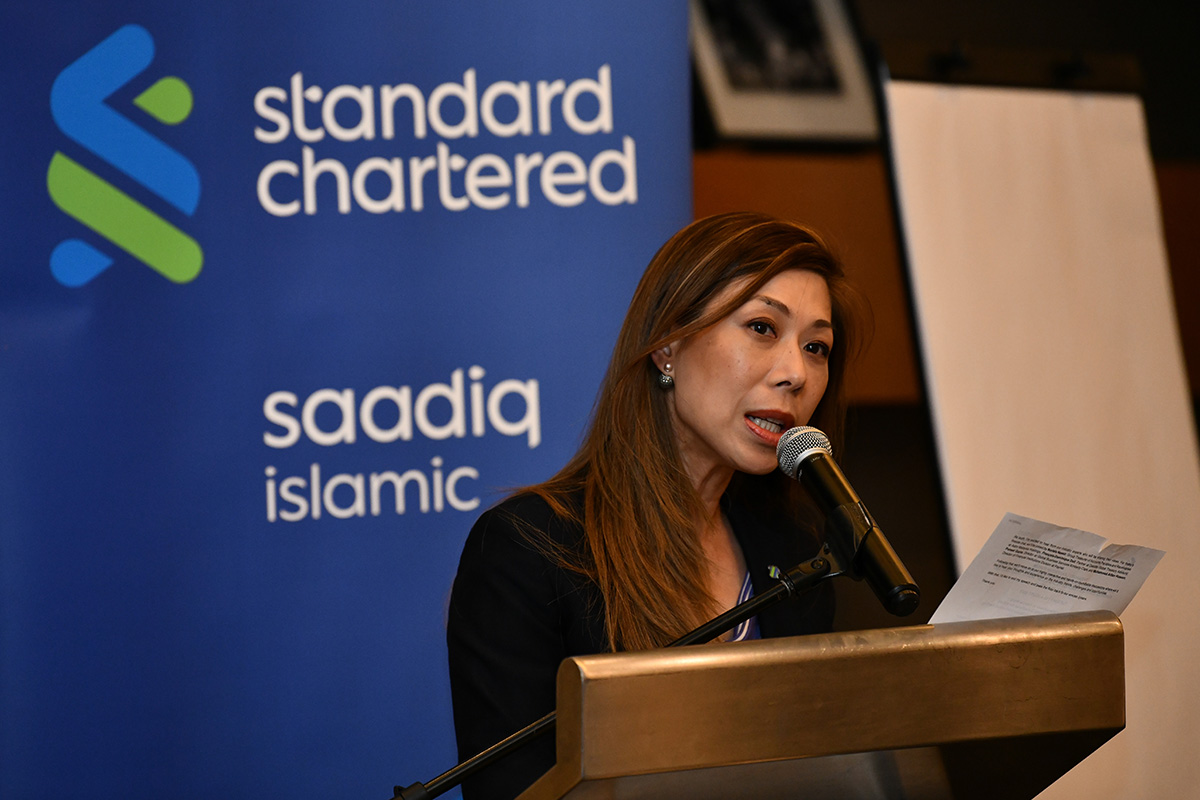
As shared services centres (SSC) and global business services (GBS) are becoming common operating models, these have shown remarkable results and benefits in terms of quality, services and efficiency. Along with this realisation, there is mounting pressure to provide better personalised customer service as well as manage more transactions, shared Patricia Wong, regional head of global subsidiaries for Asean and country head of corporate, commercial and institutional banking at Standard Chartered Malaysia.
These were among the topics discussed at Standard Chartered's Treasury Leadership Forum on achieving future-proof SSCs and GBS through technology, digital solutions and data analytics.
Cost pressure, market volatility and technological disruptions are necessitating the need for companies to undergo a digital transformation to stay competitive and resilient. Furthermore, Malaysia is ideally situated and GBS is a noted contributor of foreign direct investments due to the country being a cost-effective location with mature technology, geopolitical stability and attractive tax incentives.
"The answer to many of these challenges lies in digitalisation. Intelligent automation and insight-driven technologies such as robotic process automation and analytics not only support but also enable new ways of doing work," said Wong. "This is by creating a human and robotic workforce that leverages on unique individual strengths while augmenting and enabling each other."
For instance, the solutions provided by Standard Chartered's Straight2Bank Pay deliver seamless digital commerce across all sales channels. These include online stores, mobile apps, invoice payments and remote collections. Moreover, advanced analytics insights by Straight2Bank help treasurers unlock value from data and make better business decisions.
Scale-up business efficiency
The fireside chat during the leadership forum further provided insights from subject matter experts, moderated by Standard Chartered executive director of structured solutions development for cash Jessica Fon.
Topics covered during the fireside chat included key treasury challenges faced by organisations. Among these are visibility of global operations, digital capabilities, inadequate treasury systems infrastructure, liquidity and foreign exchange (FX) volatility. As such, key priorities over the next 12 months would be enhanced liquidity management, improved cash forecasting capabilities and optimised capital structure.
Hurdles to improving cash forecasting were also raised. These were poor quality of data, lack of effective tools, lack of incentives for business units to report on forecasts and lack of skill sets.
With a presence across all 10 Asean markets, Standard Chartered is able to meet liquidity management requirements and objectives. Moreover, the bank offers a complete suite of liquidity management products such as Straight2Bank Liquidity, which has been rolled out in 36 countries since 2012. For example, a company operating in the domains of primary Asean markets faced challenges in managing liquidity to gain control and visibility, optimising and standardising payments while navigating local regulations. To address these issues, Straight2Bank Liquidity was utilised and cross-border US dollar-denominated true end-of-day sweeps, which were timed for end of the day, allowed the client to achieve uninterrupted working capital.
To improve cash forecasting, different sectors tend to face a varied set of problems. Forecasting comes with establishing a proper set of processes, technology and integration and collaboration of the different business units. Despite the growth of electronic payments, cash is still king in Malaysia. The country, however, is close to an inflection point wherein cash is tapered off.
As such, in the endeavour to digitalise, companies should keep note of the steps to do so. Standardisation needs to begin before optimisation so as to deliver the benefits an organisation would expect. Even before standardisation, elimination needs to take place. To do so, organisations need to review their internal processes.
Thus, elimination, standardisation and finally automation are the way to go. Throughout the journey, the digitalisation efforts being made need to fit the culture and technological policies of the organisation as well.
Challenges in a transformation journey are to be expected. One of these would be to build a business case and get everyone on board. To overcome managing the internal parts and advocating change, management is key. When working with a bank, the overall project needs to be defined followed by an implementation plan.
Entering the digital realm
An application programming interface (API) is an enabler that allows businesses to transform digitally by unlocking the value of open ecosystems, fostering greater collaboration and innovative business models. This is done by converting manual processes and operations towards digital means, enabling real-time transactions and integrating transactions across multiple systems.
This was further cemented by an example of a practical use case wherein a multinational company wanted to automate the hands-off and payment of rewards to be in real time. To do so, Standard Chartered implemented an API-based solution to receive incentive claims directly from the client's account with the cash reward to be remitted into the claimant's account. This was done via the immediate payment service with real-time status updates. API banking offers real-time settlement and status updates of transactions on the client's enterprise resource planning system.
Another point of discussion involved invoice payments. Nearly 65% of business-to-business (B2B) across industry sectors now offer e-commerce capabilities. It was also noted that an average cost of processing a single invoice ranges from US$12 to US$40 (RM56 to RM186).
Straight2Bank Pay allows merchants to share invoices through manual file uploads or host to host. Thereafter, the payor is able to access Straight2Bank Pay to fetch invoices and select the invoices to be paid.
While every organisation will have different requirements for digitalisation and will be at different stages of their journey, it is important to have the right partner and tools throughout and to be future ready. This wil be critical for operational efficiency, working capital managament and risk control across the business," says Samuel Ding, Head of Transaction Banking at Standard Chartered Malaysia.
To find out how Standard Chartered can prepare your business for future opportunities, click HERE