

As the global push for decarbonisation gains momentum, Petroliam Nasional Bhd (PETRONAS) is reshaping its downstream portfolio in support of its goal of achieving net zero carbon emissions by 2050. The national oil company is driving several catalyst projects in carbon capture and storage (CCS), hydrogen and biofuels, with the latter viewed as a crucial transitional fuel for hard-to-abate sectors like aviation and transport.
Among the options, biofuels such as sustainable aviation fuel (SAF) — derived from renewable feedstocks like used cooking oil, agricultural residue and municipal waste — offer a cleaner alternative to conventional jet fuel. This aligns with the International Civil Aviation Organisation’s (ICAO) Carbon Offsetting and Reduction Scheme for International Aviation (CORSIA), which is aimed at reducing the aviation sector’s carbon footprint and supporting carbon-neutral growth. Starting 2027, all ICAO member states’ airlines will be subjected to offsetting requirements for international flights.
To meet the anticipated surge in demand from the global aviation and logistics industries, PETRONAS announced in July last year that it had reached a final investment decision (FID) with Italy-based Enilive SpA and Japan-based Euglena Co Ltd to jointly develop a US$1.3 billion (RM5.6 billion) bio-refinery in Pengerang, Johor. Located in the Pengerang Integrated Complex (PIC), the facility will produce SAF and other biofuels, including renewable diesel, also known as hydrotreated vegetable oil (HVO). Construction is slated to begin in the fourth quarter of this year, with operations targeted to commence by the second half of 2028.

— Ahmad Adly Alias,
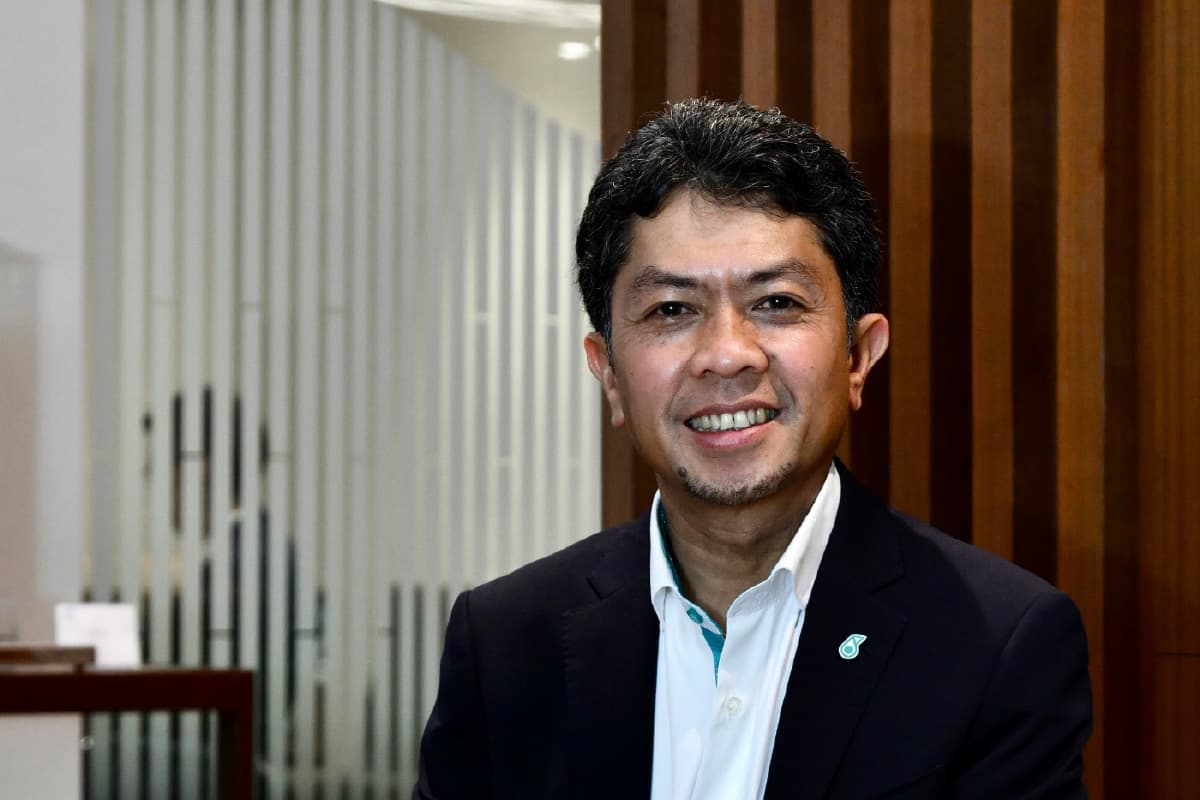
Vice-President for Refining, Marketing and Trading, PETRONAS
According to Ahmad Adly Alias, Vice-President for Refining, Marketing and Trading at PETRONAS, the Pengerang facility will process up to 650,000 tonnes of feedstock annually, primarily comprising waste-based materials such as used cooking oil, palm fatty acid distillates (a by-product of crude palm oil refining), palm oil mill effluent and tallow (animal fat). The facility is expected to produce about 12,500 barrels of bio-based products per day.
“What’s interesting about this biofuels project is that we tend to get good financing because banks and lenders are now focused on sustainable investments,” he tells The Edge in an interview.
“We intend for it to be project-financed, and we have agreed on an equity structure, partly funded through creditors. Project financing is now more attractive as banks look for sustainable investments, which is why this biofuels project secures good funding.”
Addressing hurdles
One of the main global challenges for SAF lies in its cost, which is currently two to three times higher than conventional jet fuel, says Ahmad Adly. To overcome this, he stresses the need for continuous technological advancement to bring production costs down.
“Take the solar panels. A few years ago, they were expensive, but advancement in technology has helped to reduce costs significantly. Now, installing solar panels on rooftops is financially viable — something unthinkable five years ago,” he says.
“That’s why ongoing innovation is key to making SAF more affordable. The question is: How do we keep driving those costs even lower?”
Equally important is policy support, which can come in the form of incentives such as tax waivers and capital investment, or disincentives like carbon pricing, tariffs and penalties. Mandates also play a vital role, but they come with trade-offs.
“Oftentimes, the associated costs are typically managed by businesses, either through absorption or distribution to consumers. Robust and supportive policies play a crucial role in ensuring sustainability as well as accelerating the growth of the biofuels industry,” says Ahmad Adly.
Malaysia, under its 2023 National Energy Transition Roadmap, is targeting a 47% SAF blend by 2050. With the right policy support and realistic targets, this goal can drive sustainable growth for both consumers and industry participants.
“We’re helping to determine what’s realistic for Malaysia. If we move too fast, we risk breaking the industry — the supply chain, feedstock availability, refining capacity and logistics may not yet be ready. But if we move too slowly, we risk missing our 2050 net zero target,” he says.
Positioning in the global market
PETRONAS is taking a long-term view as it expands its biofuel ambitions, with plans to scale up operations in line with growing demand. While the upcoming Pengerang facility will be the group’s first bio-refinery, the company is already exploring opportunities for future projects.
To secure steady feedstock supply, the national oil company is working with authorities and palm oil mills operators including Malaysian Palm Oil Board (MPOB), FGV Holdings Berhad and SD Guthrie Berhad to explore more business opportunities to ensure reliable, steady and efficient operations in the future, says Ahmad Adly.
At the same time, PETRONAS is investing in research to develop next-generation feedstocks. Although waste sources are currently sufficient, they may become limited as demand rises. To address this, the group is exploring other feedstock opportunities. For example, leveraging Euglena’s capabilities in cultivating rich-lipids algae that can be extracted and converted into biofuel. It is also studying non-food oil crops such as pongamia and jatropha, which can grow on marginal land and help strengthen long-term supply security.
“Globally, the concern is that biofuels could compete with food, like in the US where corn is used or Brazil where sugarcane is crushed for bioethanol. But at PETRONAS, we’re very clear. We prioritise the use of waste-based feedstock,” he emphasises.
Another key part of the ecosystem is the sales process — securing committed buyers for the biofuels. “We’ve already locked in several offtake agreements as part of our FID and we’re actively working to grow the market,” he notes.
PETRONAS began supplying SAF as part of its early entry into the biofuel market. Its first test involved a Malaysia Airlines cargo flight from Amsterdam to Kuala Lumpur, followed by a commercial flight from Kuala Lumpur to Singapore, using SAF supplied by PETRONAS Trading Corporation Sdn Bhd (PETCO) and PETRONAS Dagangan Berhad.
According to Ahmad Adly, the group has supplied SAF and signed offtake agreements with other multinationals, some of which are major international players.
“This is part of our broader push into sustainable fuels. In 2023, in collaboration with Vitol, we supplied B24 bio-marine fuel containing 24% Used Cooking Oil Methyl Ester (UCOME). Additionally, we are also active in marine fuels. We currently operate liquefied natural gas (LNG) bunkering vessels, offering a lower-carbon alternative to traditional fuel.”
PETRONAS is working on sustainable solutions in motorsport. Through its partnership with the Mercedes-AMG PETRONAS Formula One team, the company is developing advanced sustainable fuel (ASF).
For PETRONAS, biofuels are more than just a climate checkbox — they are a strategic bet on the future of energy. With the right mix of policy support, innovation and partnerships, the company is laying the groundwork to scale up sustainably. The road to 2050 will not be easy, but if biofuels can deliver on cost, supply and demand, the group intends to be right at the centre of that shift.