

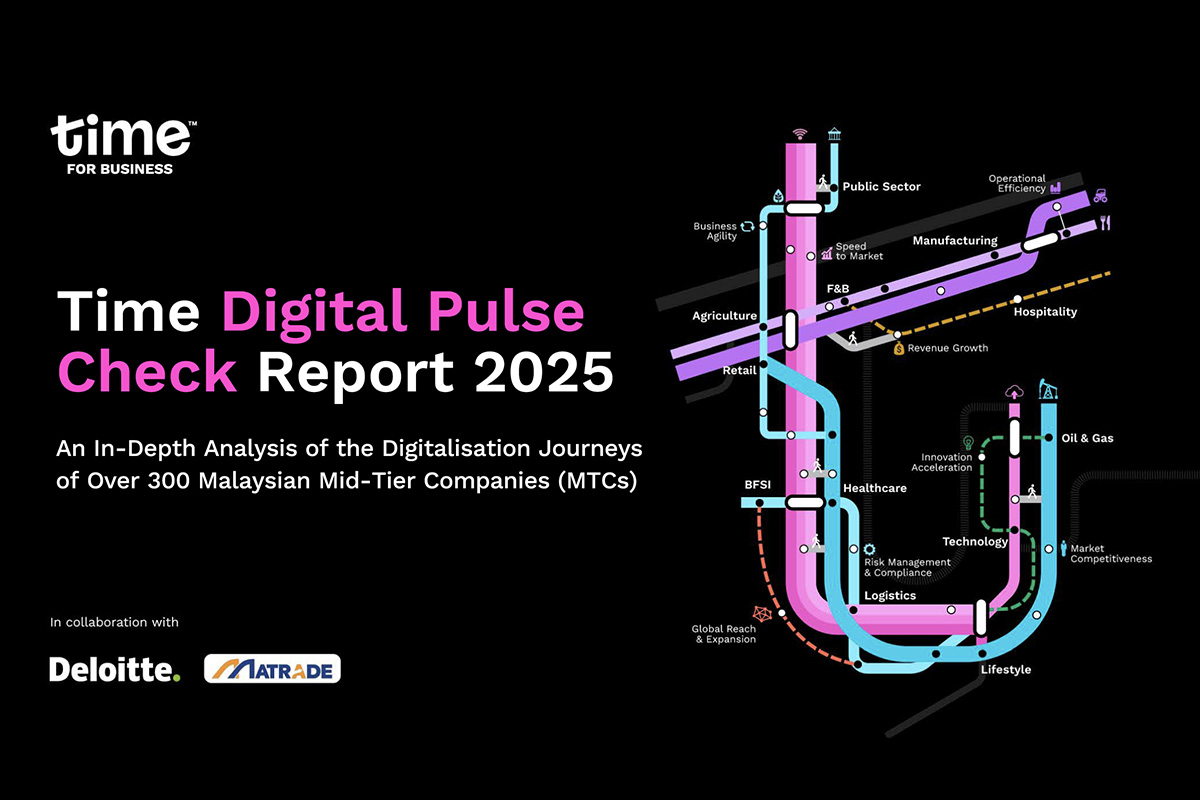

Malaysia’s digital economy is scaling at remarkable speed. Mid-tier companies (MTCs), which contribute nearly 40 per cent of GDP, are modernising customer experiences, moving to cloud, and automating operations at a rapid pace. TIME dotCom Berhad’s (Time’s) Digital Pulse Check Report 2025 frames this transformation through the lens of the 4Cs: Customer, Costs, Continuity, and Cybersecurity.
It’s a powerful framework because it reminds us that digitalisation is not just about technology adoption, it’s about trust, resilience, and sustainable growth. And at the heart of each “C” lies a simple but critical truth: without strong cybersecurity, none of the others can fully succeed.
Cyberattacks are no longer abstract, digital-only incidents. When power grids are hit, water stops flowing, or hospital systems are disrupted, the impact is felt in real lives, not just in IT systems. Securing essential services has become the foundation of national resilience.
Customer: Trust is the new growth engine
Digital-first customers expect seamless and safe experiences, but trust is fragile. In Malaysia, nearly half of organisations reported encountering AI-powered threats in the past year, many of which were AI-enhanced social engineering scams, deepfake voices, cloned “agents,” and personalised phishing messages crafted with uncanny accuracy. These attacks exploit human behaviour, not just technology, making them difficult to spot even for vigilant employees.
To counter this, companies need to strengthen identity controls, adopt AI-driven detection that can spot subtle anomalies, and reinforce awareness at every level of the organisation. Malaysian service providers such as Time play a crucial role in enabling this, delivering NACSA-certified managed services like web application firewalls and access management, while Fortinet’s platform-led approach integrates email, web, endpoint, and identity signals into one coordinated defence. Together, this combination gives businesses a pragmatic way to secure digital interactions, protecting customer trust without adding friction to the experience.
Costs: From overhead to ROI
Security is often viewed as a cost, but in reality, it is both cost avoidance and efficiency enabler. The Digital Pulse Check report highlights that many MTCs still allocate a majority of IT spend to legacy systems. At the same time, industry data shows a single breach in Malaysia can cost, on average, RM8.5 million, sometimes more than the annual IT budget of many mid-sized firms.
Fragmented point solutions only add to the challenge, multiplying licences, dashboards, and alerts while slowing down response. For lean security teams, complexity is not just inefficient; it is a liability. Consolidating security through integrated platforms and managed services is one of the most effective ways to reduce these hidden costs while improving protection. Time’s managed detection and response services, combined with Fortinet’s Security Fabric built on a unified operating system, provide exactly this outcome: simpler operations, faster response, and lower total cost of ownership. Security, in this way, becomes not an overhead but a driver of ROI.
Continuity: Confidence to Keep Moving Forward
Resilience means being able to anticipate, withstand, and recover from disruption. For critical infrastructure, power, water, healthcare, and transport, continuity is not optional. A cyberattack on these services doesn’t just cause downtime; it disrupts society.
Designing for resilience requires assuming that breaches will occur. Network segmentation, Zero Trust Network Access, and isolated, immutable backups are all part of the blueprint. Just as important, organisations must continuously test their readiness through red teaming, tabletop exercises, and Breach & Attack Simulation tools. Malaysian enterprises benefit from Time’s advanced infrastructure services such as DDoS protection, real-time monitoring, and virtual firewalls, while Fortinet strengthens resilience with secure SD-WAN and AI-driven detection and response. Together, they provide the visibility, segmentation, and agility businesses need to ensure that even on their worst day, core operations continue.
Cybersecurity: From checkbox to competitive advantage
Cybersecurity is the fourth “C” in the framework, but it is also the common thread running through all the others. Compliance with Malaysia’s Cyber Security Act 2024 is mandatory, but leading organisations go further, treating cybersecurity as a source of competitive advantage.
The reality is that attackers are industrialising. They now use automation to scan exposed assets at scale and exploit misconfigurations across cloud and identity systems. In Malaysia, organisations report that the most disruptive incidents are no longer ransomware or phishing, but the quieter threats: unpatched vulnerabilities, insider misuse, and cloud misconfigurations that often go unnoticed until the damage is done.
To stay ahead, companies must shift from reactive controls to continuous exposure management. This means constantly discovering assets, prioritising vulnerabilities based on what is actively exploited, and automating playbooks to act before attackers do. Time provides Malaysian businesses with internationally certified SOC monitoring and penetration testing services to help them meet local and global standards, while Fortinet’s AI-driven SecOps integrates SIEM, SOAR, NDR, and UEBA into a unified platform. The result is not only compliance but also measurable resilience, an assurance valued by regulators, investors, and customers alike.
The talent thread: bridging Malaysia’s skills gap
Technology alone cannot solve the challenge. With Malaysia averaging fewer than one dedicated cyber professional per 100 employees, human capability is the critical multiplier. Bridging the gap requires two approaches: equipping more people with cyber awareness as a life skill and using automation to amplify lean teams.
That means integrating cybersecurity into education, creating pathways for mid-career professionals, and strengthening collaboration between industry and academia. Time contributes through its role as a strategic partner under the CyberSecurity Malaysia Collaboration Program, while Fortinet advances the agenda with its Training Institute and academic partnerships with Malaysian universities such as Asia Pacific University, Sunway University, Universiti Teknologi MARA (UiTM), Universiti Sains Malaysia, Universiti Teknologi Petronas, Universiti Malaysia Perlis, Multimedia University, Universiti Tun Hussein Onn Malaysia and Universiti Malaysia Sabah. By combining local training pathways with global certifications, the partnership is helping to build the cyber talent pipeline Malaysia needs to sustain its digital ambitions.
Conclusion: Securing Malaysia’s 4Cs of Digital Growth
Malaysia’s journey to a trillion-ringgit digital economy is one of the world’s great growth stories. But sustaining it requires making cybersecurity the foundation of the 4Cs.
- Customer trust is protected only when digital interactions are secured.
- Costs are optimised when security reduces complexity instead of adding to it.
- Continuity is assured only when resilience is built into networks, cloud, and critical infrastructure.
- And Cybersecurity itself must evolve from compliance checkbox to competitive differentiator.
Time and Fortinet share a common vision: to help Malaysian organisations navigate this journey with confidence. Time brings local expertise, NACSA-certified managed services, and enterprise-grade infrastructure. Fortinet brings global leadership in AI-driven, platform-powered security. Together, they provide the trust, resilience, and simplicity businesses need to thrive in an increasingly complex digital world.
Cyber risk is no longer a crisis; it is a constant. By embedding cybersecurity as the common thread across the 4Cs, Malaysia can not only defend its digital future but also unlock the full potential of its digital economy.
Download Time Digital Pulse Check Report HERE to uncover actionable strategies to accelerate digitalisation and combat real-world challenges using the 4Cs framework.