


As Malaysia advances its industrial landscape and accelerates towards a low-carbon future, the national economic imperative has shifted. Attracting investments and building state-of-the-art infrastructure are vital but their ultimate success hinges on having a competent, future-ready workforce capable of operating and sustaining the industries of tomorrow.
The rapid evolution towards renewable energy, carbon capture, utilisation and storage (CCUS), hydrogen generation, digitalisation and advanced manufacturing demand an unprecedented wave of technical capabilities.
For national oil company Petroliam Nasional Berhad (PETRONAS), addressing this shift requires looking beyond conventional economic metrics. Its Senior Vice President and Group Chief Human Resources Officer Ruslan Islahudin says that the concept of national prosperity is being fundamentally redefined.
“PETRONAS views ‘new wealth’ not only as financial returns but as the creation of enduring value through knowledge, skills, innovation and capabilities that strengthen both the organisation and the nation,” explains Ruslan.
“In a rapidly changing energy landscape, competitive advantage is increasingly determined by the quality of talent and the ability to adapt, innovate and create new sources of growth.”
By investing heavily in human capital, PETRONAS generates an economic multiplier effect across Malaysia’s industrial ecosystem. Highly skilled individuals drive elevated productivity, accelerate technological innovation, attract high-value foreign direct investment, expand local supply chains and transfer expertise across sectors.
“PETRONAS has always viewed talent development not merely as a workforce agenda; it is a nation-building agenda. Every capability developed today has the potential to generate new economic value, support future industries and contribute to Malaysia’s long-term prosperity.”


Inspiring early aspirations and cultivating digital competencies
To ensure a continuous supply of skilled talent, PETRONAS constructs its talent pipeline from the ground up, engaging students long before they enter the tertiary education system. Early exposure through Science Centres and dedicated outreach initiatives helps spark interest in science, technology, engineering and mathematics (STEM) alongside future energy career pathways.
A cornerstone of this early engagement is the Discover PETRONAS @ Schools (DPS) programme. Since its inception in 2014, DPS has reached over 24,000 secondary school students nationwide. The programme illuminates diverse career opportunities within the oil, gas and energy sectors while guiding students through education sponsorship pathways, such as the PETRONAS Powering Knowledge Education Sponsorship (PPKES) programme. Since 1975, PPKES has empowered more than 40,000 Malaysians to pursue higher education, backed by an estimated RM4 billion investment.
“Through the programme, our intention is to spark curiosity early and help students see that technical and vocational pathways are not second-choice options but credible, future-focused routes into high-value careers,” he highlights.
“By engaging students directly in schools, PETRONAS introduces them to the breadth of opportunities across the energy sector — from engineering and operations to digitalisation, sustainability and new energy solutions. The aim is to shift perception from TVET (technical and vocational education training) being purely hands-on training to TVET as a gateway to problem-solving, innovation and nation-building.”
Elevating TVET into a strategic economic enabler
Aligned with the National Energy Transition Roadmap (NETR) and the National TVET Policy 2030, TVET has evolved from traditional technical instruction into a strategic driver of national competitiveness. PETRONAS plays an active role in shaping national TVET policy as a member of the National TVET Council, advocating for strong industry alignment.
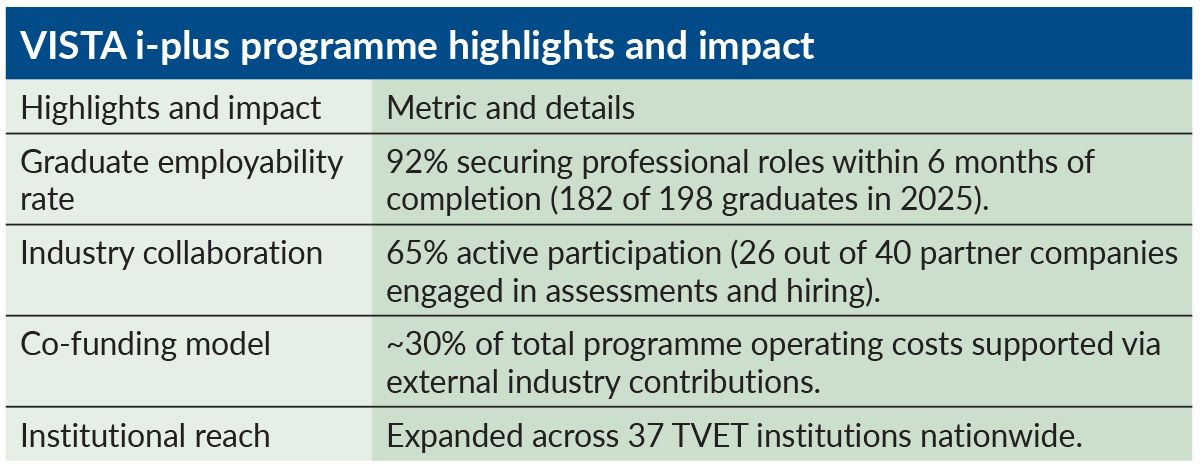
Launched in 1992, PETRONAS’ Vocational Institution Sponsorship and Training Assistance (VISTA) programme ensures technical training remains aligned with real-world industry needs, helping to build a robust pipeline of talent equipped for the evolving energy landscape.
In 2025, the programme was enhanced as VISTA i-plus, aligning technical curricula more closely with the workforce demands of the oil and gas services and equipment (OGSE) sector across five core pillars; governance, industry involvement, quality, funding and branding.
PETRONAS then formalised the VISTA i-plus Advisory Council, bringing together key ecosystem stakeholders, including the Construction Industry Development Board (CIDB) Malaysia, Human Resource Development Corporation (HRD Corp), Malaysia Petroleum Resources Corporation (MPRC), Malaysia Oil, Gas and Energy Services Council (MOGSC), Petroleum Arrangement Contractors (PACs) and the Secretariat of the National TVET Council.
“The establishment of the VISTA i-plus Advisory Council has strengthened the programme from being a training initiative into a more integrated, industry-led talent platform,” says Ruslan.
“Beyond advisory input, we also bring industry directly into the training institution during key assessment moments such as the Welding Quality Test. This allows potential employers to witness students’ technical competency, safety discipline and work readiness first-hand and, where there is a match, proceed with direct hiring.”
Powering energy transition
Complementing early education and vocational pathways are the Institut Teknologi Petroleum PETRONAS (INSTEP), PETRONAS’ technical training centre of excellence in Batu Rakit, Terengganu, and the Kimanis Petroleum Training Centre (KTC) in Kimanis, Sabah. Together, INSTEP and KTC bridge academic learning and real-world operational execution across the energy value chain, equipping talent with industry-relevant technical skills and competencies. INSTEP trains more than 1,000 local and international talents annually, while KTC has produced more than 250 graduates since its establishment in 2011, contributing to the development of Sabah’s skilled technical workforce.
According to its CEO Azhar Ahmad, the institute acts as “a progressive solutions partner enriching the energy workforce for a sustainable future, adding value for businesses and stakeholders”.
INSTEP also established the PETRONAS Energy Transition Academy (P-ETA) aligned with Malaysia’s Net Zero Carbon Emissions (NZCE) 2050 target. P-ETA focuses on four critical capability pillars: sustainability, decarbonisation, cleaner energy and energy efficiency.
Building an ASEAN energy hub
PETRONAS remains committed to scaling human capital to secure Malaysia’s industrial future.
“By 2030 and beyond, PETRONAS aims to support Malaysia’s ambition of becoming a resilient and competitive ASEAN energy hub through value-accretive growth, strategic partnerships, enhanced energy security and low-carbon development,” Ruslan says.
“While pursuing operational efficiency and responsible emissions management, PETRONAS will focus on building a future-ready workforce through digitalisation, AI, automation and high-value skills development to drive sustainable productivity, value creation and long-term economic competitiveness.”
PETRONAS’ talent strategy places strong emphasis on socio-economic and regional inclusivity, ensuring no community is left behind in the energy transition.
In Terengganu, the Oil and Gas Wakalah TVET Programme (OGWTP), run in partnership with Yayasan Pendidikan MAIDAM, provides technical education, living allowances and tuition assistance to asnaf youth from low-income households. The programme equips participants with industry-relevant certifications, including T-BOSIET, Oil & Gas Safety Passport (OGSP), and Authorized Entrant & Standby Person (AESP), preparing job-ready graduates with the technical competencies and safety qualifications required to pursue careers in the oil and gas industry. As of 2025, OGWTP has produced 164 graduates across four batches, achieving an 82% employability rate since 2024.
In East Malaysia, the Kimanis Petroleum Training Centre (KTC) in Sabah offers a fully sponsored, three-year Diploma Kemahiran Malaysia (DKM) in Industrial Instrumentation & Control accredited by the Department of Skills Development (JPK). KTC has produced over 250 Sabahan graduates, consistently achieving a graduate employability rate of over 90%.