

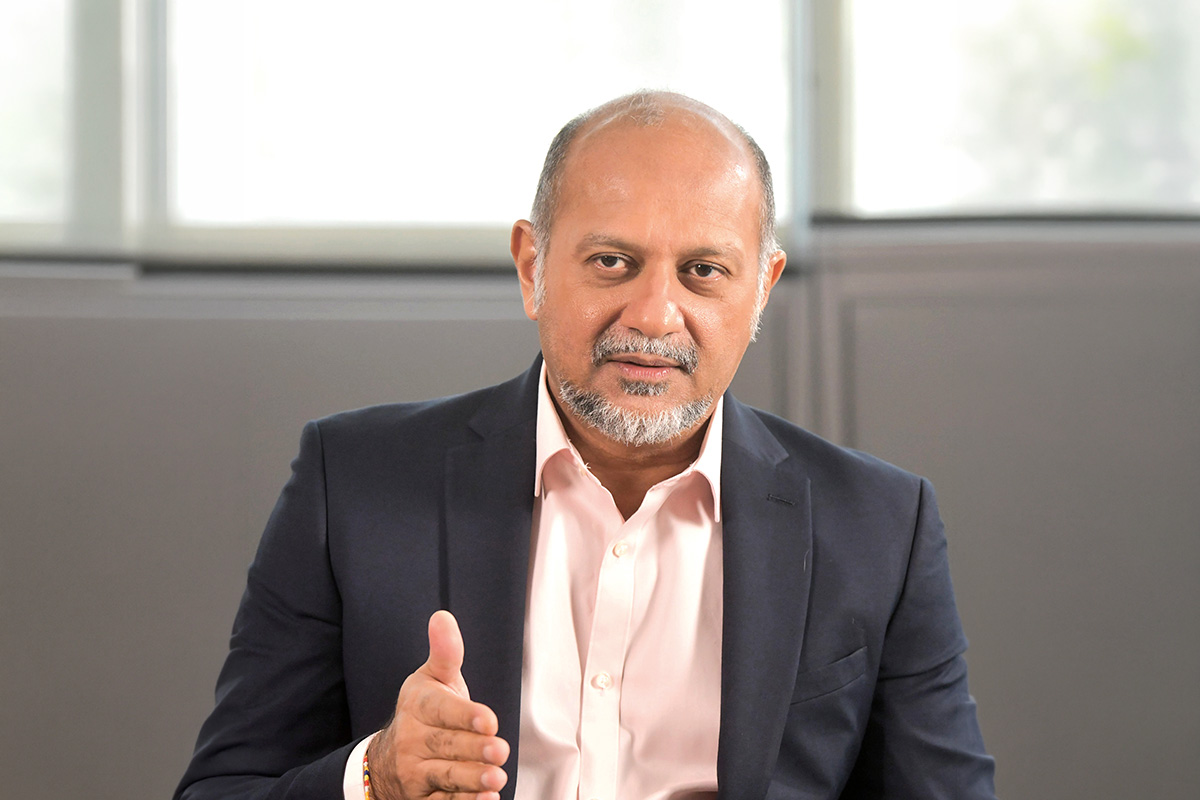

Malaysia’s ambition to become an AI Nation by 2030 is often discussed in terms of data centres, artificial intelligence infrastructure and the country’s growing role in the regional digital economy. Digital Minister Gobind Singh Deo, however, emphasises that the agenda must improve daily lives, strengthen public services and create broader economic opportunities for ordinary Malaysians and local businesses.
The goal was set out in July 2025 when Prime Minister Dato’ Seri Anwar Ibrahim announced plans to position Malaysia as an AI Nation within five years, with the digital economy expected to contribute 30% of gross domestic product by then, up from about 25% today.
While that target has clear economic significance, Gobind explained that the policy reflects a broader shift in how Malaysia governs, competes and delivers value, with AI and data serving to make systems more responsive, reduce friction in daily interactions and help individuals and businesses move more quickly into higher-value activities.
“AI Nation is essentially about making sure technology works productively for the rakyat and local businesses,” said Gobind.
This begins with a simple fact: Most Malaysians already carry a smartphone and already participate in the digital economy in one form or another. The next phase is to use data and digital tools more intelligently so that individuals are connected more quickly and accurately to the information, services and opportunities.
This could help businesses identify grants and financing more easily, provide farmers with timely support information and connect young workers with relevant training and employment, he said.
AI Nation 2030, then, is closely tied to the idea of more data-driven governance, in which government services become less generic and more responsive to individual circumstances, and in which the burden of navigating complexity shifts away from the rakyat and towards the system itself.
“The goal is to empower the rakyat to do more in less time and at lower cost. When productivity rises, incomes inevitably rise as well.”
TRUST AS A NATIONAL DIGITAL FOUNDATION
That emphasis on participation is closely linked to another central feature of the government’s approach: Trust. As more public and private services become dependent on data, trust can no longer be treated as secondary to innovation or infrastructure.
“Trust is the foundation for AI Nation 2030,” said Gobind. “People must know their data is protected and that the system works for them.”
Malaysia’s AI Nation ambition was supported by institutional reforms, including the creation of the Digital Ministry in late 2023 to coordinate AI, cloud, data infrastructure and cybersecurity policies.
“This ministry was created to bring structure and accountability into how Malaysia approaches digitalisation,” said Gobind. “Without that, ambition becomes fragmented and execution uneven.”
Much of the ministry’s early work focused on aligning agencies and building the policy foundations needed for more integrated digital governance.
Trust quickly emerged as one of the ministry’s central pillars, with reforms such as amendments to the Personal Data Protection Act and the introduction of the Cybersecurity Act 2024.
“Trust is what enables adoption, investment and participation to scale,” said Gobind.
Beyond trust, the ministry has organised its work around three broad pillars: Digital government, digital economy and digital society. In digital government, initiatives such as GovTech Malaysia, the Data Sharing Act 2025 and the National Data Sharing Committee have improved coordination across agencies and reduced siloed approaches.
The ministry has also focused on building investment readiness and accelerating adoption by enterprises, especially SMEs, through policies such as the National Cloud Computing Policy, support for 5G uptake and other programmes aimed at reducing the barriers that smaller firms often face when trying to adopt more advanced digital tools.
A key part of that effort is spearheaded by the Malaysia Digital Economy Corporation (MDEC), which plays an important role in translating national policy direction into industry adoption, ecosystem development and investment execution. MDEC is working to ensure the AI Nation agenda translates into practical adoption pathways for businesses.
MDEC FOCUSED ON ECONOMIC OUTCOMES
MDEC CEO Anuar Fariz Fadzil said that the agency’s role is to ensure that the national AI agenda is reflected in business adoption and economic outcomes on the ground.
“AI Nation 2030 will only succeed if businesses, especially SMEs, use digital and AI tools in ways that raise productivity, strengthen competitiveness and open up new areas of growth,” said Anuar. “Our task is to connect policy with execution, whether through ecosystem facilitation, industry partnerships, digital adoption programmes or investment support.”
The third pillar, digital society, reflects the government’s view that infrastructure and policy alone are insufficient if large parts of the population remain excluded, underprepared or unconvinced. This is why the ministry has placed emphasis on outreach and capability-building initiatives such as Jelajah Malaysia Digital.
A major signal of that transition has been the establishment of the National AI Office in late 2024 as a national capability with implications across public administration, economic planning and sectoral competitiveness.
That direction is increasingly being reflected in how the government is positioning digital and AI policy within the country’s broader economic strategy, particularly as Malaysia has embarked on the Thirteenth Malaysia Plan. Plans aligned with the Malaysia Digital Action Plan 2030 and the National AI Action Plan for 2026 to 2030 are expected to carry much of that execution.
Industry feedback indicates that this more structured approach is beginning to provide the clarity and confidence that both local firms and international investors look for when making long-term commitments.
National Tech Association of Malaysia (Pikom) chairman Alex Liew said that, by placing equal weight on governance, trust, talent and adoption, the government is building an ecosystem in which innovation can scale in a more orderly and credible way.
“Gobind and Anuar should be commended for ensuring that the national AI agenda is grounded in governance, trust and industry participation,” said Liew. “That is how Malaysia is progressively translating the vision of AI Nation 2030 into sustainable economic growth for the greater good of the nation.”
RM87.4 bil in AI-driven digital investments signals early momentum for AI Nation 2030
The Malaysia Digital Economy Corporation (MDEC) secured RM87.4 billion in approved digital investments in 2025, driven largely by growth in artificial intelligence (AI), big data, data centres and cloud services. This has significantly contributed to the RM152.9 billion of approved investments in the information and communication sub-sector, as recently reported by the Malaysian Investment Development Authority (Mida).

The investments, secured from more than 600 Malaysia Digital (MD) status companies, are expected to generate over 31,000 high-value jobs, reinforcing Malaysia’s position as a leading digital investment destination in Asean.
MDEC CEO Anuar Fariz Fadzil said that these latest numbers validate the strength of the national digital blueprint in attracting high-value investments. “By strengthening digital infrastructure, developing future-ready talent and fostering innovation, Malaysia is accelerating our progress towards becoming an AI Nation by 2030,” he said.
Domestic investors accounted for the largest share of digital investments at RM36.66 billion, reflecting strong confidence in Malaysia’s digital growth trajectory. This was complemented by the top three sources of foreign investments from Singapore (RM32.16 billion), the US (RM11.43 billion) and China (RM3.80 billion). The investments are also contributing to the growth of high-value digital talent. AI leads job creation with more than 12,600 roles, followed by Global Business Services (~9,000 jobs), Data Centre and Cloud services (~2,600 jobs), Creative Media Technology (~1,400 jobs) and Internet of Things (~1,100 jobs).
“MDEC’s focus is to ensure that every ringgit of investment is matched with real capability building as reflected in the creation of more than 12,600 new AI-related roles this year,” he said. Under the 13th Malaysia Plan (13MP), Malaysia is strengthening its focus on developing locaSl talent capable of building, training and shaping AI technologies.
“MDEC is laying the foundation for Malaysia to become a nation that not only adopts technology but also creates it for the world,” said Anuar. Marking its 30th anniversary this year, MDEC remains focused on turning national policy into measurable outcomes for businesses and Malaysians.