

This article first appeared in The Edge Malaysia Weekly on July 31, 2017 - August 6, 2017
IT has been a long time coming, but Touch ‘n Go Sdn Bhd (TnG) is finally dreaming big, really big.
Last week’s team-up with Jack Ma’s Ant Financial Services Group firmly places TnG in pole position in the fintech race to build Malaysia’s first digital payment giant.
After all, the joint venture has all the ingredients it needs to succeed. TnG has an effective monopoly on transit payments — tolls, parking and public transport. This captive user base boasts an estimated 10 million active cards in circulation today.
On top of that, TnG has a financial institution for a parent company — CIMB Group Holdings Bhd with a 52.2% stake.
Meanwhile, Ant Financial brings to the table the technological expertise that can propel TnG to the next level. The group’s subsidiary — Alipay — is synonymous with cashless payments in China with over 520 million users and over 10 million merchants.
Ant Financial also offers the potential for a strategic partnership via its widely known affiliate, Alibaba Group. Recall that last month, Alibaba invested a further US$1 billion in one of Southeast Asia’s largest e-commerce platforms, Lazada, raising its stake from 51% to 83%. Its total investment in Lazada now stands at US$2 billion.
Similar to how Alibaba spawned Alipay, Lazada’s e-commerce play will be a major use-case that could help drive the adoption of TnG’s proposed digital wallet.
QR codes the game changer
Right off the bat, the joint venture with Ant Financial promises to solve a long-running challenge that TnG has faced over the last 20 years — getting TnG cards out of vehicles and into retail outlets.
TnG has had an iron grip on transit payments but any attempt to venture beyond toll booths and parking lots has proved tough. This is despite the company’s unrivalled advantage — literally every Malaysian over the age of 12 has been walking around with a TnG card in his wallet in the past decade: the MyKad.
However, the payment infrastructure is incredibly costly to deploy. Rolling out TnG-capable payment terminals en masse would be a big risk with no guarantee of user adoption.
The company would not comment for this story and the breakdown of transit and non-transit usage is not publicly available. But suffice it to say that its retail payment terminals are sparse, a novelty at best.
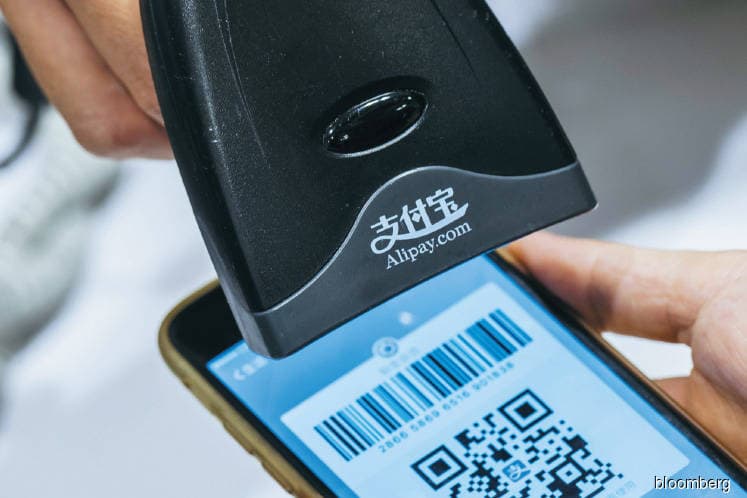
Alipay’s QR code technology, however, could be a game changer. It has massive traction in China due to its extremely low deployment cost. All a merchant needs is a smartphone or tablet and an internet connection to transact with customers.
Thus, TnG’s coming evolution will not see wider propagation of its namesake card. Instead, the partnership will aim to put a digital wallet in smartphones and QR code-enabled terminals at every merchant.
It’s all about data
A good analogy for TnG’s existing business model is that of a toll. For every transaction made with its card, TnG takes a small commission.
In FY2015, the group’s latest available financial statement, TnG booked a net profit of RM15.5 million on revenue of RM162.7 million. Half of that revenue came from commissions.
Another key aspect of the group’s business is the massive cash float it carries from the prepaid deposits, which amounted to a whopping RM389.5 million as at Dec 31, 2015. During the year, the group earned a staggering RM15.3 million in interest income, equivalent to 3.9% of the prepaid deposits.
Moving forward, however, this business model will have to change if it is to become a dominant payment player.
“Alipay’s real value does not come from transaction commissions. It comes from the data it collects. Imagine, it collects data from its customers’ transactions, covering almost every facet of their lives,” explains one bank executive.
Big data analytics allow payment companies to have an in-depth understanding of their customers’ behaviour — from their spending habits and preferences right down to their credit rating.
In turn, this opens up endless possibilities to market parallel services directly to the right consumers. This ranges from wealth management products to insurance and even micro financing.
In other words, it is more valuable for TnG to understand where the traffic in its metaphorical tolls are flowing.
However, TnG is currently data-poor. It is understood that most users do not register their cards and only a tiny portion of MyKad holders bother to use it for payment. Even if TnG had the back-end capacity to crunch the numbers, it would have very little data to work with.
This will be a key area that TnG will have to transform going forward but it might be challenging. In many countries, transit cards are not registered to users. This keeps travel data anonymous, protecting users’ privacy. Key examples of this are London’s Oyster Card and Hong Kong’s Octopus Card.
Thus, it remains to be seen if TnG can convince existing users to register their cards and link these to a digital wallet.
Nonetheless, a large part of TnG’s appeal to Ant Financial is its friendly and recognisable face to Malaysian consumers.
“Alipay’s strategy is not to strong-arm its way into new markets. Instead, it prefers to partner local companies that have an established presence and a strong trust relationship with local consumers,” explains the banker, pointing to Alipay’s recent partnerships in the region.
In short, Ant Financial wants to leverage TnG’s branding. Thus, it is expected that any digital wallet the partnership launches will place TnG’s branding at the forefront — a TnGPay perhaps.
In Thailand, for example, Alipay has tied up with the CP Group’s Ascend Money. Over in the Philippines, it has linked up with one of the country’s largest conglomerates, Ayala Corp.
Go big or go home
Even with a population of 31 million, the Malaysian market is probably too small to sustain two payment players. After all, building a payment ecosystem is all about scale.
In turn, this means TnG will have to move quickly and aggressively to displace any potential contender. The last thing the group would want is a long-drawn-out price war in a bid to acquire users.
Attracting users will involve creating value for users while investing heavily in marketing. This ranges from advertising and promotions to directly subsidising goods and services to gain market share — not unlike what Uber and Grab are doing.
In China, the likes of Alipay and WeChat were able to grow rapidly by filling the gap in the then highly unbanked population. In Malaysia, however, there are already a myriad of conventional cashless services that TnG will have to compete with — credit cards, debit cards and direct bank transfers, to name but a few.
But that does not mean the country is lacking in opportunity.
Converting cash transactions to cashless transactions is where payment firms like TnG will have the most room to grow. And given how cash-dependent Malaysians are, TnG has yet another reason to succeed.
It only remains to be seen if it can execute quicker and better than its competitors.
Save by subscribing to us for your print and/or digital copy.
P/S: The Edge is also available on Apple's App Store and Android's Google Play.