

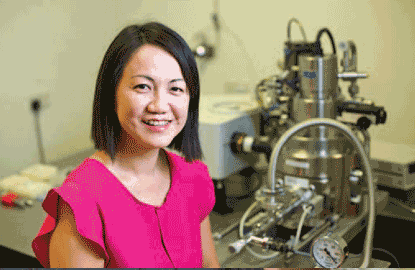
Ling Xing Yi, assistant professor at the school of physical and mathematical science at Nanyang Technological University (NTU), focuses her research on enabling people living in remote areas to detect toxins and pollutants in the water and soil.
Ling has developed a handy and ultra-sensitive nanoparticle-based environmental sensor for quick onsite detection. The palm-sized sensor uses shape-controlled metallic nanoparticles to form emulsion-based colloidosomes that wrap round the toxins. This makes the toxins detectable using a portable Raman vibrational spectroscopy as each has a unique “chemical fingerprint”.
“Over the past few years, our group has advanced the Raman spectroscopic sensing field by pioneering the emulsion-based sensor, using single-crystalline, shape-controlled nanoparticles as the basic building blocks,” she says.
According to Ling, the sensor is able to identify traces of toxins as low as 0.3fmol or 10-15 moles. “The contamination of water and soil by environmental toxins such as arsenic, cadmium and chromium is a challenge faced by every country. In Singapore, the effects of environmental contamination will be particularly acute due to its dense population and proximity of industrial areas,” she adds. “This [device] is also particularly useful for people living in remote areas, where you can’t bring in a big instrument.”
While the sensor allows the quick detection of toxic elements in water and soil, it will take at least three years for the product to be fully developed for large-scale production. “A lot of quality-control testing is still needed to fully convert it into a commercial product,” Ling notes.
She is currently seeking funding to spin off a company to develop the sensor. However, she laments that there are not many investors interested in science-based start-ups in Singapore. Ling adds: “It is difficult to find funding in Singapore, but I will still want to look for investors here because my lab is here and we started all our research here at NTU. In Singapore, we are producing so many PhD students and we need to find a platform for them to apply their research knowledge, so it will be a waste if we don’t start our company here.”
Meanwhile, Ling has yet to patent her work as it costs about $10,000 a year. “We have published our research and someone could probably replicate what we do. On the other hand, there is still a lot of fine-tuning and tweaking we can do to the nanoparticles and emulsion to make it better, so not all is lost if someone manages to bring a similar product to market first,” she observes.
In 2015, Ling was awarded the L’Oréal Singapore Women In Science National Fellowship for Physical and Engineering Science, for which she received a grant of $30,000. The annual awards is organised by L’Oréal with the support of the Singapore National Commission for Unesco and the Agency for Science, Technology and Research (A*STAR). “The award is an important recognition of my work and I hope that with this, I will be able to attract more funding for it,” she says.
This article appeared in the Enterprise of Issue 721 (March 28) of The Edge Singapore.