

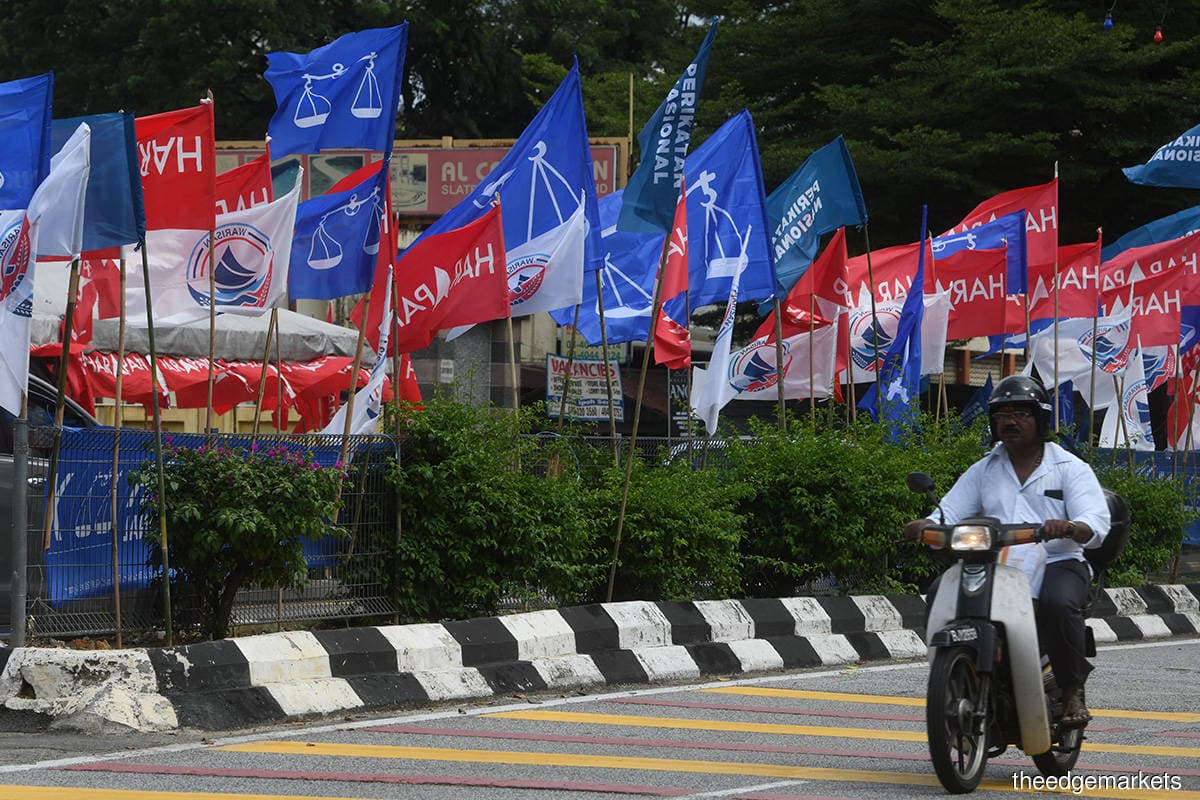
As Malaysia heads to the polls on 19 November 2022, one cannot but question the role big data plays in election campaigns and the electorate process.
We live in the age of big data and algorithmic governance. In an increasingly politically aware world, the challenges that new technologies and forms of techno power pose do not merely challenge privacy and autonomy. They are challenges to our understanding of democracy itself.
The topic was discussed at length through a collaboration between PRME (Principles of Responsible Management Education) at the School of Business and the School of Arts and Social Sciences, Monash University Malaysia, with Latheefa Koya, fifth Chief Commissioner of the Malaysian Anti-Corruption Commission, lawyer and human rights activist heading the discussion. Monash University Malaysia is building an interdisciplinary research capacity in data and democracy, guided by the Sustainable Development Goals (SDG 16), a global effort to "promote peaceful and inclusive societies for sustainable development, provide access to justice for all and build effective, accountable and inclusive institutions at all levels."
Big data analytics entered Malaysian politics significantly during the 2018 general elections when INVOKE employed 104,340 survey responses to predict the fall of the Barisan Nasional government. INVOKE uses Big Data analytics to construct a more accurate representation of voters' inclinations, emulating the Obama campaign in 2012.
Despite its electoral success, INVOKE's methods of microtargeting, voter segmentation, and psychographics raise ethical questions. INVOKE is not alone. Big data has meant that political organisations now have the tools to identify issues important to specific individuals, determine how to present their case in the most effective way for those individuals, and the means to communicate their message directly to them. In some ways, this is ideal for the democratic process.
However, individual political advertising on social media micro-targets the message to a subset without allowing others to see what is being sent or advertised. Any attempt at making political discourse private risks undermining the public discussion of political views and identities. The proliferation of echo chambers and filter bubbles such as social media contributes to reinforcing our prejudices while shielding us from the values, thoughts and feelings of others.
A stable democracy requires a shared identity and political culture to prevent it from fracturing into separate political communities. Without neutral, inclusive and open public spheres, the aggregation of individual interests or beliefs about the common good risks distortion, the control of political institutions loses effectiveness, and the civic commitments of citizens may deteriorate as trust declines.
The problem is that political actors are greatly incentivised to maximise big data analytics. A more efficient campaign means a higher chance of winning. Despite their public persona and manifesto, politicians are obsessed with winning elections and the people's welfare is mostly a spillover of their ambitions. The electorate sees the democratic system as a hope for better lives, whereas politicians see them as vehicles for their aspirations of prestige, power and wealth.
This gap can be exacerbated by big data electoral tools. Politicians can pander only to the most consequential electorates and the most popular issues, ignoring the underprivileged, the desperate and the uninformed. Big data analytics could also supercharge electoral gerrymandering, manipulating the electorate - the case of the candidates choosing their voters, the opposite of how elections are supposed to be.
In the long run, these developments can lead to political polarisation. Polarisation is characterised by the divergence of political opinions, beliefs, attitudes, and attitudes toward political adversaries. It can exacerbate the role of identity in politics and animosity towards other out-groups. In extreme cases, polarisation can lead to the unwillingness to interact with and dehumanisation towards political adversaries.
As far as data in campaigns are concerned, individual-level data comes from voter registration databases. Most recently, the personal data of over 800,000 Malaysians were allegedly syphoned from the MySPR Daftar website. The website allowed Malaysians to register as voters online. However, with the shift to automatic registration this year, the MySPR system now only functions for changing voting addresses and the application for postal voting for those overseas and other eligible individuals.
The Personal Data Protection Act 2010 (PDPA 2010), which came into force in 2013, regulates privacy protection in Malaysia concerning cyber security and data protection. However, the Department of Personal Data Protection has commented that the PDPA 2010 does not apply to state and federal government bodies and that the Act regulates the processing of personal information in commercial transactions. That would also mean that big data will be completely unregulated in the context of the electorate process.
Moreover, the Malaysian Federal Constitution does not expressly mention the right to privacy within its list of fundamental liberties. Nevertheless, the right to privacy is potentially provided for by Article 5, which states that no person shall be deprived of his life or personal liberty save per the law. Indeed, the framers of the constitution would not have foreseen the ambit of Article 5 to encompass the matter at hand. Nonetheless, Article 5 should be broad enough to encompass that one should be able to make choices in life.
With such threats to democracy and encroachment into private lives looming, the adequacy of laws and governance of big data becomes critical to solving the problem.
Indeed, "big data" politics has weighty inferences not only for the privacy of Malaysian voters but also for the health of democracy and the integrity of elections. It is growing immensely, and data usage seems limitless, especially today. As the collection, organisation and retention of data have become commonplace in the electorate process, the ethical significance behind big data is now crucial. While the ethics involved are abstract concepts, they can have real-world implications. Like any technology, big data is often seen as ethically neutral. Its use, however, is not. The aim is to develop better methods and means to inform and align actions with values.