

This article first appeared in The Edge Financial Daily on July 6, 2017 - July 12, 2017
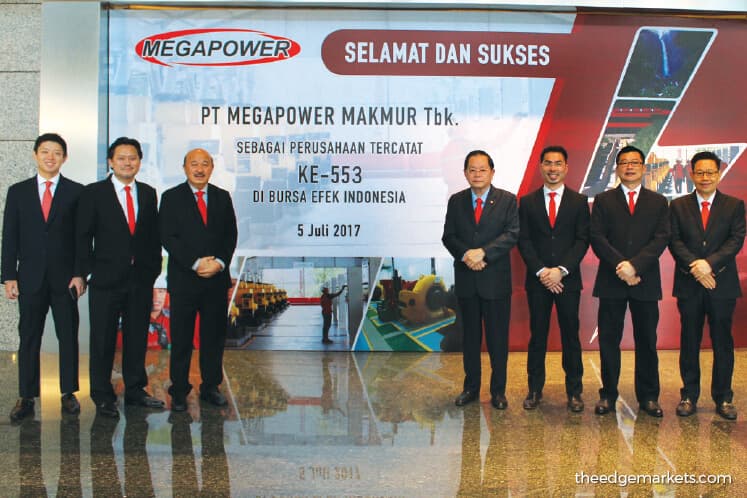
JAKARTA: After close to a year’s delay, Bina Puri Holdings Bhd’s Indonesian power subsidiary PT Megapower Makmur Tbk made a strong debut on the Indonesia Stock Exchange (IDX) yesterday, when it opened 70% above its offer price.
PT Megapower debuted at 340 rupiah (11 sen), compared with its offer price of 200 rupiah. At market close, the stock stayed firm at 340 rupiah, valuing it at 277.78 trillion rupiah. The listing raised 49 billion rupiah for PT Megapower.
PT Megapower was supposed to be listed in August 2016 but the plan was delayed as Bina Puri needed to reconcile certain accounting transactions due to differing accounting policies between Malaysia and Indonesia.
PT Megapower is 80%-owned by Bina Puri Power Sdn Bhd, which is 80%-owned by Bina Puri. The company is in micropower generation and the procurement of goods and services for power generation.
It currently produces electricity at its 10ha 4.2mw hydropower facility in Makassar, Sulawesi for government-owned electricity distributor, PT Perusahaan Listrik Negara (PLN).Besides the Makassar plant, it has eight diesel power plants in Indonesia with a combined capacity of about 54mw.
Indonesia’s government launched the 35,000mw programme in 2015 to meet the national demand for electricity, and expects 23% of electricity to be sourced from renewable energy by 2025. According to Bina Puri’s group executive director Datuk Matthew Tee Kai Woon, about 60% of Indonesia’s population currently have access to electricity.
Eager to meet the country’s electricity demand, Bina Puri is looking at developing two more hydropower plants in Sulawesi, according to PT Megapower’s chief executive officer Kang Jimmi. The locations have been identified.
“We will proceed with doing our studies and research, and move on to the design and planning stage,” Kang told reporters after PT Megapower’s listing ceremony here yesterday. “Once done, we will submit the plan to PLN for approval before passing the necessary documents to the energy ministry and going back to PLN to sign the contract,” he added. The entire planning to securing approval process is expected to take at least a year.
For now, Bina Puri’s construction division remains its main revenue contributor, though its power division’s profit margin is in the double-digit region, versus the construction business’ slim single digits.
“The power sector’s current contribution to the overall group revenue may not be very high but in terms of bottom line, it is much better than the construction. Profit margins for the power and construction segments are about 15% and 1% respectively,” Tee said.
“The energy business is profitable because the rates are good, especially for hydroelectricity. For example, we sell hydropower [to PLN] for 10 US cents (43 sen) per kWH — compared to Malaysia which is selling for about five to six sen — and diesel for about one US cent,” Kang said.
Meanwhile, though Tee said the group is operating in a tough business environment, Bina Puri’s outlook on the industries it is in still “looks good”.
“For the construction business, a lot of projects under the11th Malaysia Plan will be rolled out and the ministries are expected to be calling for tenders accordingly,” Tee said.
Bina Puri has an outstanding order book of RM2.2 billion, mostly from infrastructure and building projects, whereas its tender book is valued at over RM10 billion.
“There are no plans to expand outside Malaysia now. We have a small presence in Thailand but extending further regionally will be done on a case-by-case basis,” Tee added.