


(Oct 13): ASML Holding NV’s guidance for building out capacity has become a crucial new part of the Dutch company’s earnings days, and will be even more so this time as investors seek signs of reassurance in the sector’s faltering rally.
After a stellar first-half, semiconductor stocks have come off the boil, with shares of South Korean chipmakers slumping to a two-month low on Tuesday, following a fresh slide in US names.
Investors will be looking to ASML and key client Taiwan Semiconductor Manufacturing Co (TSMC) to instill some confidence over the next 48 hours.
ASML, which reports before markets open on Wednesday, will be watched most closely for its outlook on fulfilling buoyant demand for its chipmaking equipment. Particularly so as it no longer publishes quarterly order numbers. TSMC releases results the following day.
“It is that capacity that is on the mind of the market and with no sight of order numbers, and a limited view of the backlog, it is vital that there is some sort of upgrade to its capacity targets,” said Ben Barringer, head of technology research at Quilter Cheviot.
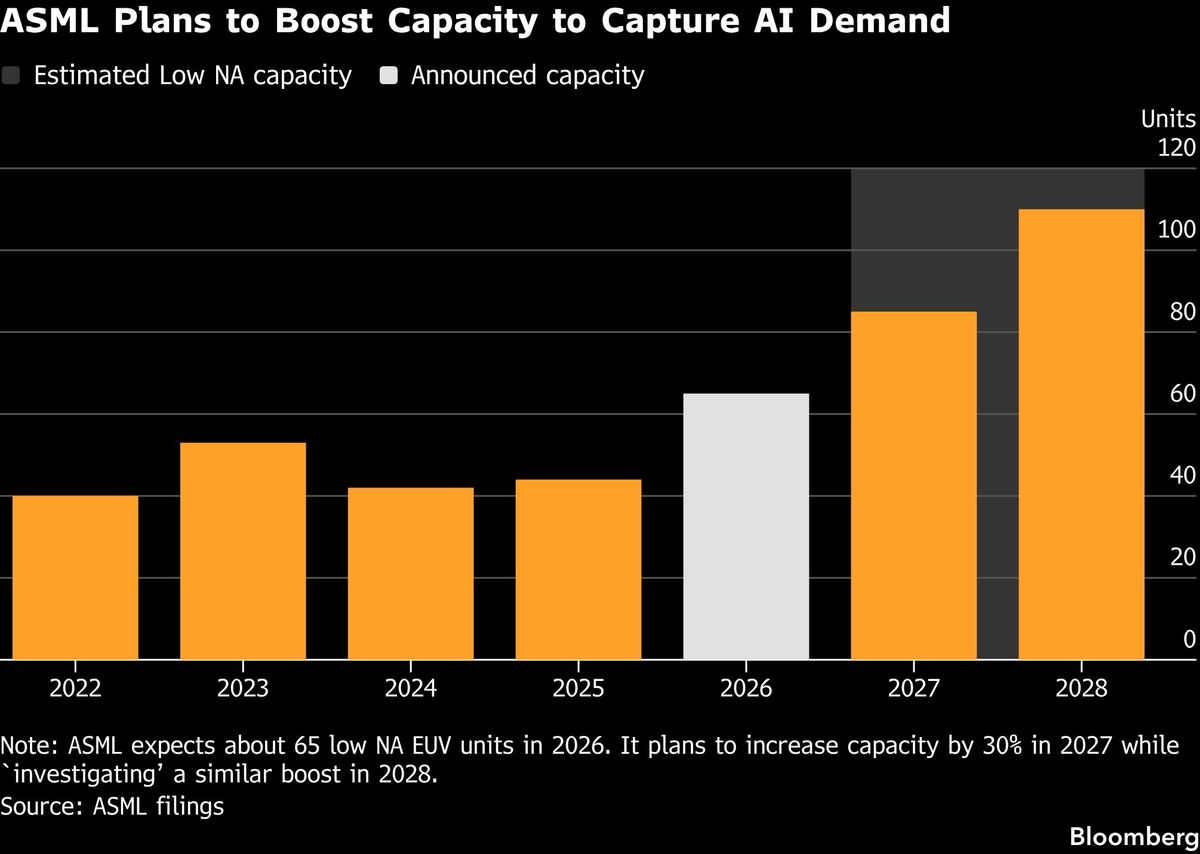
While ASML has ceased giving quarterly order numbers, citing their “lumpy” nature, it has started sharing guidance for the number of machines expected to be built this year and beyond, one that’s increasingly used by investors to gauge the strength of demand and ASML’s ability to scale up supply.
In July, ASML said it plans to boost capacity by 30% next year for its second-most advanced tool, the low-NA extreme ultraviolet (EUV) lithography machine, which would take its annual shipment target to 85 units.
Each of its low-NA tools costs roughly €200 million (RM912.96 million) apiece and takes more than a year to deliver from the time of order. ASML said in July it is working to cut the time needed to build and test lithography tools at its factories by about a third.
But when it comes to 2028, there’s further uncertainty: ASML said it’s “investigating” whether another 30% capacity increase would be viable, without firmly committing to the target of about 110 tools.
Analysts are generally more bullish. The pace of capacity increases could go beyond 30% for both next year and the year after, according to UBS Group AG. Morgan Stanley sees ASML delivering more than 90 tools in 2027.
“If the client demand is higher, they would be able to raise the capacity numbers,” Bernstein’s David Dai said in an email. Still, the firm may keep its guidance unchanged for now before raising it three months later, because “demand will be much clearer then.”
Both ASML and TSMC appear conservative in ramping up their supply because “they’ve been burned before,” said Josep Bori, a global equity analyst at Aviva Investors. He sees an opportunity to add to the stock if it were to sell off on a lack of guidance upgrades.
Price hikes
Potential price increases are another focus. Chief financial officer Roger Dassen said in July there’s more flexibility to adjust pricing as productivity of its EUV tools rises. Later, The Information reported that the firm is planning a price hike, despite pushbacks from TSMC. Last week, South Korean publication The Elec reported that ASML is raising prices of replacement parts in the country by 10%.
Pricing can serve as another driver for revenue growth, in addition to more tools being sold. Analysts on average are forecasting a 28% increase in revenue for next year, on top of a 34% rise in 2026.
Bank of America estimates that ASML’s earnings will probably rise by 8% for every 5% increase in tools and servicing prices. Higher pricing could start to boost earnings toward the end of 2027, according to analysts led by Didier Scemama.
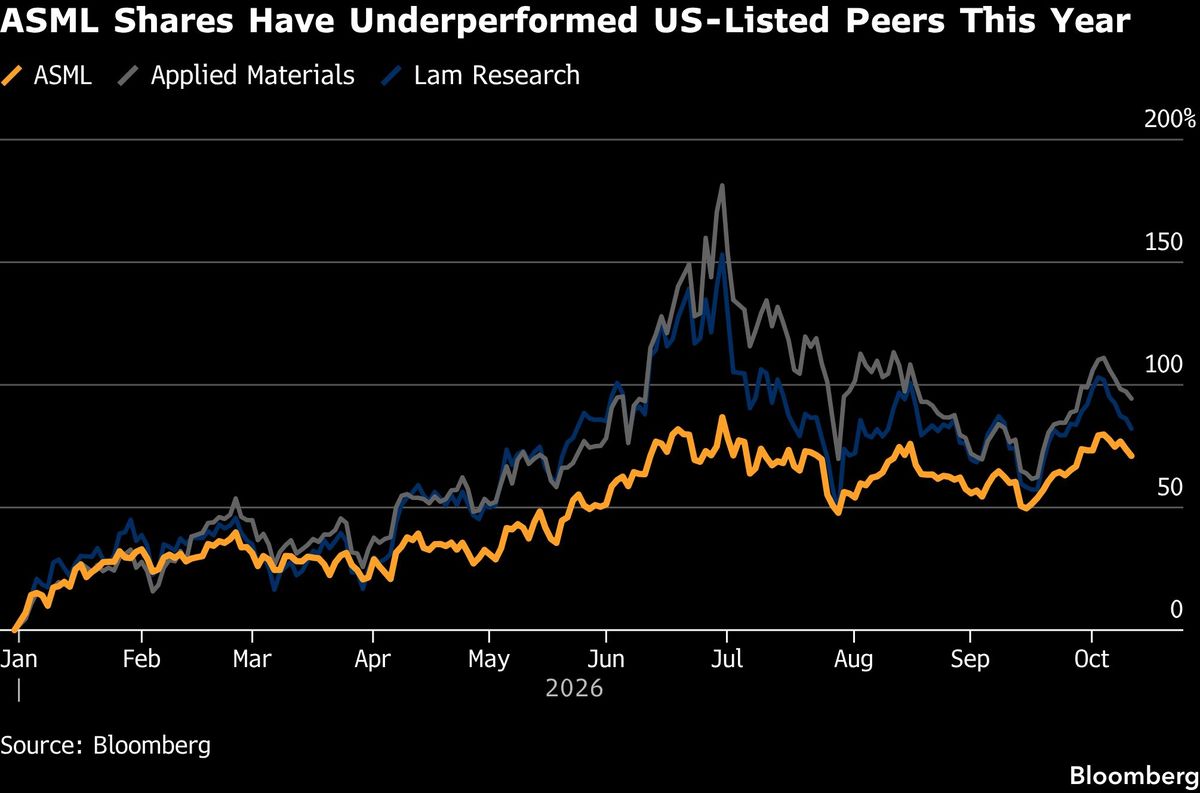
Trading at 32 times next year’s earnings, ASML’s premium versus US-listed peers Applied Materials Inc and Lam Research Corp is close to the lowest in over a decade.
Among hedge fund investors, the stock was viewed as one to short to fund purchases of other semiconductor shares, according to a JPMorgan Chase & Co trading desk note published last week.
Higher EUV capacity, stronger pricing and ultimately a more bullish medium-term framework may be necessary to drive further earnings upgrades, it said. “A lot of the bull case is now well understood,” the desk wrote.
Uploaded by Felyx Teoh