

This article first appeared in Capital, The Edge Malaysia Weekly on October 12, 2026 - October 18, 2026
TWO more additions to the ACE Market will debut this week, starting with Penang-based EcoSys (Malaysia) Bhd (KL:ECOSYS) on Wednesday (Oct 14), followed by Selangor-based EGH International Bhd (KL:ECOGRP) on Friday (Oct 16).
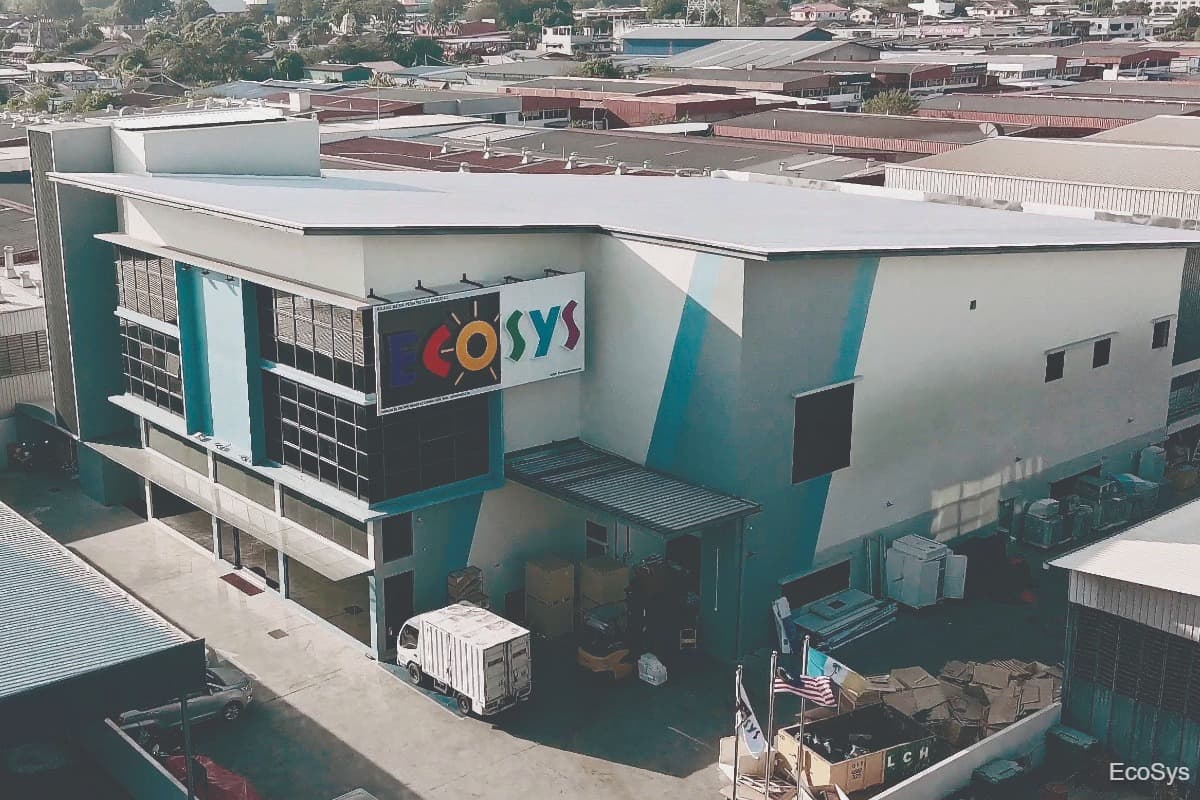
EcoSys makes ultra-high-purity (UHP) precision engineering components for semiconductor equipment and sells abatement systems that treat hazardous gases released in semiconductor and solar panel manufacturing.
Meanwhile, EGH International undertakes turnkey and design-and-build interior fit-out projects for hotels and resorts, healthcare facilities, serviced apartments and other property segments. The company also sells furniture, fittings and equipment and building materials.
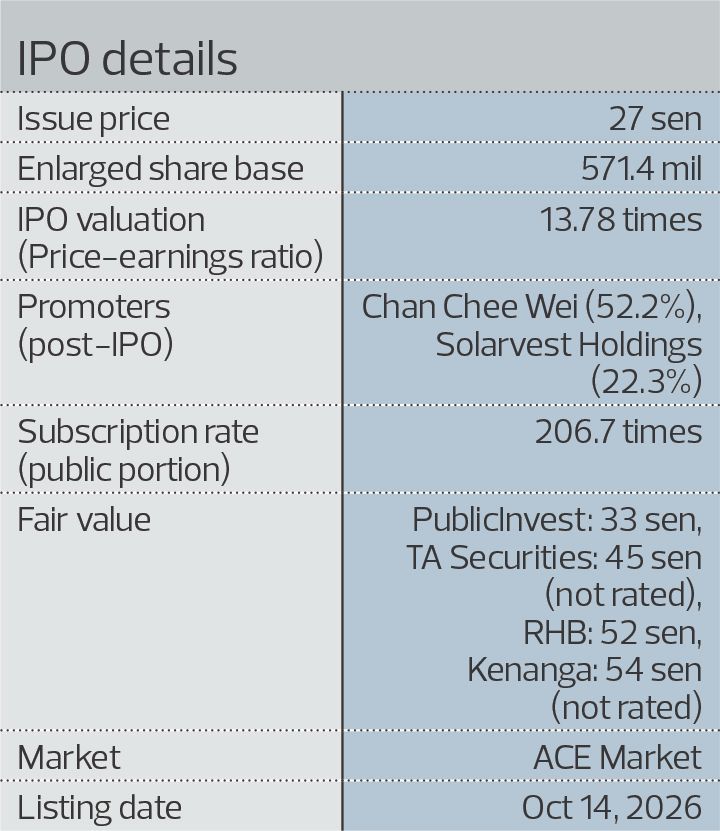
EcoSys is offering 145.7 million new shares, or 25.5% of its enlarged share base, at 27 sen apiece, raising RM39.3 million and valuing the company at RM154.3 million upon listing. There is no offer-for-sale component. The public portion drew 31,734 applications for 5.93 billion shares and was oversubscribed by 206.7 times. This makes EcoSys the second-highest subscribed company to list this year, behind SRKK AI Bhd (KL:SRKKAI), which was oversubscribed by 312.3 times. EGH International’s public portion drew 3,101 applications for 131.33 million shares and was oversubscribed by 2.63 times.
EGH International is marginally larger, with a post-listing value of RM160 million, based on its IPO price of 16 sen. Its IPO comprises 240 million new shares and an offer for sale of 120 million existing shares, representing 36% of its enlarged share base of one billion. The public issue will raise RM38.4 million for the company, while the offer for sale will raise another RM19.2 million for the selling shareholder. The sole selling shareholder is Datuk Doh Jee Ming, managing director of property developer Lagenda Properties Bhd (KL:LAGENDA).
EcoSys
EcoSys’ roots can be traced back to 2005, when managing director Chan Chee Wei and his wife, Voon Sin Choo, acquired EcoSys PLT, which initially focused on trading and servicing parts and modules used in front-end semiconductor manufacturing equipment. The group then expanded into UHP precision engineering in 2009, and acquired US semiconductor giant Applied Materials Inc’s EcoSys abatement product line and associated intellectual property in 2011.
The group has two main business segments: the UHP segment manufactures precision components and sub-assembly modules used in semiconductor equipment; and under the abatement segment, its proprietary abatement systems capture and neutralise hazardous gases generated during semiconductor and solar photovoltaic manufacturing. The abatement technology is backed by 48 patents, 36 trademarks and three wordmarks.
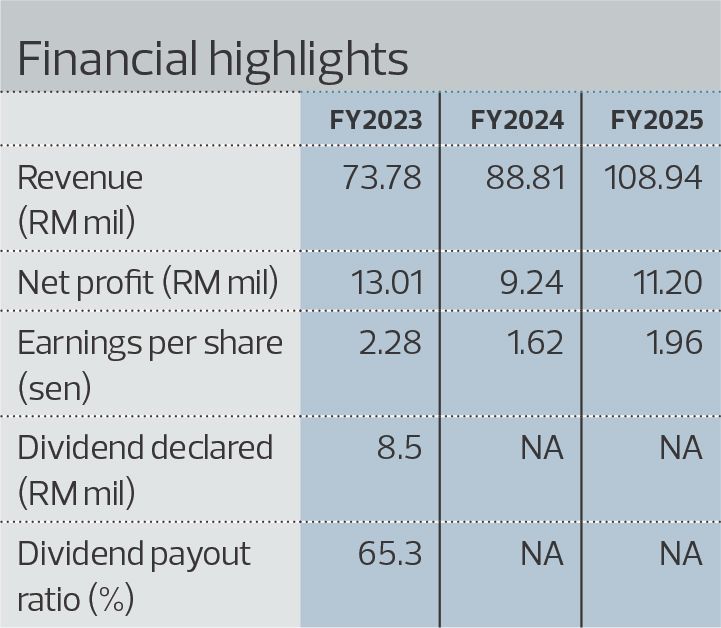
The business has recovered strongly, following a downturn in FY2023, which Kenanga Investment Bank says in its report was due to fewer UHP orders placed in the year, following bulk purchases the year before. Revenue fell to RM73.8 million that year before rebounding to RM88.8 million in FY2024 and RM108.9 million in FY2025. Adjusted net profit recovered from about RM5 million in FY2023 to about RM8 million in FY2024 and RM11 million in FY2025.
In FY2025, UHP contributed RM63 million, or 57.8% of group revenue, while the abatement segment contributed RM46 million, or 42.2% of group revenue.
EcoSys’ UHP products are largely manufactured to customers’ designs and specifications while its abatement systems are developed under its own brand, technology and intellectual property. This gives the group greater control over product development and commercialisation. The latter also carries higher gross margins.
Much of the next phase of growth is expected to come from abatement.
As RHB Research puts it, “the UHP segment provides an established earnings base while abatement gives higher growth avenue”.
Abatement system deliveries almost doubled to 194 units from 99 a year earlier. Its gross margins also improved to 29.9%, compared with 19.5% for UHP.
India has also emerged as a particularly important market. Revenue from the country jumped to RM38.2 million in FY2025, from RM6.3 million a year earlier. The country made up 35.1% of group revenue in FY2025, ahead of Singapore at 33.1% and Malaysia at 27.2%.
Kenanga describes the opportunity as an “India solar buildout [that] opens a new abatement growth engine”. India is targeting at least 80gw of domestic ingot and wafer manufacturing capacity by June 2028, from about 2gw currently.
The research house forecasts that abatement will account for 44% of group revenue in FY2026, rising to 45% in FY2027. Solar manufacturing typically requires additional filtration systems and accessories because of heavier powder loads, resulting in higher equipment content per system and potentially supporting higher selling prices and margins.
EcoSys is putting a sizeable portion of its IPO proceeds behind that business. Of the RM39.3 million raised, 43.2% will be used to procure key components and modules for abatement systems.
The group had already relocated from its space-constrained Bayan Lepas facility on Penang island to a 24,613 sq ft factory in Simpang Ampat on the mainland in October 2025, giving it room to increase abatement production. PublicInvest says the move has raised annual abatement assembly capacity by about 49%.
Another RM4.9 million will fund equipment and hiring, including an automated chemical cleaning and surface-treatment line that brings a currently outsourced process in-house.
The group’s Indian operations will receive another RM1.5 million, with EcoSys planning a dedicated sales and service centre by the fourth quarter of 2026 and 11 additional hires.
The order book offers some revenue visibility. EcoSys had RM94.3 million in outstanding purchase orders as at Aug 25, of which about RM63.4 million is due for delivery in FY2026 and RM30.9 million in FY2027. RHB expects more than RM20 million of abatement orders alone to be delivered in the second half of FY2026.
The UHP business is also being expanded. Kenanga says EcoSys is doubling its cleanroom capacity because existing UHP capacity is nearing its limit, and that the added capacity should come onstream as the semiconductor equipment cycle improves.
Nevertheless, the expansion comes after a softer start to FY2026. Revenue fell 28.5% year on year in the first quarter while net profit declined 48.6% to RM2.2 million, partly reflecting the expiry of its Pioneer Status tax incentive in November 2025.
PublicInvest also cautions that EcoSys’ abatement revenue has historically been “lumpy, largely depending on customer demand”, as purchases are tied to customers’ upgrading existing facilities or expanding manufacturing capacity. Abatement deliveries moderated from 50 units to 35, PublicInvest adds.
Customer concentration is another risk. A small group of major customers accounted for as much as 73.2% of FY2025 revenue, PublicInvest says, while Kenanga puts the top five at 84% in 1QFY2026. Sales are made on purchase orders rather than long-term agreements.
All four houses still expect earnings to keep growing. TA Securities forecasts core profit of RM13.1 million, RM15 million and RM18.1 million for FY2026 to FY2028 respectively, while PublicInvest expects core net profit to reach RM18.7 million by FY2028, implying a three-year compound annual growth rate (CAGR) of about 19%. RHB projects a three-year core earnings CAGR of about 17%, while Kenanga forecasts core profit of RM12.7 million in FY2026 and RM17.1 million in FY2027.
Valuations vary widely despite the broadly similar earnings outlook. PublicInvest is the most conservative, valuing EcoSys at 33 sen, based on about 12 times FY2027 earnings. TA Securities arrives at 45 sen using 17 times CY2027 earnings, while RHB applies 20 times FY2027 earnings for a 52 sen fair value. Kenanga is the most bullish at 54 sen, using a blended 18 times FY2027 price-earnings ratio (PER), with a higher multiple assigned to UHP than abatement.
The listing should also leave EcoSys with a stronger balance sheet. TA Securities expects the group to be in a pro forma net cash position of RM29.6 million, or 5.2 sen per share, after the IPO and utilisation of proceeds.
Chan will retain control after the listing with a 52.2% stake, while pre-IPO investor Solarvest Holdings Bhd (KL:SLVEST) will retain 22.3%. The IPO will leave an estimated public free float of 25.5%.
EGH International
EGH International traces its operating history to ECO Interiors, which was incorporated in 2009 and has been led since 2010 by managing director Datuk Weslie Lim Yuk Ming. The group has since completed more than 200 projects, including more than 57 hotels and resorts, 20 healthcare facilities, three educational institutions and five airport lounges in Malaysia and overseas, according to RHB Research.
Interior fit-out services provide the bulk of revenue, contributing RM172.2 million, or 92.1% of FY2026 (ended March 31, 2026) revenue. The remaining RM14.9 million, or 7.9%, came from the sale of furniture, fittings and equipment and building materials, including its business-to-consumer retail arm, IPO World.
Revenue rose to RM187.1 million in FY2026 from RM161.6 million in FY2023, while net profit attributable to owners rose to RM10.9 million from RM2.3 million, the prospectus shows, as gross margin widened to 20% from 9.2%, according to Mercury Securities.
RHB attributes that improvement to what it calls “procurement-led value engineering”, with EGH International sourcing materials directly and in larger volumes to keep project costs competitive. Materials make up about 70% of project costs. The group’s larger completed jobs include the RM210.7 million Park Hyatt Hotel at Merdeka 118 and the RM143.2 million Antara Genting project.
The company will go public with RM313.5 million of unbilled orders across 18 projects as at Aug 31, about 1.7 times its FY2026 revenue, Mercury Securities says. The research house estimates that RM155.9 million will be recognised in FY2027 and RM78.2 million in FY2028. The book is concentrated: RHB says the RM118.9 million Armani Hallson KLCC fit-out, due to start in January 2027, makes up 38% of it. The Xin Tian Di Serviced Apartment project accounts for another 18%. The concentration can cut both ways — large wins provide earnings visibility, but delays or execution issues on any contracted jobs can have an outsized impact.
RHB adds that seven of EGH International’s 18 ongoing projects have extension-of-time applications pending, owing to issues such as site obstruction, design changes and limited site access.
Growth will therefore hinge on replenishment. Mercury says management guided that its tender book is two to three times the order book, with “a historical win rate of about 30%”. RHB, noting that the group does not disclose its tender book, assumes new wins of RM140 million for the rest of FY2027 and RM235 million in FY2028, against management’s stated capacity of about RM300 million worth of jobs.
For the quarter ended June 30, EGH International posted revenue of RM58.7 million, about 25% above FY2026’s quarterly average, RHB says, with net profit attributable to owners of RM4.08 million.
The company is also trying to build a smaller, less project-dependent revenue stream via IPO World, its business-to-consumer (B2C) division. The B2C arm grew sales from RM1.1 million in FY2023 to RM5.7 million in FY2026, and is developing a partner model with interior designers, contractors and property agents. Mercury says it has 50 to 60 partners onboard ahead of its official launch. IPO World accounted for only about 3% of FY2026 group revenue.
FY2027 core net profit forecasts range from RM14.6 million (Mercury) to RM16 million (TA Securities) and RM17.7 million (RHB). TA Securities models a 25% revenue CAGR until FY2029, compared with roughly 17% implied by Mercury’s forecasts. Mercury, citing market researcher Infobusiness, expects the industry to grow 5.2% a year until 2030. Mercury’s own order schedule covers only RM78.2 million of its FY2028 revenue forecast of RM252.3 million, leaving about 69% outside the existing order book.
The houses differ on margins. RHB expects gross margins to ease to between 18% and 19% from 20% as large tendered contracts replace legacy jobs, while Mercury holds it at 20%.
Of the RM38.4 million raised from new shares, RM14.4 million will repay moneylender loans carrying 11% to 12% interest, saving about RM0.8 million a year, RHB says. Total borrowings stood at RM99.65 million at the latest practicable date, up from RM84.6 million at March 31, the prospectus shows. TA Securities estimates pro forma net gearing at 0.3 times after the listing.
Some RM13 million will go towards working capital and RM5 million to a new head office, warehouse and showroom in Puchong, Selangor, which is due for completion in the first quarter of 2028.
Risks are typical of a project-based contractor. The top five customers accounted for 70.1% of FY2026 revenue, according to RHB. Fixed-price contracts may expose EGH International to material and labour cost inflation.
Mercury added that retention sums also accounted for more than half of trade receivables in FY2026, contributing to a reported collection period of 132.5 days.
Both Mercury, which has a “subscribe” call, and RHB value EGH International at 19 sen, using 11.5 times and 10 times FY2028 earnings respectively. TA Securities is more bullish at 22 sen, based on 11 times FY2027 earnings, about 40% below its construction sector average of 17.7 times. The research house attributes the discount to the company’s smaller market capitalisation post-listing.
Post-IPO, Lim will hold 31.31%, Doh 25.24% — down from 49%, and Lim’s sister Seow Ni 7.45%, resulting in an estimated free float of 36%. Both companies have no formal dividend policy.
M&A Securities is the principal adviser, sponsor, underwriter and placement agent for EcoSys, while Eco Asia Capital Advisory Sdn Bhd is its financial adviser. Berjaya Securities Sdn Bhd is the principal adviser, sponsor, sole underwriter and sole placement agent for EGH International.
Save by subscribing to us for your print and/or digital copy.
P/S: The Edge is also available on Apple's App Store and Android's Google Play.