

This article first appeared in Capital, The Edge Malaysia Weekly on May 18, 2026 - May 24, 2026
MR DIY Group (M) Bhd (KL:MRDIY) will be relegated to the MSCI Malaysia Small Cap Index, alongside QL Resources Bhd (KL:QL). In its latest review of Malaysian equities, MSCI has also removed Axiata Group Bhd (KL:AXIATA), YTL Corporation Bhd (KL:YTL), PETRONAS Dagangan Bhd (KL:PETDAG) and Nestlé (Malaysia) Bhd (KL:NESTLE) from the MSCI Malaysia Index.
Mr DIY, a household name, may remain on foreign funds’ radars, but only those that are keen on small-cap counters.
When its share price peaked at RM2.83 in April 2021 — six months after its initial public offer (IPO) — the retailer’s market capitalisation swelled to RM26.7 billion, valuing it at a forward price-earnings ratio (PER) of over 47 times. Five years on, Mr DIY’s PER is in the mid-20s as its share price has retreated from the peak; earnings growth is not in sync with its aggressive store expansion.
At the time of writing, Bloomberg consensus data shows 13 out of 17 analysts are recommending their clients to invest in the retail stock. The average target price is RM2.06, implying an upside of roughly 17% from its latest closing price of RM1.76.

The analysts’ optimism hinges on confidence in the retailer’s ability to weather weakening consumer spending through its value-oriented business model and nationwide scale that have resulted in its resilient earnings profile.
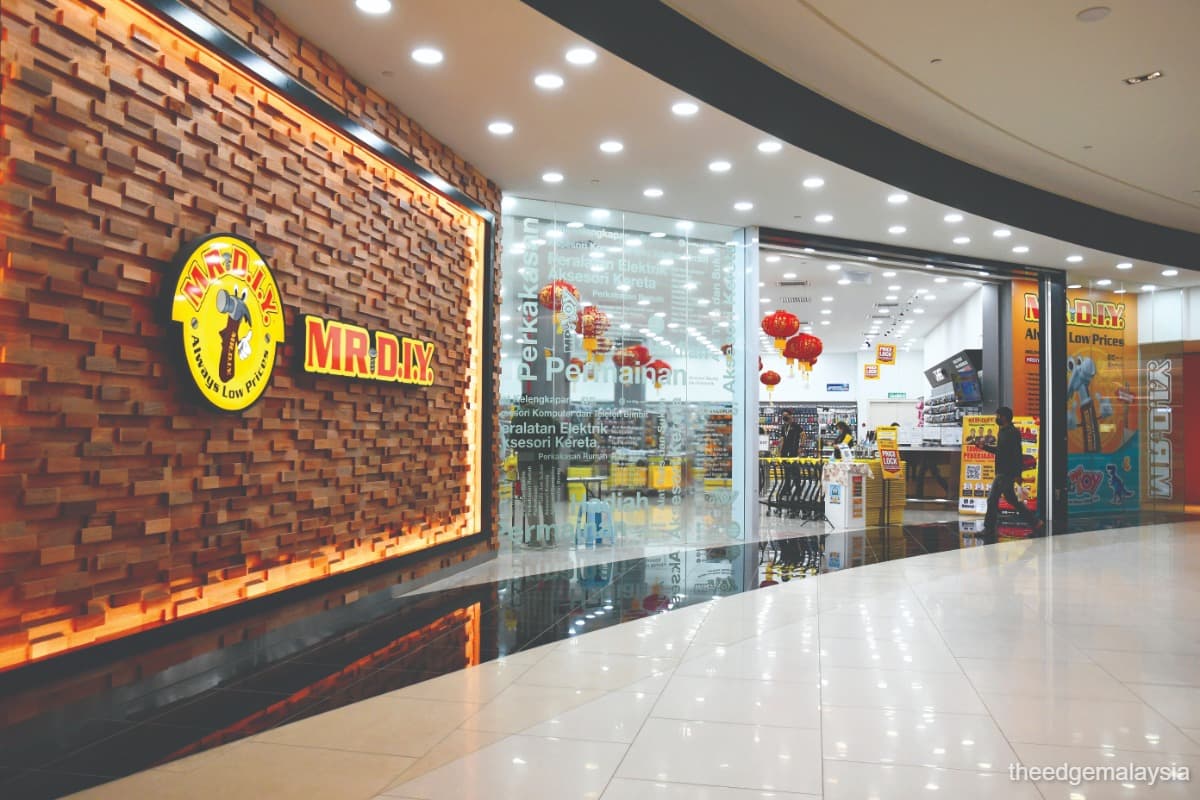
Known for its “Always Low Prices” tagline, Mr DIY has grown into one of Malaysia’s largest value retailers with 1,584 stores across the country and Brunei. Its scale gives the group strong bargaining power with suppliers, allowing it to maintain aggressive pricing and eat into the market share pie previously enjoyed by traditional neighbourhood hardware shops.
Pheim Asset Management fund manager Khoo Zing Sheng says Mr DIY is well positioned to benefit from “downtrading” behaviour as consumers become increasingly price sensitive. “In the current inflationary environment, consumers are moving away from premium retailers toward affordable essentials, and that directly benefits Mr DIY’s value proposition.”
Meanwhile, Malacca Securities research head Loui Low Ley Yee believes investors would want to gain exposure to retailers offering affordable and essential products. “Mr DIY is likely to remain mildly positive because the consumer sector is still viewed as defensive, and most of the products sold in its stores are necessities.”
But Mr DIY’s earnings figures seem to have showed otherwise in recent years — it has opened more stores but the stores have been selling less.
Growth story faces new test
Over the past five years, net profit nearly doubled from RM337.2 million in FY2020, representing a compound annual growth rate (CAGR) of 13.4%, while revenue increased from RM2.56 billion to RM4.95 billion.
The number of outlets more than doubled from 734 in 2020 to 1,584 at end-2025, translating into a store-count CAGR of 16.6%. It plans to add 155 stores this year and aims to have 2,000 outlets by 2028.
For the financial year ended Dec 31, 2025 (FY2025), Mr DIY posted a net profit of RM632.7 million, up 11% year on year (y-o-y), while revenue rose 6.5% to RM4.95 billion, supported by continued outlet expansion and improving gross margins.

Store expansion has fed Mr DIY’s decent earnings growth. Nonetheless, the contraction in its same-store sales (SSS) in the last three years could be an indication of diminishing marginal benefits of opening more stores.
SSS growth was once comfortably steady. The group recorded an SSS contraction of 3.7% in FY2023, 1.9% in FY2024 and 2% in FY2025, in contrast to growths of 4.4% in FY2020 and 11.2% in FY2021.
When its store network expanded to 1,000 outlets in FY2022, its SSS growth decelerated to 1%. Between FY2023 and FY2025, the group opened 494 stores, leaving some investors concerned over market saturation and store cannibalisation, particularly in the urban areas.
Khoo agrees that Mr DIY needs to improve SSS, while noting that a stronger ringgit will help reduce cost of goods sourced from China, which will in turn widen profit margin.
However, he notes that management has redirected some procurement savings into promotional campaigns to drive sales. “If this volume-driven strategy succeeds in stabilising SSS growth, it could become a catalyst for a valuation rerating.”
Khoo, meanwhile, highlights that the retailer has made efforts to diversify its portfolio to cater for young consumers.
The expansion of the KKV outlets in Malaysia is one example. MR DIY forked out RM9.6 million for a 49% stake in KKV Supplier Chain Sdn Bhd — the entity operating KKV stores in Malaysia — from KK Group, the China-based company that owns the KKV lifestyle brand. The joint venture will operate and expand the KKV brand across the country.
East Malaysia is increasingly viewed as one of the retailer’s final meaningful growth frontiers due to the relatively lower store penetration. The region has only 26.9 stores per million population versus the national average of 41.6 stores.
MBSB Research believes the group’s procurement scale and private-label penetration, and the stronger ringgit, have put it in a favourable position. More than 65% of the group’s products are sourced from China, allowing it to benefit from the firmer ringgit.
Private-label products now account for more than 48% of sales, up sharply from 17% at its listing, providing better pricing control and supporting higher gross margins.
Gross profit margins are projected to improve from 45.8% in FY2024 to 46.9% by FY2027, supported by operational efficiencies from the group’s upcoming 600,000 sq ft automated warehouse.
The warehouse, expected to be fully operational by March, should centralise fulfilment, reduce labour intensity and improve inventory accuracy through automation systems, while easing logistics bottlenecks and improving throughput efficiency, says MBSB Research.
Dividend offers downside cushion
Dividend yield remains another key attraction for investors. Mr DIY paid out a record RM758 million in dividends for FY2025, translating into a yield of 4% to 5%, depending on share price movements. Its strong cash generation and relatively asset-light business model is expected to continue to support shareholder returns.
Khoo describes the payout profile as providing a “solid valuation floor”, reinforcing the stock’s appeal as a resilient, high-yield consumer play heading into FY2026.
Still, competition within the value retail segment is intensifying. Peers such as 99 Speed Mart Retail Holdings Bhd (KL:99SMART) and KK Mart Retail Bhd are expanding aggressively, while e-commerce platforms continue to exert pricing pressure across the household and lifestyle categories.
“The risk is, competition is getting stronger as peers are beefing up the game,” says Malacca Securities’ Low.
Despite those concerns, analysts generally believe the stock remains reasonably valued relative to its earnings resilience.
Khoo estimates Mr DIY is trading at a PER of 22 times FY2027 earnings, broadly in line with Eco-Shop Marketing Bhd’s (KL:ECOSHOP) forward PER of 27 times but still at a discount to 99 Speed Mart’s forward PER of 38 times.
Eco-Shop’s and 99 Speed Mart’s reported earnings growth rates currently stand at about 18% and 30% respectively, significantly outpacing Mr DIY’s 11%.
“To give context, consumer staples players generally command around 33 times price-earnings multiples, while discretionary retailers trade closer to 17 times,” Khoo says.
After Mr DIY, more retailers have been listed on Bursa Malaysia. They are not only competing for sales, but also investor interest.
Save by subscribing to us for your print and/or digital copy.
P/S: The Edge is also available on Apple's App Store and Android's Google Play.