


KUALA LUMPUR (Jan 12): After a strong economic recovery in 2022, Malaysia’s economic growth is expected to slow to 4% in 2023, down from an estimated 8.8% for 2022, due to a high base effect and the weakening of external demand amid a sluggish global economy, according to Standard Chartered Bank (StanChart) Malaysia.
“Most of the headwinds are on the external demand side. We expect global growth at 2.5% in 2023 [slowing down from the expected growth of 3.4% in 2023]. For the US, we have negative growth [forecast], while for Europe just slightly positive," said the group’s Asean chief economist Edward Lee Wee Kok at StanChart’s first half 2023 (1H2023) market outlook media briefing on Thursday (Jan 12).
China also plays an important role in export growth for Asean, including Malaysia. Given the Covid-19 pandemic is running rampant in China due to the easing of Covid-19 restrictions, Lee said Covid-19 woes in China could hamper local export growth to China.
“Having said that, I would also add that Malaysia is one of the most diversified in terms of export destinations and also items. This will help in terms of giving some support to external demand. Also, I am expecting Asean growth, which is also big for Malaysia in terms of its [external] demand. So, (Malaysia's) exports will be slower but not terribly,” he said.
Meanwhile, Malaysia’s economic growth will likely be supported by tailwinds such as tourism recovery. Inbound tourism accounted for 8% of the country's gross domestic product (GDP) pre-Covid-19, Lee noted.
He also expects domestic demand to support sectors like construction and food and beverage, which are yet to fully catch up, with the latest growth figures still below pre-Covid levels.
Bank Negara Malaysia (BNM) is expected to further tighten its monetary policy in 1H2023, by increasing the benchmark overnight policy rate (OPR) to 3.25%, from 2.75% at end-2022, said Lee.
Lee forecast that BNM would raise the OPR by 25 basis points in January and then in May, and that the government would have announced some form of targeted subsidy by the second half of the year.
In terms of headline inflation, Lee expects it to come in slightly lower at 3.1% in 2023 from 3.4% in 2022.
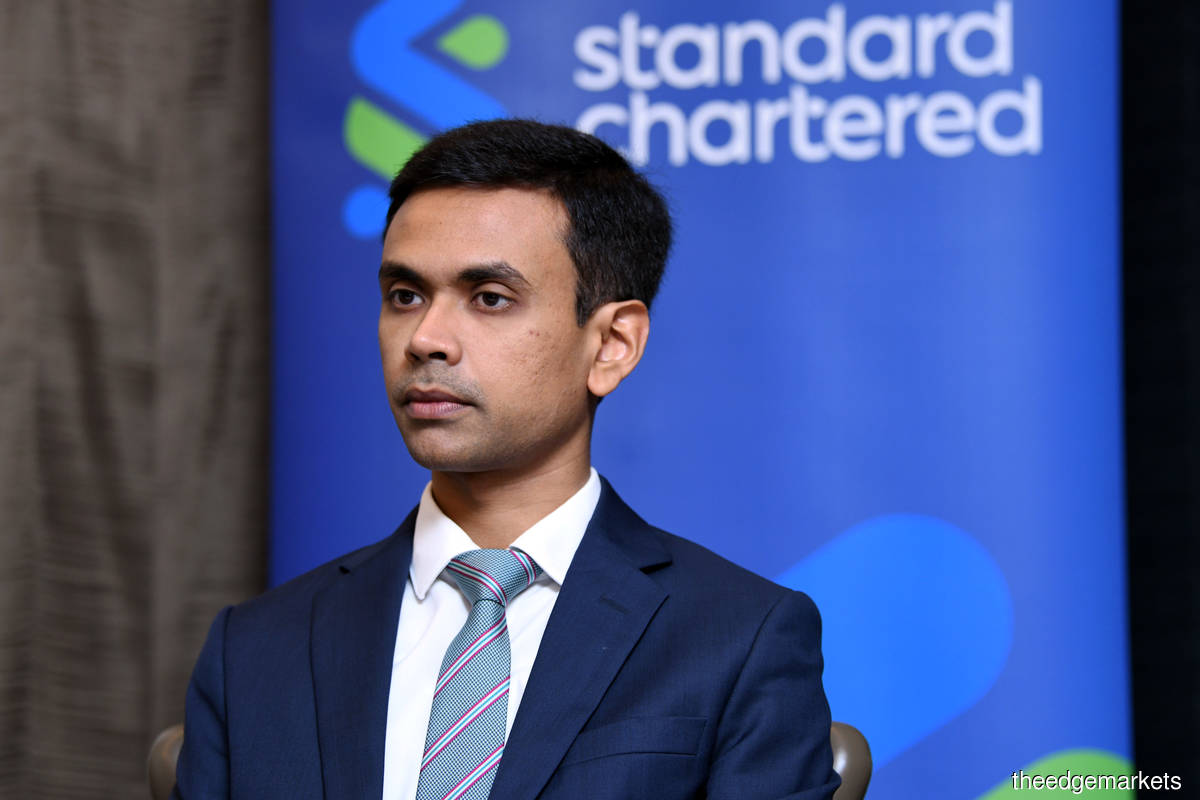
On the local currency front, StanChart’s Asia Foreign Exchange (FX) strategist Divya Devesh said the bank holds a relatively “neutral” outlook on the ringgit, which he expects to continue to be supported by high commodity prices.
Divya added that returning tourist receipts should also support the service balance under the current account.
Another tailwind to the ringgit is the current account surplus, which StanChart is expecting to improve to 3% of GDP in 2023 from 2% in 2022.
In contrast, low reserve import cover and corporates’ preference to hold US dollar in a strong US dollar environment may negate the positive effects of a current account surplus.
“We forecast that the US dollar against the ringgit would be at 4.25 level by June. [However,] there could be more downside risks to that view.... if there is a soft landing situation in the US and the US growth does not turn out to be as negative as we are thinking, you might see more US dollar appreciation, and this might have some downside risks to the ringgit.
“By the end of the year, we expect the US dollar to ringgit at 4.40. Overall, our forecast is between 4.20 and 4.40 through this year,” Divya added.
At the time of writing on Thursday, the ringgit was trading at 4.3675 against the greenback, according to Bloomberg data. Compared to a year ago, ringgit has depreciated over 4%, when the local currency was trading at 4.1853 against the US dollar.