With the end of the Movement Control Order (MCO) in sight, many businesses, that have been practically inoperational for the past two months, are now making plans to resume operations.
However, returning to the status quo may prove difficult, as businesses are now required to adhere to a new norm such as having consistent body temperature checks and a significant portion of the workforce working from home. Above all, business owners are now faced with the daunting task of ensuring that the workplace is safe for employees, visitors and customers.
Hence, Green Packet Bhd launched KipleLive on May 7, to offer a comprehensive end-to-end solution aimed at helping businesses resume operations as seamlessly as possible with relatively low cost and effort. The solution mainly comprises of AI thermal scanners, an app for customers, employees or visitors, and software for business owners.
"Currently, the businesses that have opened up are resorting to a lot of manual work. They employ security guards to physically measure body temperatures using a handheld thermal scanner, and record the data on paper. All this recording and reporting is not just unsafe for the guards and employees, but it has also become an additional workload for the business. How can we automate this process?" says Ti Lian Seng, CEO of KipleLive.
Ti explains that with KipleLive's solution, employees would only need to have their face and body temperature scanned at the entrance of the building via the AI thermal scanner, and they would be allowed into the building without any physical contact.
AI thermal Scanners by KipleLive
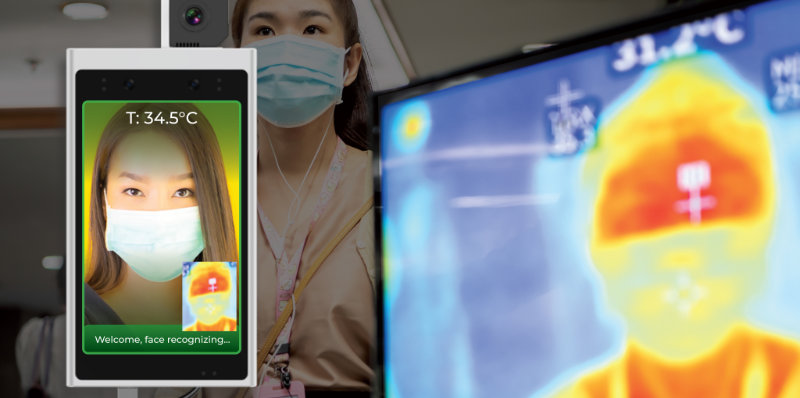
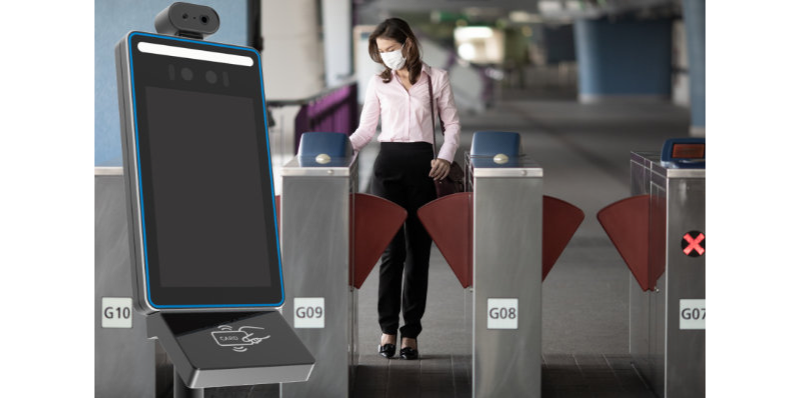
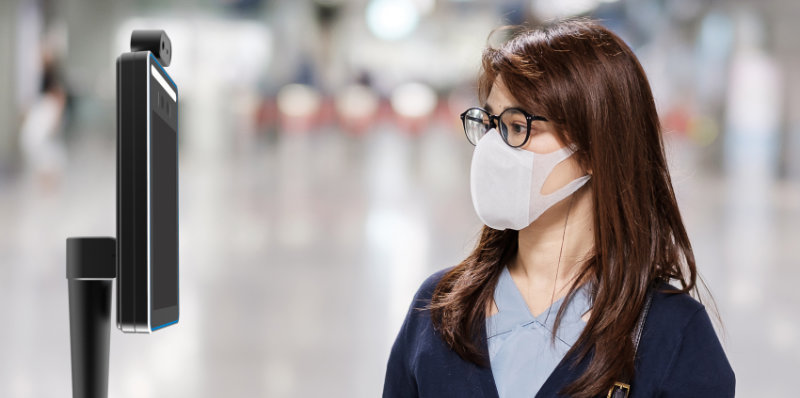
The artificial intelligence built into the scanner is able to identify the individual through their distinct facial features, even if they are wearing a face mask. Ti explains that the artificial intelligence is advanced enough to also detect if an individual is not wearing a face mask, identify the individual, and alert a security guard stationed nearby.
Ti explains that the AI thermal scanners are the only hardware required to get the entire KipleLive solution up and running. The low and mid-tier range of AI thermal scanners are a plug-and-play solution which can be set up in a single day, which is vital to get the workplace operational as soon as possible.
The mid and top-tier range of AI thermal scanners are made possible through a partnership with SenseTime, a China-based AI tech company which has similar existing solutions implemented in large corporate buildings and international airports. These devices can scan up to 10 people at once, at a distance of up to three metres.
KipleLive has also come up with its own proprietary AI thermal scanner, a low-cost solution aimed at helping small businesses that do not require the bells and whistles of the higher range models.
"For the last few weeks, we have been looking at how we might be able to support small buildings and small businesses because they are the ones that truly need to be supported. So we came up with a cheaper and affordable version, which is easy for them to install. It is just a basic terminal, with a simple stand, scanner and screen," says Ti.
"For small businesses, you do not need such a powerful device that can store up to 50,000 pictures because you might not even have that number of employees. So we want to make sure that this technology is affordable enough to be accessible to everyone, because everyone should have the opportunity to safeguard their workplace."
However, Ti points out that KipleLive is not just a hardware provider, but an end-to-end solution provider that takes the government-imposed standard operating procedures (SOPs) into consideration. KipleLive plays a role from before the individual enters the building, all the way to crisis monitoring in the advent of a Covid-19 outbreak within the building.
Through the KipleLive app, employees are able to key in their personal and family details as well as their recent travel records for contact tracing purposes. The bundled software also allows employers to easily dictate employee roster and schedule, monitor workplace disinfection, stagger lunchtime and break hours, Covid-19 suspect reporting and a whole range of other useful features.
All of this data is stored digitally on a central platform for easy access. Employers can also broadcast crucial information quickly and efficiently to all employees in and out of the workplace, respective departments, individual floors within the office, or even individual employees, serving as a supplementary human resource and communication tool to help businesses transition to this new way of running their businesses
Not only are employees and visitors identified by their facial features, they are also assigned a unique QR code which keeps track of their health status, recorded body temperature, digital health declaration form and more.
The QR code can also be used symbiotically with another Green Packet fintech brand called KiplePay, an e-wallet payment system used by restaurants and small businesses. Ti explains that such a simple integration would have widespread implications.
"For dine-in restaurants, you are required to record your customer's body temperature and also their personal details, which can be a huge chore. But if both an office and restaurant adopt the KipleLive solution, then the employees can dine in seamlessly and easily. We would then have an automatic digital paper trail and contact tracing access," says Ti.
"The QR code could then be used for KiplePay as well. The more people adopt the KipleLive ecosystem, the more QR codes will see widespread use, and the easier it is to trace and contain the spread of the virus."
With the first phase launch, Ti has a target of deploying 10,000 AI thermal scanners with the launch of the KipleLive ecosystem, and is expecting it to sell out fast. The first batch of devices being the most crucial milestone to achieve, then based on the learning to evaluate the effectiveness of the ecosystem and tweak and adjust the product accordingly to plan out for the subsequent phases.
"The main challenge is to encourage the rapid adoption of this ecosystem in an integrated community. It can be a small community, take for example, Bangsar. If most businesses in the same community adopt this system, the user experience will be seamless, and each business can leverage on each other's KipleLive system, which will make this ecosystem more effective and meaningful," says Ti.
"We are actively working to improve the ecosystem, and we would like to see KipleLive evolve naturally in this new environment. In the end, we aim to safeguard and protect our client's workplace, and give them a peace of mind to reopen their businesses."
To find out more, logon here