



A recent study showed that advancing operations maturity boosts your efficiency and profitability.
Accenture wanted to understand the connection between business operations maturity and performance. So, in 2020, we surveyed more than 1,100 C-suite and VP-level executives across 11 countries and 13 industries. We identified four levels of operations maturity: stable, efficient, predictive and future-ready.

Each of the four levels is underpinned by technologies that drive efficiency, insights and increasing capabilities.
Moving up just one level - from predictive to future-ready - yields a profitability increase of 5.8 percentage points and efficiency gains of 18.8%.
Our analysis also included an assessment of what we call transformational value. It characterizes the future-ready state.
It explains how future-ready organizations are primed to capture performance gains and deliver excellent customer and employee experiences.
And our experience working with more than 400 leading organizations across 20 countries and 18 industries attests to productivity and efficiency gains up to 50%.
Fast-tracking success
We found that:
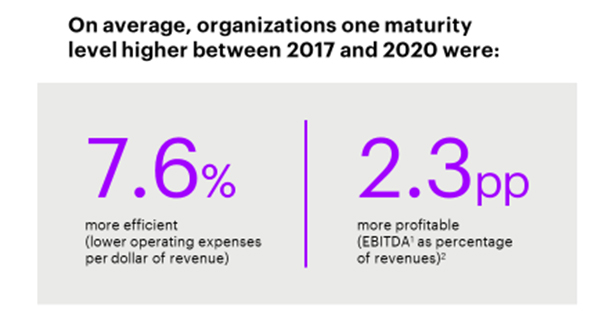
- Increased maturity raises efficiency and profits: Organizations that were one maturity level higher between 2017 and 2020 were, on average, 7.6% more efficient (lower operating expenses per dollar of revenue) and 2.3 percentage points more profitable
- Being future-ready brings even more advantages: On average, future-ready organizations we surveyed show a 2.8x boost in corporate profitability and 1.7x higher efficiency than those at other levels. Organizations in the stable and efficient levels that reached future-readiness by 2020 gained a 2.1x boost to operational efficiency and a 4.1x boost to profitability, compared to their peers that made more moderate maturity gains.
- Operations maturity can boost global profits: Our modeling analyses indicate that if all organizations around the world moved from the stable, efficient or predictive levels to become future-ready by 2020, this would equate to US$5.4T in added global profitability.
To measure and predict progress, we looked at where organizations were three years ago, where they are today and where they're predicted to be in three years. A majority of organizations have made dramatic progress toward next-level maturity over the past three years. But most (93%) have further to go (see Figure 2, middle column).
Most are committed to reaching a higher level of maturity in the next three years (see Figure 2, right side).

Organizations in high tech and insurance reported higher levels of maturity than others. In three years, we expect many sectors to leap ahead, Particularly automotive, insurance and banking.
Three ways to become future-ready
Surprisingly, we found that only 7% of respondents fall into the future-ready category.
How can others catch up?
The path to becoming future-ready is not necessarily linear. Even stable organizations can accelerate their journeys by moving up more than one maturity level. Adding intelligence to the journey-by applying a strategic approach to advancing the operating model and transforming the business through technology, processes and people-is critical.
Overall, we find there are three things you must know to become future-ready.

Organizations tend to approach operations improvements too incrementally.
The 7% of future-ready organizations we uncovered think big and, define their destination at the start making it easier to map the bold steps to close the gap between that aspiration and your current state - something many firms fail to do.
Among the future-ready organizations in our study, 82% expect to scale leading practices across the enterprise within the next three years. And 86% of them expect business and technology functions to collaborate fully during that period. That's up from the 55% that say they do so today.
By comparison, 28% of efficient organizations expect to realize such levels of collaboration in three years. Just 3% say they are doing so now.

Some steps between one level of maturity and the next just can't be skipped. Here are three that Accenture recognizes as crucial:
Step 1: Automate at scale
By 2023, nearly five times as many company executives expect their operating models to run end-to-end digitized processes compared to today.
Among organizations with future-ready operations, 38% are scaling AI, with 63% planning to have scaled AI in three years.
In stark contrast, just 1% of efficient organizations are currently scaling AI. Less than 20% expect to have scaled AI in three years.
Step 2: Augment human talent with technology
By fostering a human+machine workforce where technology helps people (not the other way around), organizations can allocate work to realize efficiencies. People will be freed up for more creative and critical thinking-the best way to identify new sources of value.
More than one-third (34%) of future-ready organizations have already adopted an agile workforce strategy at scale. They can tap into ecosystem partners to mobilize people with special skills as needed.
Step 3: Commit to data-driven decision making-using better, more diverse data
Experience and intuition are vital. However, as business complexities have multiplied, so too has the need for comprehensive, high-quality data to inform decision making. By using diverse data (structured and unstructured, internal and external, value chain vs. siloed) and elevating data quality, executives will be able to combine the best of both in a continuous feedback loop.
More than half (52%) of the organizations with future-ready operations are already using analytics at scale. Just 2% of efficient organizations say the same.
In the past, it would have taken organizations at least three years to advance even a single operations maturity level.
But now, moving ahead is much easier, thanks to the cloud and how it enhances data and analytics. Future-ready organizations reveal an impressive degree of maturity (90%) when it comes to using cloud infrastructure at scale . With today's cloud services, organizations can pay as they go when it comes to hardware and software, ramping their capacity use up or down as necessary.

Future-readiness brings organizations a competitive edge and agility. But efficiency and profitability in the short term are not enough.
Being future-ready requires a flexible operating model-an optimized combination of multidisciplinary teams and technologies on demand that work across a broad ecosystem of partners. The goal: Deliver exceptional business outcomes at scale, from anywhere, anytime.
Ecosystem partnerships bring complementary skill sets and more diverse data. Together, they foster continuous evolution instead of one-time, project-focused improvements, and offer access to advanced technologies such as AI and blockchain.
The journey to becoming future-ready by applying intelligent operations isn't straightforward. Nor is it the same for everyone.
Now is the time to make your move to intelligent operations.
Here are 6 knowledge levers to get started:
- Think big and go beyond incremental change.
- Enhance intuition with the highest-quality, diverse data.
- Scale automation and analytics, AI and integrated solutions with leading practices.
- Foster a human+machine, specialized workforce.
- Put a cloud infrastructure at the heart.
- Build complementary third-party and ecosystem relationships.
Find out more about how you can fast track your operations and be future ready here.