

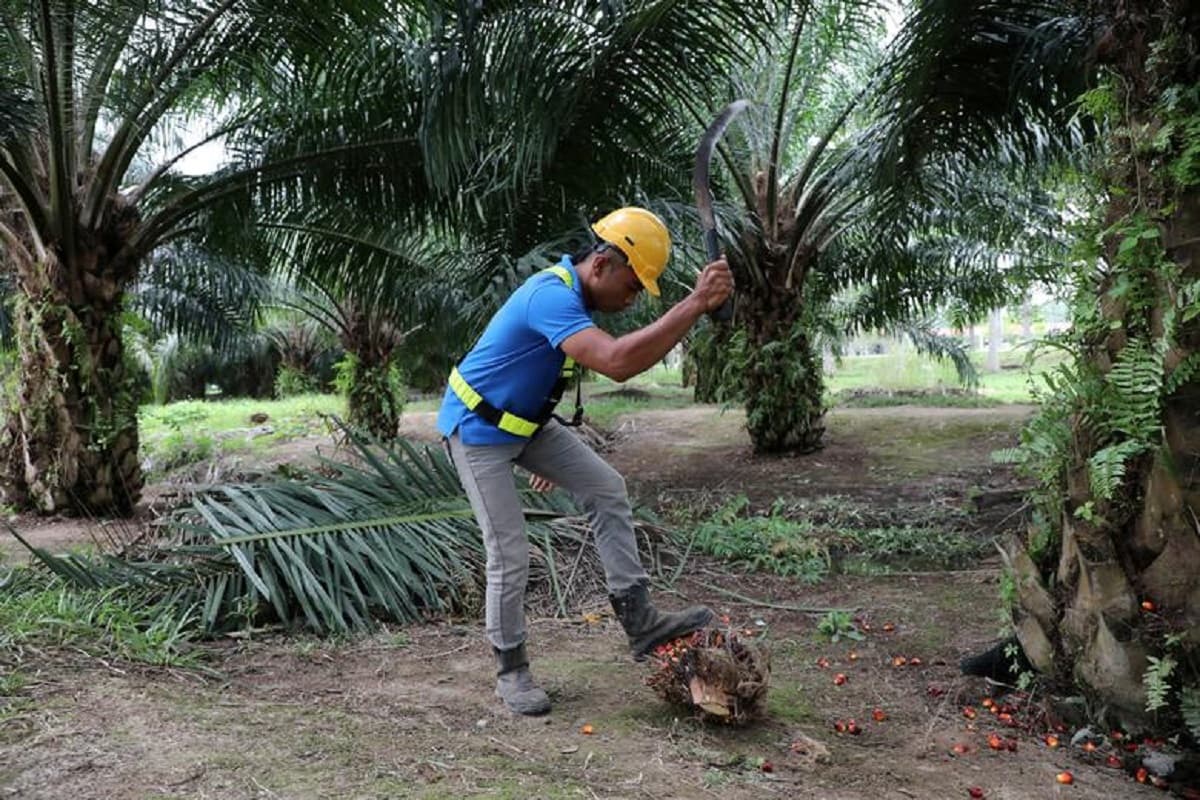
KUALA LUMPUR (Sept 9): The current foreign worker shortage seen in Malaysia will have a negative impact on Sime Darby Plantation Bhd (SDP)’s production.
During a briefing organised by AmInvestment Bank Bhd and Bursa Malaysia Bhd, SDP chief financial officer Renaka Ramachandran noted that the plantation giant is currently facing a shortage of 2,500 foreign workers or 10% of its foreign worker workforce in Malaysia.
“The expectation is still that production will drop, and that it [the foreign worker shortage] would get more protracted,” she said.
Renaka further explained that SDP is at risk of losing 5,000 to 6,000 foreign workers once their contracts expire.
She underscored the importance of skilled harvesters when it comes to harvesting fruits, and that SDP is looking at hiring locals, as well as retraining existing general workers to be harvesters.
As it stands, the planter has taken on an additional 300 local workers in its books to take over the tasks previously executed by foreign workers. At the same time, SDP is also reskilling its general estate workers to become harvesters as well.
It is also looking at developing incentives that will make working at estates more palatable for local talent.
When asked if the current economic environment has resulted in a greater uptick in local talent signing on to be plantation workers, Renaka noted that there has not been a huge increase in the number of applicants.
She also mentioned that SDP has approached detention centres such as jails to possibly bring in released prisoners as estate workers if they meet the criteria held by the group.
Renaka explained that as a result of the worker shortage, SDP's harvesting intervals have been extended. On average, harvests would be conducted once every 10 to 12 days, whereas now, they are done once every 15 days.
The quality of the palm fruit collected has been impacted, particularly in East Malaysia, according to Renaka.
As such, while the worker shortage is not expected to result in a direct impact on its earnings for the financial year ending Dec 31, 2020 (FY20), it is expected to have an impact in terms of lower yield.
As of Dec 31, 2019, total fresh fruit bunch (FFB) production for continuing operations stood at 9.58 million tonnes a year. In terms of FFB yield per ha, SDP posted 19.93 tonnes of FFB per ha a year.
Malaysia accounts for the largest portion of its FFB production, registering 5.10 million tonnes a year as of Dec 31, 2019.
As it currently stands, it is harvesting approximately 20 tonnes per ha and is aiming to harvest 23 tonnes of FFB per ha by 2023.
She viewed that its operating profit for the second half of the year (2HFY20) should equate to its 1HFY20 results due to current crude palm oil price, adding that prices of the oil should be around RM2,800 a tonne for 2020.
For 1HFY20, SDP saw its net profit swell to RM846 million, from RM101 million in the corresponding period last year.
This was on account of better earnings from its upstream business, as well as RM197 million gained from the sale of land in Malaysia and the divestment of subsidiaries.
Half-year revenue was up at RM6.26 billion, from RM5.87 billion posted in the year-ago period.
The issue of foreign workers for the plantation sector has been particularly pertinent in recent months, as the government has moved to freeze the hiring of new foreign workers, with groups such as the Malaysian Palm Oil Association and the Malaysian Estate Owners’ Association voicing their concerns over the freeze.
SDP shares settled unchanged at RM5.09 at noon market close, valuing it at some RM35.04 billion. It saw 434,300 shares transacted.